My Pile: Winter Windfall

I mowed the lawn today, the first Sunday of March. Though a bright, blue-sky day, it’s hardly in the mid-40s by mid afternoon. With the soil temperatures even lower, the grass is still dormant; in fact, it is brown and brittle. The sight of bare ground is at least a change from last winter, when snow covered the ground until nearly April.

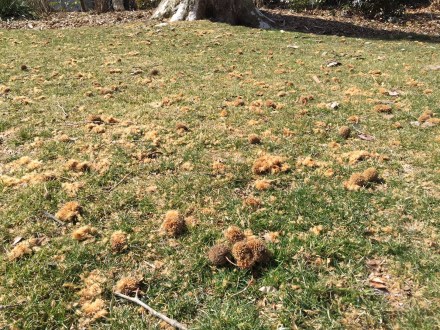
Why mow, and why now? The sycamore tree that lords over the northwest corner of my yard has been shedding spiky seed balls all through the winter. Once as hard as golf balls, the seed pods that adorn the branches overhead by the thousands are now ripening. Cottony brown fluff drifts across the yard on the gentlest of breezes; firmer winds knock the balls down to the ground, where they disintegrate into so much dander.

You have to give the tree credit for being so fecund – old-timers know the sycamore as the buttonball tree for its prodigious supply of so much spawn – but on a suburban lawnscape, the scattered mess is a nuisance. The downspouts of my gutters are filled with fluff, as are the storm drains along the street. Last weekend I fired up the leaf blower to preemptively whisk the seedballs and dander from the gravel driveway; otherwise I’m sure I’d have to spend the spring pulling sprouts or, worse, contemplate using weed killer.

The fluffy seeds are so thick across the lawn that my across-the-street neighbor commented on it the other day; in fact it was he who suggested I haul out the mower and scarf it all up with the leaf catcher. Aside from the scandalous unsightliness of so much windblown detritus, I worry whether the covering of seeds will choke off growth of the grass. And I wonder whether this windfall of organic plant matter, once gathered, could benefit my pile.

So I haul the Toro from the saltbox shed and set it in a patch of sunlight in front of my pile to warm the engine block. I last used the mower in late November to mulch the final leaves of fall, and wonder if it will start up. I check the gas tank to find it half-full, and worry whether the gas has gone bad.  But the engine starts up after a few tugs on the starter cord, and off I go.

Coursing over the brittle brown grass, I fill three tall leaf bags full of fluff and set them against the side of the tool shed, hard by my pile. I have no plans to mess with my pile weekend, but at least for now my lawn is relatively clear of the messy amount of fluff.

I haul out the mower for a late-winter gathering of the seedballs that fall across the lawn in the shadow of the sycamore tree.

I haul out the mower for a late-winter gathering of the seedballs that have fallen across the lawn in the shadow of the sycamore tree.

Intrigued by such a display of fecundity, I read up on Plantanus occidentalis, and find that the seed balls are called achenes, which means “dry, hairy fruit.” Each ball contains hundreds of seeds emanating from a round kernel the size of a pea. Each seedhead has a tail, which ripens into silken strands. It’s actually a marvel of design. I also find, on www.eattheweeds.com, that the seeds are eaten by some birds, “including the purple finch, goldfinch, chickadees, and dark-eyed junco. The seeds are also eaten by muskrats, beavers, and squirrels.” I’ve never seen anything, feathered or furred, exhibit the slightest appetite for sycamore seeds, but this year’s windfall may explain why the finches and chickadees have been noticeably absent from my bird-feeder this winter.

On www.homeguides.sfgate.com, I read that “While sycamore seed balls can be a nuisance to clear away, they can also be put to a variety of practical uses,” from craft projects to, yes, compost:

“Since sycamore seed balls are organic plant matter, they will decompose naturally over time. Rather than bagging them and throwing them away with the garbage, compost the seed balls so that their nutrients can be recycled to create rich new soil. Sycamore seed balls take longer to break down than everyday kitchen scraps, so place them in a large outdoor compost bin where they can decompose gradually.”
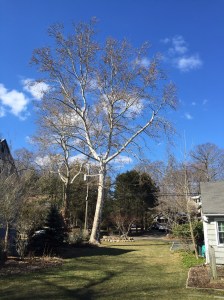
The sycamore tree that lords over the corner of my yard is still adorned with countless seed balls.

The sycamore tree that lords over the corner of my yard is still adorned with countless seed balls.

Of course, the easiest solution would be for me to send off the bags of seed fluff to the yard waste dump with the collection of wind-blown branches and limbs I’ve collected over the winter. But that’s not why I tend to my pile.

The tricky part will be in incorporating this fine mess within my pile in a way that heats the seeds sufficiently to prevent them from germinating. As is, I’ve gathering up only a fraction of all the seed balls; countless more seeds now lie atop the garden beds and lawn. I look up through the sycamore arching branches to see as many, if not more, seed balls wait to fall across my yard.

Some years, the sycamore produces only a smattering of seed balls; who knows what vagueries of the tree itself and the climatic prompts it responds to have combined to produce such a windfall, but there it is. Keeping all this “brown” filler onsite and adding it to my pile will be my challenge as the season changes and my pile resumes its march toward fruition.

My Pile: Armchair Composting

Winter is slowly loosening its grip upon the landscape and my pile — but here in coastal southern New England the onset of spring remains a distant prospect. In a futile bid to break a bad case of cabin fever, I tried to take a walk on the beach with the dog yesterday but was turned back by a biting, bone-chilling wind.

The lure of resuming outdoor pleasures is growing stronger by the day, spurred on by the fact that spring training is now under way down south for the boys of summer and the envious sights on weekend TV of pro golfers playing away across verdant fairways in warmer climes.

The grass isn’t always greener elsewhere, but for the moment it is: I awoke this morning to find the backyard dusted by a thin covering of snow. Letting the dog out, I trudge across the crusty stubble of grass to check on my pile. Tendrils of steam rise through damp patches of salt marsh straw. The inner warmth of my pile is sloughing off the coating of snow, a most welcome sign.

My pile shrugs off a dusting of snow on an early March morning.

My pile shrugs off a dusting of snow on an early March morning.

But still, it is a slow march toward spring, which in these parts always includes a slog through mud season as the frozen ground slowly thaws and turns to mush. At the moment, there is little of productive use to do with my pile, or anywhere else in the backyard lawn and garden. There is no seaweed to glean from the beach; no green yard waste to dispatch; not even much kitchen scraps to bother with. If there is a downtime for my pile, a period in its yearly cycle when the heap is best left to its own devices, this is it.

“January to the end of March,” lamented Vita Sackville-West. ” I wish we had a name for that intermediate season which includes St. Valentine’s Day, February 14th, and All Fools’ Day, April 1st. It is neither one thing nor the other, neither winter nor spring. Could we call it wint-pring, which has a good Anglo-Saxon sound about it, and accept it, like marriage, for better or worse?”

No wonder the concept of taking a spring “break” — a fling from wint-pring — is so tantalizing for those of us still sidelined by winter. In years past, Florida has been our escape, whether it’s a week on the beach near the grandparents’ condo or a visit to the fantastical attractions of an amusement park in Orlando.

Alas, this year my son and I will ride out the remaining days of winter at home. I head inside to spend a Saturday afternoon with further readings from my shelf of garden books and some online browsing. Many avid gardeners while away this interrugnum by perusing seed catalogs and such. I long for a more active escape.

Call it armchair composting, a virtual trip to where the sun is always shining upon ground more fertile and fecund than anything back home. I grab my copy of Dirt, by William Bryant Logan, a “mystic biologist” who has written the Cuttings garden column in The New York Times.

Saint Phocas, the patron saint of composting.

He’s also described on the jacket as the Writer-in-residence at the Cathedral of St. John the Divine in New York City, which no doubt contributed to the book’s subtitle, “The Ecstatic Skin of the Earth.”

Setting out the case for replenishing the global supply of quality topsoil in part by through recycling efforts, Logan writes: “Like every other gardener, I wanted to find the magic soil, the dirt of Eden. The eighteenth-century Agriculturalist Arthur Young called the vale in southern England between Farnham and Alton ‘the finest ten miles in England.’ I wanted to find the finest ten acres in America.”

I turn to the chapter, “The Compost Man,” and soon find myself happily transported to the Disney World of compost.

Logan’s quest for the best dirt on earth takes him to Florida, where he meets one Clark Gregory:

“He slung a gallon Ziploc bag into my lap. ‘Smell that,’ he said.

It looked dark and it felt squishy. ‘What is it?’ I asked. After all, I’d just met the guy.

‘Scallop viscera compost,’ he replied.

Ah….Well, I was asking for it, so I opened the bag and took a very slight whiff. Then I breathed in deeply. It smelled sweet and earthy, with a little tang of citrus somewhere. If I’d been a wine taster, I could probably have described it fully, but it was more than ok. It was very pleasant.

‘Ninety six tons of scallop viscera, twelve hundred yards of shredded pine bark from a log builder, twenty-four tons of orange peel, and nine tons of shredded water hyacinth,’ said Gregory.

What? I asked.

‘That’s what it’s made out of,’ he said.”

Gregory escorts Logan to a municipal landfill and composting operation in Brevard County. There, Logan meets up with Ollie King, who takes him up on top of his Scat tractor and starts to work the five-hundred-foot-long rows of compost in the making.

“’I like working the compost,’” he says.

A whitish cloud of steam rises behind us as we churn up the eight-foot-high rows. He turns neatly at the end of each row and guns the big Scat down the next one. Occasionally, we hit a patch that is less well cooked and a stink of dead meat rises.

Afterward, as we walk down the chocolate-brown rows together, Ollie says of the smell I’ve mentioned, ‘That’s nothing,’ He looks around in the heap, combing through the remains of conch, crabs, whelks and barnacle-covered cans, the wasted ‘by-catch’ of a commercial scallop-dredging operation. He sniffs at a red crab claw that now has the texture of wet cardboard, then discards it. He sniffs a whelk, makes a face, and hands it to me.

‘There!’ he says simply.

This is not the smell of ammonia or sulphur. It is beyond odor.

I asked him, ‘I know that you can compost many things, but aren’t there things that just have to be thrown away?’

‘There’s no such place as away,’ he replied curtly.

‘Look,’ I insisted. ‘Compost is compost, but aren’t some things just waste?

He answered, ‘It isn’t waste until it’s wasted.’

I’m also intrigued by the chapter, “Saint Phocas As Fertilizer,” which is about the patron saint of the garden, who instructed the Romans who killed him to compost him in his garden.

Here’s more dirt on “Dirt,” from youtube.com:

If I had a bucket list of compost destinations, high on the list would be Cedar Grove Composting outside of Seattle, Washington. I found mention of the operation on the delightfully named website, www.compostjunkie.com, managed by Dave Dittmar, who professes to be “addicted to compost.”

I learn that Cedar Grove is one of the largest commercial composting companies in the United States, processing over 350,000 tons of yard waste and green waste annually at five facilities that is then sold for use in soil amending, water conservation, erosion control, farming, and post construction soil enhancement. It is also used as the base to create high-end mulches, designed soil blends, green roof mixes and other growing media. Cedar Grove offers a full line of compost-based soil amendments available for purchase by the truckload or sustainable organic products for consumers by the bag, according to their website.

An aerial view of one of Dedar Grove's composting facilities outside of Seattle, Washington.

An aerial view of one of Cedar Grove’s composting facilities outside of Seattle, Washington.

“Working collaboratively with waste haulers, city and county government, businesses and citizens, it represents one of the best models of green and sustainable industry in the country,” reports Dittmar.

I’m fascinated to learn that there are more “compost junkies” out there than I ever realized: I read on Cedar Grove’s website that their facility in Everett has “had more visitors than any other composting facility in North America, with over 5,000 people from 17 countries touring our operation.”

Below is a visitor’s photo of his son playing in Cedar Grove compost. And I thought I was immersed in my pile…

A young boy playing in Cedar Grove compost.

A young boy playing in Cedar Grove compost.