My Pile: Going to Seed

It’s a fine time of year to be a gardener in these parts, the southwestern corner of Connecticut, along the shores of Long Island Sound. The landscape is alive with lush green growth. The oaks and maples and other hardwoods are beginning to leaf out, casting their pollen far and wide, coating cars and nostrils alike. The showy blooms of flowering shrubs and trees, the pink and white dogwood chief among them, dazzle along the roadsides, in enough profusion to prompt an annual festival. The local garden clubs and historical society host hidden garden tours and plant sales.

I tend to my yard on a cool, damp Saturday, nipping and tucking the perennial azaleas, rhodys and butterfly bushes, spot-weeding the garden beds and lawn. With the grass bright green but slow to grow, I’m not overly tasked, and can wander across the yard plotting future transplants among the perennial beds and pondering what to plant this year in the vegetable garden.

Usually I stroll along with a dandelion digger in hand, gazing about the ground in a sweeping, non-focused manner, like a beachcomber. When a weed catches my eye, I stoop to flick as much of the taproot as I can get from the soil, leaving the plant to shrivel in the heat of the sun before the seeds mature. One of my earliest memories is of heading out to the backyard with a paper grocery bag and digger; it was my first chore — and job. My mother promised me the lordly amount of one dollar to fill up the bag with dandelions. I’m pretty sure I made money off the same dandelions all summer long.

Hand-weeding is a meditation on foot, a touchpoint that appeals to both the hunter and gatherer in me. It’s a fair amount of exercise, the bending and squatting, and over time my perambulations have allowed me to avoid using chemical treatments. I admit to keeping a spray bottle of Ortho Weed-B-Gon on hand to spritz any poison ivy that’s taken root, or the worst of the perennial weeds that creep up on both me and the lawn. Wild strawberry, chickweed and creeping charlie are all part and parcel of my lawn, but sometimes spread so malignantly, if not maliciously, they must be terminated with extreme prejudice.

Tomorrow is Mother’s Day, by tradition the date by which it’s safe to plant the season’s annuals without fear of having them succumb to frost. I’ve already seeded several rows of lettuce and kale in the garden, which are sprouting nicely in the cool spring weather. But with days of cold rain in the forecast, I decide to wait until next weekend to head to the local nursery to bring home the flats of tomatoes and herbs that grow to fill my vegetable garden each summer.

To prepare for planting, I clear the small patch of weeds and self-seeded herbs — the cilantro is profligate this spring — filling a small plastic tarp that I drag over to my pile to add to the materials I’ve already gathered. My kitchen bucket of food scraps and soggy coffee filters is nearly full, as is the lidded ash can my backyard neighbors keep outside their back door for me to collect weekly.

Across the street my neighbors weed the tidy flower bed beside their front door. Each spring, they plant trays and trays of begonias, petunias, alyssum and other hothouse annuals, but first must clear the way of the springtime weeds and grasses that perennially jump the Belgian brick block from their lawn. They’ve filled two blue recycling bins with ripped-up weeds, and I stroll across the way to offer to take the dirty mess off their hands. The bins are heavy with the culled clumps of fast-growing, opportunistic plants, most still clutching a dense filigree of dirt in their veiny roots.
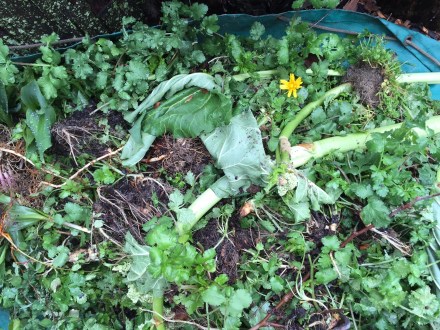
A collection of soily spring weeds and self-starters culled from the garden, mostly fragrant cilantro, are added to my pile.

A collection of soily spring weeds and self-starters culled from the garden, mostly fragrant cilantro, are added to my pile.

It can be a gamble to add spring weeds to a compost heap. They’re prodigious in producing massive amounts of seed in short order, which keep developing even after being uprooted. And once mature, the hard-coated seeds can last for years in the soil, just waiting for the right conditions to ripen and propagate anew, like locusts.

Garlic mustard is particularly pernicious. A native of Europe, this noxious weed now blankets Eastern lawns and woodlands. In its first year it grows as a stubby rosette, producing ankle-high stems loaded with slender capsules of seeds — up to 600 a plant, I read in a New York Times article by Dave Taft, “Garlic Mustard: Evil, Invasive, Delicious.”

True, some foragers collect the leaves to add to spring salads; I typically gather up handful of plucked sprouts and drop them straight through the iron grate of the storm drain along the side of the road. The seeds, Taft reports, can “linger for five or more years, awaiting suitable conditions.” Though my fingers do smell faintly of garlic, I read further that the leaves contain traces of cyanide, adding to its toxic standing in my yard.

But I’m confident my pile will cook and consume most of the weedlings I uproot on my wanderings, which makes this load of heavyweight organic green matter a welcome addition to my pile. Weeds are spring-loaded with nutrients snatched from the soil, and to recycle their ill-gotten gains through my pile and return them as fresh, weed-defeating humus, is only fitting — just desserts, as it were, for composting duties.

As I’m digging a hole in the steaming center of my pile to bury, in layers, the messy weeds, along with the kitchen scraps, another neighbor comes by while walking his dog, a female pit bull that is vigorously friendly with my own mutt.
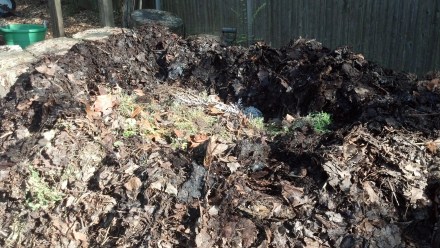
The weeds, already loaded with seedheads but also heavy with roots loaded with dirt and nutrients, are buried deep in my pile.

The weeds, already loaded with seedheads but also heavy with roots loaded with dirt and nutrients, are buried deep in my pile.

My property, being a double lot on a corner, stands out among the postage stamp yards of most of my neighbors for the size of its grassy space on which to roam. Having a sociable dog who’s often out and about in the yard with me makes our yard a popular waystation, part dog park, part playground. The trampoline is also open to the neighborhood kids, and it’s not uncommon for me to come home from work to find a mom or nanny sitting on the picnic table next to the trampoline watching the kids jump and tumble around, getting tired for bedtime. Fortunately, over the years there’s been only one broken arm among the young bouncy set, and, to my relief, no lawsuits. And any squabbles among the dogs usually involve a tussle over a tennis ball and are soon broken up.

As the pit bull sported with my dog, my neighbor watched me work my pile. He said he had his own pile of leaves raked up into a pile in the corner of his backyard, and added that he kept a bucket half-buried in the ground nearby into which he put some kitchen scraps. But he’d never combined the two elements and so was interested in my efforts.

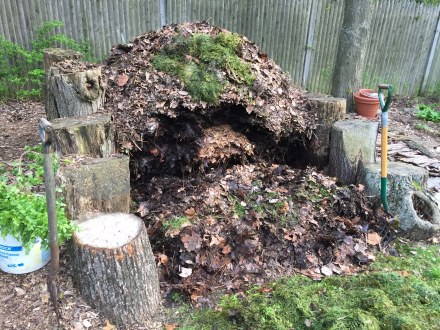
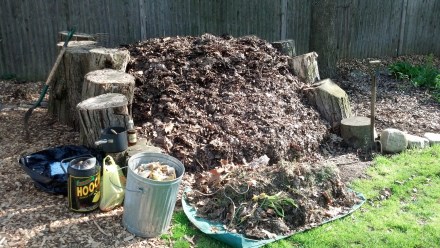
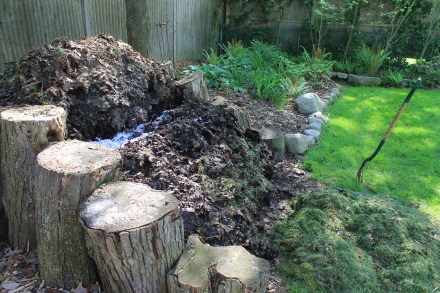
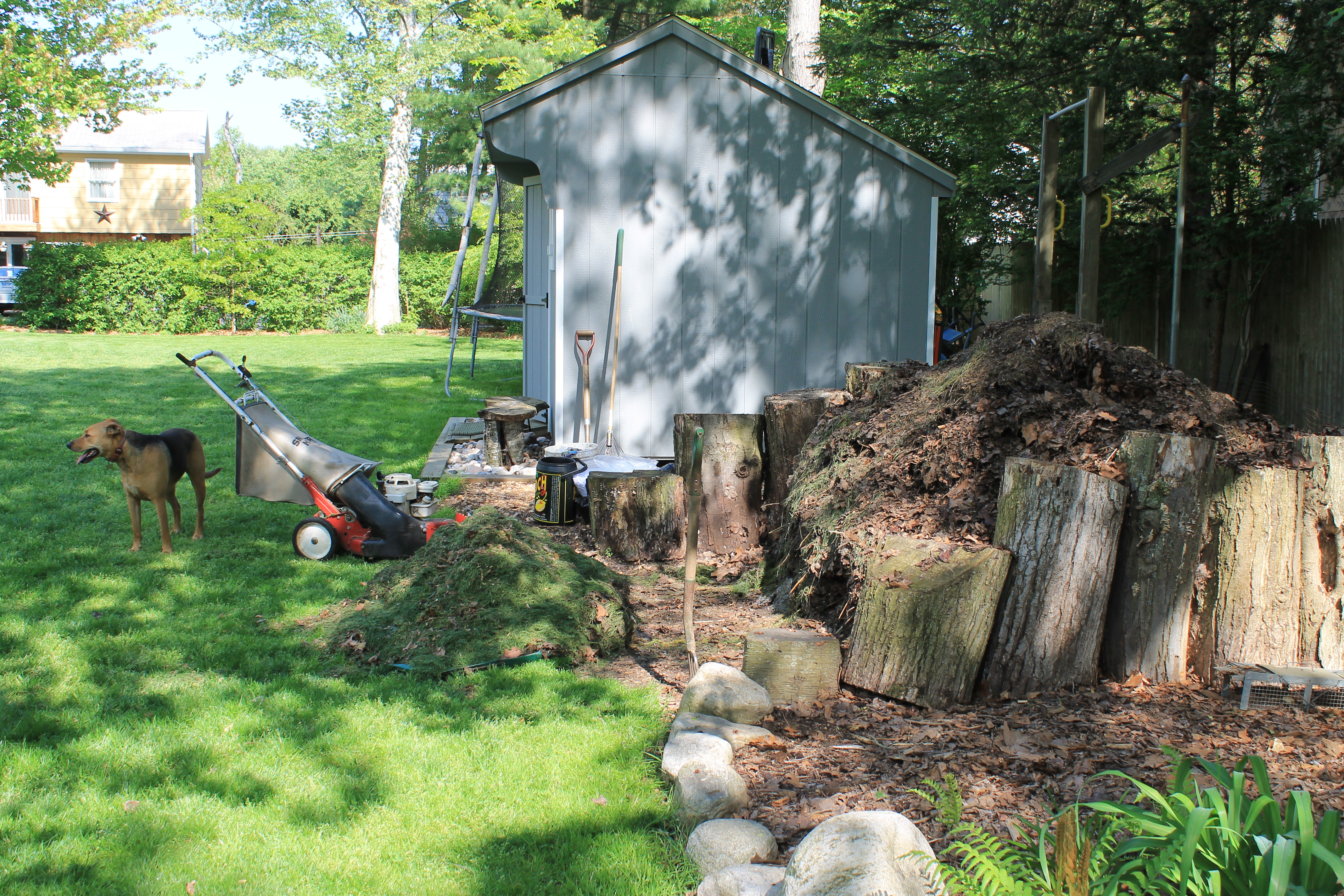
Set alongside the tool shed and trampoline, my pile has grown in size and stature over the years and is now a fairly prominent hardscape feature in the backyard. I like showing it off, though having someone watch as I disgorge buckets of kitchen scraps and pitchforks of weeds into the backyard heap makes me a bit self-conscious, like having someone watch you clean out the fridge. My pile has long been more of a Private Idaho than public performance art. But I enjoy delivering what amounts to a compost tutorial, a podcast for one.

Whether to humor me or bide his time while his dog got tuckered out, the neighbor stayed through to see me top off my pile with gleanings of old leaf litter from the front and back sides, restoring the ying-yang balance of old browns and fresh greens. Will he return home and commit to turning his own pile of leaves into a real-life compost heap? Or will he tell his wife over dinner about the eccentric down the street who stuffs his rotting garbage in a backyard dump of a landfill as if it’s something to brag about?

Hard to say. My pile will remain on display, in all its humble glory, at least for another couple months, when it once again will disappear by being dispersed across my lawn and garden beds. But for now, it rises anew, suffused with the green growth of spring.
My Pile: The Big Dig

It’s May Day, and my pile is now fully six months old. In November, it rose, phoenix like, from the remnants of last year’s heap of compost, which had been whittled down through the late summer and fall to a small starter mound of rich, dark humus and scrambly stalks and stems harvested from the vegetable garden.

My pile soon swelled with the onslaught of fallen leaves, supplemented by layers of sandy, sinewy seaweed and salt marsh hay beachcombed from the nearby shore and with grass clippings from a lawn revived by the balmy, sun-dappled days of autumn. As the season turned and I finished the yard cleanup before the cold set in, the heap of mostly dry chopped leaves received the spent growth of perennials culled from the garden beds, dried needles of pine and fir, and regular infusions of kitchen scraps, coffee grounds, shredded paper and other organic compostibles. It drank eagerly from the business end of a garden hose, and exhaled a steady stream of vapors from its midst.

For two months, my pile carried a burden of thick insulating snow, before thawing with the strengthening sun of early spring. Despite receiving hundreds of pounds fresh fodder along the way, from a barrel of horse manure to bag catchers full of sycamore seedballs scarfed up from the dormant winter lawn, as well as my efforts to toss and turn it, my pile has steadily settled in upon itself. I’ve trimmed its edges; tidied up the corners and poked and prodded its innards. By volume, it’s shrunken by nearly a third, and by look is now more composed stack than overstuffed heap. From a distance it still seems a big mess of decomposing leaves.

As much as the first half-life of my pile is dominated by dead brown leaves, the ever-quickening race to its fruition as finished compost will be now driven by mass infusions of hot green grass clippings.

Today, a Sunday, is the day I mow the ever-thickening lawn and add its surplus trimmings of minced green blades of grass to my pile. True, over the past three weeks I’ve stuffed it with my neighbor’s artificially enriched clippings, as well as a batch of more naturally nitrogen-spiked grass, courtesy of the resident deer and dog’s urea. But those contributions are just appetizers for the main course of fresh greens. Today marks a literal tectonic shift for my pile, in shape and composition.

Even with the newly sharpened blade set on high, the Toro’s catcher fills quickly. I mulch back into the lawn most of the clippings, yet stop a half-dozen times when the mower chokes to detach the hopper from the mower and dump the moist, fragrant clippings at the base of my pile.


The fresh grass clippings and other recyclables will soon be mixed deep within my pile.

The fresh grass clippings and other recyclables will soon be mixed deep within my pile.

As usual, I set out my other fixings – a week’s worth kitchen scraps from next door and of my own, as well as two small plastic bags of shredded paper from the office. I figure the crinkled white strips, laboriously processed from wood pulp, would make a fine counterbalance to the finely chopped blades of lush green grass. Add too much grass to a compost pile without mixing it with drier, brown materials and a compost heap that’s humming along into a stinky, anaerobic mess.

“Not all grass clippings should be removed from the lawn; when left after mowing, their nutrients enrich the lawn itself, without the application of chemical fertilizers,” I read in “The Rodale Book of Composting.” “However, most lawns do not need as much enrichment as a full growing season’s clippings will provide. Collecting grass clippings also helps reduce weed growth by removing weed seeds from the lawn.

“Freshly gathered green clippings are exceedingly rich in nitrogen and will heat up on their own if pulled into a pile. But, because of their high water content, they will also pack down and become slimy. This can be avoided by adding grass clippings in thin layers, alternating with leaves, garbage, manure and other materials, thus preventing them from clumping together.

“Clippings that have been allowed to dry out will have lost much of their nitrogen content but are still valuable as an energy source and to absorb excess moisture….Grass clippings and leaves can be turned into finished compost in 2 weeks if the heap is chopped and turned every 3 days.”

So here I stand, pitchfork in hand, to at long last begin to unearth the hard-pressed beginnings of my pile from back when. I stick the pitchfork, upside down, into the front edge of my pile to pull a wedge of moist, matted leaves from underneath. My previous working of the pile have helped create a nearly vertical wall, which I undercut by pulling chunks forward to form a front line of decayed, crumbly leaves. It’s the first light of day these leaves have seen since the fall. Each forkful writhes with squiggly worms and glistens with flecks of mica from the beach. Any trace of the seaweed they traveled in on is long gone.

I dig as far under the front wall of compost as I dare, until it threatens to collapse forward under its own weight. I toss a layer of grass clippings into the newly made trench, then cover with several pitchforks full of dried brown leaves gleaned from the corners of the log walls. They appear as fresh as the day they tumbled down from the top of my pile last fall.

I cleave a few more pitchforks of dark, rotted leaf mold from the bottom center of my pile, then stand back to watch the front face of the pile tumble down upon itself. I spread the avalanche out across the new front of my pile to create what amounts to a moraine.

As I excavate further into the center of my pile, I unearth a pocket of pristine leaf litter. Bone dry and compressed into a tightly wadded stack, the leaves lie underneath the digging I have done through the winter. Bound by the weight of all that is above it, the clutch of leaves has repelled any intrusion of water or rot, and now resists even the tines of the pitchfork. I tease the leaves apart bit by bit, and spread them across the newly created trench and cover them with a combination of grass clippings, white shredded paper and moist gatherings from the sides of my pile. Released from their state of suspended animation, they will now fully join the fungible, seething mess of rot and transmutation that is my pile.

IMG_2397

Digging out the deepest layers of leaf mold to pull them out to the front of my pile, I uncover a pocket of dry, hard-pressed leaves untouched by the rot that surrounds it.

I dig further into my pile, nearing the heart of it. Again it collapses, and I add more grass, as well as the kitchen scraps, deeply, mostly to play hide-and-seek with my mysterious rodent interloper. Its furtive trail has gone cold, and I can only hope that the mass of grass clippings added to the mix, easily a hundred pounds or more, will mask any scent of food waste to scavenge.

Essentially, I’m stepping my wandering pile forward, according to my plan of turning it inside out and upside down, largely in place. Its front has moved forward about two feet, hard by the edge of the lawn, and is a crumbly mix of nearly finished compost. I make note of using it as a top-dressing for when I plant the vegetable garden, once the risk of frost is past.

I portion out the rest of the grass and shredded paper, tucking it deep within a third trench. I can no longer reach down to ground, but I’m close, and far enough into the center of the pile to come across the barely discernible remains of my earliest insertions of kitchen recyclables and such. I spot a broken egg shell and the skin of an avocado, still adorned with the supermarket stick-on label. The pitchfork snags a seashell, then a wadded up section of soggy newspaper, the bottom of the rabbit hutch from before the snows of late January, I figure. I tease it apart with the tines of the pitchfork and bury it anew with the last of the grass clippings.

To cover the rest of the clippings, I scrape the hard-tine rake across the top of my pile, pulling the outer layer of sun-baked leaves forward, releasing volumes of vaporish steam from the rot taking place just below the surface. I cover it all with fat forkfuls of more raw compost from along the back side, tangly with the rotting stems of the salt marsh hay that insulated my pile through the winter. In short order my pile is newly restored to its customary height. Its front half, at least, is newly suffused with fresh mixed greens and rotting brown.

Next time I mow, I’ll repeat this process, working from the back of my pile, then I will dig inward from each flanking side. It will take me another month or so to get to the very bottom of my pile, the small mound of humus reserved from last season that served as the activator for rot and decay to come. But from today to harvest, my pile will be a most active compost heap, suffused with high-octane grass clippings. Keeping it aerated now becomes my chore, and it will be good hard exercise as I work to expose the compressed leaves deep within my pile and tease them apart to allow my pile’s “Friends of Distinction”*  – the worms, the creepy-crawlers, the mold-makers and microbes – to finish the job.

* The allusion seems fitting to me, for this group recorded a ’60s hit — “Grazing in the Grass” — that makes a great soundtrack for backyard composters:

Grazin’ in the grass is a gas, baby, can you dig it
What a trip just watchin’ as the world goes past
(Grazin’ in the grass is a gas, baby, can you dig it)
There are so many good things to see
While grazin’ in the grass
(Grazin’ in the grass is a gas, baby, can you dig it)
Flowers with colours for takin’
Everything outta sight in the grass
(Grazin’ in the grass is a gas, baby, can you dig it)
The sun beaming down between the leaves
(Grazin’ in the grass is a gas, baby, can you dig it)
And the bir-ir-ir-irds dartin’ in and out of the trees
(Grazin’ in the grass is a gas, baby, can you dig it)

Everything here is so clear, you can see it
And everything here is so real, you can feel it
And it’s real, so real, so real, so real, so real, so real
Can you dig it
Whooo-oooh

I can dig it, he can dig it
She can dig it, we can dig it
They can dig it, you can dig it
Oh, let’s dig it
Can you dig it, baby
I can dig it, he can dig it
She can dig it, we can dig it
They can dig it, you can dig it
Oh, let’s dig it
Can you dig it, baby

My Pile: As the Worm Turns

I celebrate Earth Day by spending a bright and sunny Sunday morning tooling around in the backyard. The crabapple and dogwoods have burst forth in full bloom, and the japanese maples and willow tree are vibrant with their own budding out, as are the lilac bushes, bright yellow forsythia and wilding privet shrubs that I’ve let grow tall along the fence line. I tromp across the morning dew for some hand-weeding — the low cast of the sun makes it easy to spot the “tall poppies” rising from the lawn that catch my eye and dandelion digger.

Once it’s late enough not to bother the neighbors, I haul the mower from the shed to make the first cut of grass. Its quick work, for I only need to scalp the few patches of turf scattered around the yard that have grown tall and lushly green, spiked by the dog’s urine, and likely that of the resident deer that make nightly pit stops to and through my yard. The spots are thickest in the sections of lawn nearest the back door and patio, as well as a strip of dog-walking territory along the road, starting with the mailbox and ending with a telephone pole, both of which are ringed by thick rings of grass. The uneven growth makes me realize how finely attuned the grass is to inputs of nutrients — and that adding store-bought fertilizer to a yard basically amounts to just so much pissing on your lawn.

I mow two stripes around the perimeter of the lawn, to etch the borders of the perennial beds and to hoover up more of the sycamore dander that continues to rain down upon the yard and streetscape. The result gives me a tidier lawn that will be uniformly lush, if not still messy with spring weeds, and in need of mowing fully in another week or so.

I also am left with two catchers full of first-cut grass to add to my pile. I set the clippings, along with a week’s worth of food scraps from my kitchen and the neighbors’ and a winter’s worth of gleanings from the vacuum cleaner, beside my pile.

The latest contributions for my pile.

The latest contributions for my pile.

Through the week, the daytime temperatures have spiked into the 70s. An overnight shower has dampened the top of my pile, and as I dig into it with the pitchfork, to resculpt the top to make room for today’s insertions, the earthy smells of ripening rot rise up from the warm inner reaches. I fluff up forkfuls of moist, mold-flecked leaves of all kinds, mixed with a scattering of blackened and jagged hollowed reeds of the salt marsh hay. It’s a pleasing inside look at the fecundity that is my pile.

Having inserted last week’s grass clippings from the neighbor in a row excavated along the front of the heap, today I delve deep into the back side. I find no sign of the trespassing rodent, and set aside the live trap cage that was perched on a ragged shelf of leaves midway up from the ground. To gain easier access to the jagged wall of pressed leaves along the back side of my pile, I take a screwdriver to jimmy the staples that fix the wire fence to the right back log and curl the fence out of the way.

Over the past several months I’ve carved my way into this crush of leaves, using it as fodder to mix with a steady supply of rich green organic material, from buckets of coffee grounds and barrels of seaweed to the routine additions of food waste from the kitchen. There are also contributions of horse manure and sycamore seed fluff, layers of crinkly shreds of office paper and a fair amount of urine-soaked  straw from the pet rabbit next door. All that and more makes up my pile.

With heaped pitchforkfuls of leaves piled high along the narrowing log-wall sides and across the front of my pile, I hollow out a trench across the back as deep as the pitchfork can reach. Into this fluffy maw, I upturn the buckets of food scraps, spread the dusty detritus from the vacuum cleaner bag and parcel out the dried green bedding of hay from the rabbit hutch. Mixing it in is easy, and I’m always amazed by how quickly these insertions disappear without a trace.

To backfill, I scoop up the tailings of crumbly leaf mold from the corners of the rear side of my pile, dank with my morning pees, then stick the tines along the bottom to pry out forkfuls of leaves from the base. Once free of the press of weight above, each forkful expands by volume and becomes further unbound when I toss the lot across the top of the pile.

I  alternate with layers of the dog’s own scented grass clippings to build the top of my pile back up to chest high. Even with the sycamore seed duff, which seems as inert as the detritus from the vacuum bag, this latest addition of food waste and grasscycling, along with big gulps of air, will surely spark a fresh riot of bacterial growth. There is much decomposition taking place within my wandering pile as it steadily consumes itself. As I tidy up the backside wall, I know am coming ever closer to reaching the steamy cauldron that is at the heart of it. Once the grass begins to grow in earnest, I’ll soon have a surfeit of clippings to add, to stoke my pile to a fever pitch of decay as spring turns to summer.

I finish my Earth Day work by burying the last of the grass clippings under a top dressing of crumbly, dirt-flecked leaves. The summit of my pile rises to a precarious point. My log cabin of a pile now looks as much like an A-frame as it does a rounded heap. My pile will soon settle upon itself as it exhales the stirred-in air and the latest round of rot kicks in. After I put away the tools I head to back porch and turn to gaze upon my newly heightened and refurbished pile and see two robins, one tromping across the top and its mate pecking at the base.

The backside of my wandering pile. I've shaved three feet or more from the backside of the heap to help my steadily consume itself.

The backside of my wandering pile. I’ve shaved three feet or more from the backside of the heap to help my steadily consume itself.

My puny efforts at composting pale in comparison to the true workhorses of my pile: Earthworms. They are peerless in chewing their way through rotted organic matter and turning it into the finished end product known as humus. Truth be told, new soil is mostly worm poop.

The worm castings that dot my still dormant lawn, along with the squadron of robins that patrol the turf, are ample evidence of this handiwork. Gutwork might be a better term to describe the inexorably dogged pursuits of the class act that is Oligochaeta.

A worm is an animated intestine,” Steve Jones writes in “The Darwin Archipelago.” “The body is divided into segments, each possessed of an outer layer of muscle that encircles it and an inner muscle sheet that runs parallel to the axis. Each segment bears a simple kidney. A series of even simpler hearts is distributed along the animal’s length. The body is hollow and filled with fluid, with a long digestive tube down the center.

“Aristotle described worms as the ‘Earth’s entrails.’ Cleopatra decreed them to be sacred animals and established a cadre of priests devoted to their well-being. [As Darwin’s book put it], ‘All the vegetable mould over the whole country has passed many times through, and will again pass many times through, the intestinal canal of worms.’”

Worms are what make my pile work, and I strive to make the heap hospitable to the collective of worms that resides within it. Lowly as they are, worms are near the top of the bio pyramid that is my pile, and they lead the way to its deconstruction, perforating my pile with their burrowing and churning out countless worm castings along the way.

In form, my pile may look like a heap of leaves mixed with green trimmings, but it functions more like a coral reef, with countless worms standing in (or squirming) for the multitude of sea polyps that crank out deposits of limestone that, in turn, become the base of an entire ecosystem. Worms do the same on dry land, and what they leave behind is soil.

Charles Darwin had a lot to say about both coral and earthworms, among other truly landmark research, thoughts and conclusions about our own origins and purpose in life.

Allow me to let Joe Palca of NPR’s “All Things Considered” to explain things further. In a 2009 story, “Darwin’s Earthworm Experiments Broke New Ground,” he reports:

“Many people know about Darwin’s famous voyage aboard the Beagle — of his observations of the birds on the Galapagos Islands. Less well known is that Darwin spent quite a bit of time studying earthworms.

“Initially, his earthworm work drew as much, or more, attention as his evolution work. His book, The Formation of Vegetable Mould Through the Action of Worms, With Observations on Their Habits, published in 1881, sold even better than On the Origin of Species during Darwin’s lifetime.

“‘At the time when Darwin started looking at the worms, no one appreciated the role they had in agriculture,’ says Alun Anderson, a journalist who became interested in Darwin’s worm work.

“In fact, Anderson says, in the mid 19th century, most people thought earthworms were pests.

“But Darwin was convinced they were valuable for turning over the soil, in part by chewing it up and pooping it out, thereby making it more fertile.”

Darwin spent decades studying worms at his estate in the English countryside to find out how fast and effecient worms were turning in the soil, and how much new earth they produced.

His thesis was that England’s “lush topsoil was the product of ceaseless soil consumption and defecation by earthworms: 53,767 per acre, depositing 10 tons of fresh soil atop each acre of English countryside, every single year,” I read on Wired’s website. It was earthworms, Darwin realized, that had buried the monoliths of Stonehenge.

“It may be doubted whether there are any other animals which have played so important a part in the history of the world as have these lowly, organized creatures,” Darwin wrote.

I turn and add to and aerate my pile once a week or so. Earthworms do the same 24/7.

I turn and add to and aerate my pile once a week or so. Earthworms do the same 24/7.

Steve Jones digs deeper still, in “The Darwin Archipelago:”

“An acre of rich and cultivated ground is riddled by five million burrows – which, together, add up to the equivalent of a six-inch drainpipe. Half the air beneath the surface enters through burrows, and water flows through disturbed soil ten times faster than in unperforated.

“The surface of the Earth, if watched for long enough, is as unruly as the sea. Everywhere, it is on the move. Gravity, water, frost, heat and the passing seasons all play a part, but life disturbs its calm in many other ways. Living creatures – from bacteria to beetle larvae and from badgers to worms—form and fertilise the ground. The largest reservoir of diversity on the planet lies beneath our feet, with a thousand times more kinds of single-cell organisms per square meter than anywhere else… a shovel full of good earth contains more individuals than there are people on the planet…Insects, mites, spiders and subterranean snails, together with worms, may make up fifteen tons of flesh in a hectacre of soil.

“In an English apple orchard they eat almost every leaf that falls—two tons in every hectacre each year. In the same area of pasture, they can munch through an annual thirty tons of cow dung.

“The constant flood of slime pumped out as they burrow also recycles other minerals such as nitrogen…their casts contain five times as much nitrogen and ten times as much potassium as does the soil itself.”

After starting his masterwork on worms, Darwin went off on the Beagle and to come home with the “Origin of Species.”

I will stick closer to home and tend to my pile and the worms that will do the real heavy lifting in turning a heap of leaves and recycled greens into rich new earth.

My Pile: Turf Wars

Between a busy week at work and at home with spring-cleaning projects, it’s been a struggle of late to devote attention to my pile. But that’s the nice thing about tending a backyard compost heap: There’s not much of a deadline involved, and my pile makes few demands upon me, other than those I put upon it. My pile is the very definition of a self-starter.

Besides, my pile continues to benefit from the largesse of others. This evening I return home from work to find that my across-the-street neighbor has mowed his lawn and deposited the clippings at the base of my pile.

With a cool, dry start to spring in these parts, I have yet to cut my own grass. My neighbor, however, three weeks ago spread a 50-pound bag of fertilizer across his lawn and watered it in with his sprinkler system. He’s already mowed twice. The first cutting he mulched back into the lawn, but his turbocharged turf has since grown so fast that he had to mow again, this time with the grass catcher. His wife was upset by all the clippings that their daughter tracked into the house after playing in their front yard.

Something borrowed, something green: My neighbor Craig's grass clippings, to be added to the top of my pile.

Something borrowed, something green: My neighbor’s grass clippings, to be mixed into the top of my pile.

Chemical fertilizers for lawns have only been around since just after World War II. According to Tom Andersen, whose 2002 book, “This Fine Piece of Water,” documents the devastating impact of excess nitrogen and other mandmade pollutants have had on water quality (and life) in Long Island Island since then.

“In the Northeast United States, each acre of fertilized lawn is covered with an average of 134 pounds of nitrogen a year…Nitrogen that occurs naturally in the soil is taken up by plants for growth only as it is needed, but chemical nitrogen dissolves easily in water, and anything not used immediately by the grass is washed away in the first rainstorm.”

My pile is a sponge for that nitrogen, keeping at least some of it from flowing down the storm drain and into the nearby Sound, where the excess nitrogen causes all kinds of problems, from algal blooms to dead zones without oxygen that kill anything that swims or crawls in the water.

I have some qualms about adding such chemical-laden contributions to my pile, but welcome the fresh green material to what is largely still a pile of old brown leaves. And I figure the mineral cocktail that makes up the typical store-bought fertilizer will in time break down into its elemental parts that will ultimately be absorbed by my pile to a more natural end.

Those manufactured ingredients are worth closer inspection, and are generally listed by a three-number ratio of nitrogen, phosphorous and potassium, most often using their chemical symbols, N-P-K. For example, I read on lawnfertilizers.com, a bag of a 50-pound bag of 10-10-10 fertilizer would provide 5 lbs of nitrogen, 5 lbs of phosphorous and 5 lbs of potassium.

The most abundant element in the air we breathe, as a solid nutrient nitrogen promotes foliage and overall growth and is the mineral that gives grass its dark green color. Too much can overload both a grass lawn and local waterways. Phosphorous spurs root development, and I read that an adequate supply helps lawn grasses develop drought tolerance. As with nitrogen, an excess of phosphorous in runoff leads to algae blooms, which can prove toxic to both aquatic ecosystems and humans. Potassium promotes disease resistance and aids in the production of flowers and fruit, the research says.

The rest of the ingredients in a typical bag of store-bought fertilizer are fillers to keep the granules from clumping and a bunch of trace minerals, among them magnesium, calcium, sulfur, iron, manganese, zinc, boron and molybdenum. All are helpful in the proper proportion, though I’d need a textbook to help explain why and to what extent.

Of course, all of these minerals and nutrients occur naturally, and assembling them in natural abundance and dispatching them in the proper proportion throughout my backyard is a big reason why I tend a compost heap in the first place.

Stu Campbell, in “Let It Rot,” provides a helpful reality check: “Many composter-gardeners worry too much about producing compost with a very high and well-balanced NPK. Would it be terribly disillusioning to be told that compost is not a miracle fertilizer? In most good compost, the content of NPK is actually very low. In fact, it usually does not have a high enough percentage of NPK to be considered a fertilizer at all. But you can boost the NPK by adding natural sources of nitrogen, phosphorous and potassium to your compost pile.”

Like I said, my pile is nothing if not magnanimous, and mostly welcoming of begged or borrowed or store-bought supplies. It’s also a very capable buffer, a backyard treatment facility that I trust to safely process all manner of raw ingredients into a finished product that is, if not wholly organic, then at least ultimately natural and homemade. So into the mix this hopped-up grass will go. Besides, I have some housekeeping to do of my own.

The still-unseen rodent continues to have its way within my pile, and by the looks of it has ferreted out the kindergartner’s compost of last week. I see that the rat or whatever it is has not only eschewed the wedge of cheese I set in the live animal trap but has used it as a springboard to get to the good stuff hidden within. I checked the trap this morning and it was near buried under a fresh outpouring of tailings from its latest tunneling. At least the trap is good for something.

The live bait trap, set along the back edge of my pile mostly buried by the rodent's diggings.

The live bait trap, set along the back edge of my pile, made a good springboard for the rodent, who tunneled a new hole just above it.

It seems I have to accept the interloping rodent’s presence, at least for now. I can rationalize most anything, and I figure the varmint’s burrowing instincts no doubt are helping aerate the oldest, dankest parts of my pile, perhaps even enough to offset the biological cost of what it takes from the pile as food.

So this evening I spread out the crusty leaves atop my pile and layer the grass clippings with pitchforks of matted leaves from the front side and back. The unscheduled addition of this hothouse material to my pile should be unappetizing to the rat. And re-sculpting my pile into a nearly vertical wall in front and shoring up the ledge in back will allow me to undermine it with my next insertion of grass clippings from my own yard.

I reset the live trap with a slather of peanut butter and retire for the evening. I can’t help but feel that somehow, the varmint has me at a disadvantage and will have its way with my pile, at least until I scrape away the last of this year’s finished compost and spread it across my garden and lawn.

Humans have long shared the outer fringes and inner crevasses of our hearths and homes and barns, especially our midden heaps and agricultural leftovers, which is more or less exactly what my pile is.

I suppose tending a compost pile tends to promote such a “live and let live” approach to all creatures, great and small. And while that mindset includes striving to be the best organic backyard gardener I can be, I admit to occasionally relying on more drastic, manmade solutions when the circumstances seem dire enough to warrant a lethal approach.

The back story: Five or so years ago, my lawn was under mortal attack. After grassing it with the initial renovation of the property, the newly expanded greenscape grew well for a few seasons. Then whole patches of turf started to scrape off with the gentlest of raking, or even scuff of a shoe. Before long, I could roll up the dried thatch like a carpet. Every time I dug underneath the sod I would find the cause: the subsoil was permeated with short, fat, dirty-white grubs, the ugly larval stage of the scarab beetle. The grubs chomp through the grass roots like so many micro mowers, scalping the lawn from below. At its worse, my lawn attracted foraging skunks, who grubbed out a meal from the turf, inflicting further damage.

I considered applying nematodes, an organic option that relies on a beneficial parasitic creature to do the dirty work of killing grubs. But it’s an expensive solution and requires just the right conditions and timing.

After much agonizing, I bought a bag of commercial grub killer from Home Depot and spread it across the worst parts of the lawn. I kept the dog and son and all others at bay for the better part of a week.

I’m sure there was some collateral damage; earthworms seemed to be in short supply for a time, and it may be my imagination, but the fireflies that rise from the sod each July also seemed muted that year. But since the application of the “nuclear option” of the grub killer insecticide, the lawn has been as thick and lush as it’s ever been.

Relying on chemicals to treat and care for the garden and lawn is made easy by the longstanding habits and practices of our culture. Last weekend my neighbor had sprayed his gravel driveway with Roundup, and had enough left in the canister to ask if I wanted a spritz or two to hit the weeds coming up through my own gravel driveway and in the cracks between my flagstone back patio.

I waved him off with a “thanks, but no thanks.” Herbicides I can do without.

Though I admit to being a weed killer in my own way, I prefer it to be a fair fight, mostly relying on hand to hand combat. Over the years I’ve spent hours and hours hand-weeding my garden and lawn, mostly as I amble about the yard throwing tennis balls for the dog to catch or picking up dog droppings. I often stick a dandelion digger in the back pocket of my jeans, and have become fairly adept at stooping between throws to flick a weed, roots and all, out of the ground before the dog returns with his slobbery ball.

The first eradication effort focused on dandelions, which blighted my lawn for several years, the seeds blowing into my yard from an untended slope along the street, just upwind from my house. I’ve also waged war with other weeds, among them creeping wild strawberry, certain sedges, wild onions and other contagions that somehow reach critical mass from one spring to the next. Clover I keep, to feed both bees and the turf, which it benefits by adding nitrogen through the symbiotic hookups of its roots and bacteria in the soil.

With some overseeding and the spreading of many wheelbarrows full of humus, plus aeration with a rented machine every couple of falls, my lawn has become a lush thatch of green. But still, enough crabgrass sprouts each spring for me to grow callouses on my fingers and a sore back from bending over to pluck out crabgrass plants before it goes to seed and repeats the cycle all over again.

It’s not so much that I favor a monoculture of grass. My “grass” lawn is a meadow-like mix of annual and perennial rye, fescues, bluegrass, bent grass, poa annua and a medley of weedy greens that manage to survive mowing and escape my wandering clutches.

But crabgrass is the most pernicious, spreading unsightly and producing copious amounts of seeds if left unchecked. Crabgrass seeds can remain active in the soil for years, just waiting for the right conditions to germinate. I was amazed to realize, from the book “Green Immigrants,” that crabgrass is derived from millet, the oldest grain cultivated by man. Evidently, it was unwittingly brought to America by immigrants from Eastern Europe, where it was once grown as a grain.

Like most lawnkeepers in the northern-tier states, I like my turf grass skinny and soft, green and lush. Clover will do, but crabgrass and dandelion just don’t pass muster.

To that end, I’ve been considering taking a systemic approach to my weeding this spring by applying a natural treatment that’s part herbicide, part fertilizer. Corn gluten.

Lately I’ve been reading up on this product, and here’s what I’ve gleaned. This, from Paul Tukey of the safelawns.org website:

“Scarcely any subject in organic lawn care has spurred more discussion in the past two decades than corn gluten meal, the corn bi-product that was patented by Iowa State University in 1991 for its pre-emergent weed control properties. In the past decade, as the demand for alternatives to toxic chemicals has risen, the use of corn gluten meal on lawns has grown exponentially…

“Dr. Nick Christians, one of the most widely respected figures in the lawn care industry, is credited with developing corn gluten meal as a pre-emergent lawn herbicide. His product kills the dicot weeds (clover, plantain, dandelions, etc.) before they grow to adult size. The weed seeds actually do germinate, but the corn gluten meal inhibits the expansion of the plants’ roots and they quickly die of dehydration.”

A stock shot of what corn gluten looks like. I figure it would cost $100 for one treatment of my lawn.

A stock shot of what corn gluten looks like. I figure it would cost $100 for one treatment of my lawn.

As a native Cornhusker from Nebraska, I like the idea of using a corn byproduct on my lawn. Corn is as American as it gets, and how the grain has evolved over the millennia to become a food staple makes for a pretty cool story, even if the crop has been hijacked of late by Bog Ag. I’m still on the fence about GMO, but it pains me to know that so much of today’s high-tech corn is produced to fuel the needs of ethanol makers and government-subsidy takers.

Here’s some more about corn gluten as a herbicide, from the organic lawncare section of About.com:

Corn gluten inhibits root formation of germinating seeds. Timing a corn gluten application is crucial for it to work properly. Corn gluten needs to be applied before weed seed germination. The seed will germinate and form a shoot, but not a root. Prior to germination, a short drying period is needed to kill the germinated, but rootless, plant. If conditions are too wet during germination, the plant will recover and form a root.

Corn gluten is a pre-emergent herbicide only; it provides no post-emergent weed control. If seeds have already germinated, a late application of corn gluten will only serve as fertilizer for the weeds.

The first application of corn gluten will only suppress up to 60% of the weed seeds. The initial results may be disappointing but after several applications it can achieve better than 80% effectiveness.”

This cool, dry spring creates the perfect conditions for testing out corn gluten on my lawn. But I balk at both the price and being suckered into a long-term program that commits me to more expenditures. Paul Tukey seems to agree:

“My standing answer to anyone who asks about this natural weed alternative is that corn gluten meal has been vastly oversold by an overeager industry. With the rising prices of corn gluten meal in the past three years, homeowners can go broke trying to buy enough product to really make a difference in their weed population.”

I have my pile and it turns out a fair equivalent of naturally produced soil amendments for free. As last summer turned to fall, I spread upwards of 50 wheelbarrows of freshly made humus across my garden beds. This year, my compost crop will be devoted to my grass lawn. With an aeration and some overseeding, plus the 50 or so inches of rain that it gets in fairly regular doses throughout the year, my motley lawn will continue to thrive.

And the corn in my backyard this summer will be not cast piecemeal upon the ground but rising up whole in my garden, and from there on the cob hot off the grill, just as it should be.

My Pile: Rats!

While the cat’s away …

Following a short spring-vacation trip to Florida with my son, I drop him off to spend the rest of the school break with his mother and return home. It’s a Thursday evening, and after setting the luggage down, I head outside with the dog. He makes a beeline for my pile, and I follow. I’ve missed them both. My pile is more than a pet hobby. It reconnects me to my home, my backyard, my life.

From afar, I see that the front of my pile is a shambles; a deep gash carved from the sloping face. The pitch fork leans haphazardly against the log wall. My pile has been ransacked.

Walking around the backside to return the pitchfork to its customary spot propping up the back fence, I find more troubling evidence: At the base of the logs that form the back corner of the heap, a conical slope of crumbly leaf mold extends from the crack between the two logs, just below a neat round hole about two inches wide that disappears into the darkness. Worse, at the base of the tailings is a tumbled nugget of horse manure, which I know I buried deep in the center of my pile a month ago. It’s an unmistakable sign that a small burrowing animal has discovered the bounty of food buried deep within my pile. And that the interloper is not only industrious but discerning.

The hole seems too narrow to be formed by a possum or skunk; too large for a chipmunk, mouse or vole; too deep for a squirrel. It’s been years since I’ve had to wonder and worry about sharing my pile with a rodent. Now this. Rats!

On a ledge of matted leaves near the top of my pile, I spot another bore hole, noticeable from the slivers of crinkly white paper scattered downslope. A few peels of potato skin are casually flicked aside. I can imagine the banquet of fresh to rotting food that an enterprising varmint would find within the warm, damp matrix of leaves that is my pile. Shelter, too, though from the dog’s eager nosing around the perimeter of the nearby tool shed, I suspect that whatever’s feasting on my pile also has a safe house of a burrow in the deep bed of trap rock the shed sits on. And that tells me where there’s one rat, there’s probably more. Double rats!

The tailings from a burrowing rodent in the back corner of my pile; its trail into mix soon runs cold.

The tailings from a burrowing rodent in the back corner of my pile; its trail into the mix soon runs cold.

The mystery about what happened to the front of my pile is solved when the neighborhood kid I’d asked to look after the dog comes by to collect his pay. He thanks me for the bills I fork over and excitedly tells me about the worms that he and some buddies dug up before going fishing for bluegill and small bass in a nearby pond.

While it’s only natural to feel territorial about the backyard compost heap I tend to throughout the year, today’s a reminder that I share my pile with others; some with two feet, some with four, most with many more or none at all. I’m happy that my pile is a playground for boyhood pleasures, and a productive bait shop at that.

I don’t have much of my own kitchen scraps to contribute, but the neighbor’s compost bucket is full and there’s a half-full bag of shredded paper from the office that I’d stashed in the tool shed before leaving town. I also gather a bucket-full of precocious spring weeds from an amble across the yard to clean up after the dog. I like hand-weeding dandelions and such before they go to seed. They’re easy to spot among the still-shrubby grass, and culling them short-circuits more widespread infestations. Their leaves and cloddy tap roots make especially nutritious additions to my pile. If I could train backyard critters to like dandelion salads, I’d be all set.

Starting at the varmint’s entrance in the corner, I carve out a trench midway up the back side of my pile, heaping forkfuls of sodden leaves onto the top.

The trail quickly grows cold, and I give up on the rash idea of rotting out the furry little rodent with the pitchfork. My pile’s too dense for that, and I’m sure the rat has tunneled every which way through this newfound midden.

Once the hole along the back is about the size of a foot locker, I load in layers of shredded paper, kitchen scraps, some wind-blown leaves from the yard and the clutch of early-spring weeds, then cover it all with foot-thick trimmings of dried matted leaves from the rear flank, fashioning a new horizontal ledge along the backside.

There's scant chance of rooting out the rodent that has taken up residence in my pile, but the effort does allow me to add some shredded paper, kitchen scraps and fresh plucked weeds to my pile.

There’s scant chance of rooting out the rodent that has taken up residence in my pile, but the effort does allow me to add some shredded paper, kitchen scraps and fresh-plucked weeds to my pile.

Moving around to the front side, I tidy up the kids’ fishing expeditions for the worms and finish by skimming a row of leaves from along the bottom edge to return my pile to its customary shape.

I borrow the Hav-a-Heart rodent cage from my neighbor and bait it with a slather of peanut butter. I place the trap on the ledge of leaves along the back side of my pile and set one opening facing the corner hole. I can’t imagine why my new lodger would scamper into the wire cage while he has a smorgasbord of kitchen scraps to uncover, but we’ll see.

Rain is in the forecast, so I finish by poking the undisturbed sections of my pile with the length of rebar. After a few thrusts, its tip begins to smoke with hot vapors. A poke down through the center section where I last inserted kitchen scraps and the manure releases a faint whiff of rotted egg. The parrying with the rebar should give my pile a few much needed gulps of fresh air and allow any rain that falls to percolate down through its outer skin. If I’ve happened to spear a small varmint of a squatter in the process, then that’s just his tough luck. It goes with the territory.