

The best thing about my pile? The deer don’t touch it.
I share all else in my backyard with white-tail deer. Lots of them. Resilient, highly adaptable and just darn Bambi-cute, Odocoileus virginianus now makes itself at home in many a suburb, including my own.
My neighborhood street and its flanking swaths of lushly landscaped yards connect an access road that parallels the marshy drainage ditch along a major highway (I-95) to an upland ridge of granite ledge and hardwood trees that is too hard to build on and, thus, largely undeveloped.
Midway between those two refuges of privacy and protection is my property, a convenient way station for deer on their daily commute.
Being a corner lot, it’s not practical to fence it all off, so nightly, as sure as sin, I am visited by a stealthy band of hungry deer.
I don’t know exactly how many and how they are related, but I figure it’s a family group of a doe and yearlings traveling along with their mother. Because the furtive prey animals forage mostly at night, I hardly ever see deer in my backyard, but I know them for the damage the cause – the evidence they leave behind.

Not my garden, but you get the picture. (Actually, the deer in my yard are much fatter!)
Sets of two-pronged cloven hoof-prints are familiar tracks across my yard, especially during mud season. The deer scat provides more clues to just how popular my salad bar of a garden is with these rangy ruminants, and how long and where they linger. Patches of green-brown pellets are scattered like buckshot next the yew shrubs and evergreens planted alongside the house, in the perennial beds along the side of the yard, or just plopped in the middle of the lawn.
I can’t be bothered with deterrents such as wrapping bushes in netting or installing strobe lights or sonic devices. Nor do I have a mind to spraying my yard, either by contracting a commercial service or by buying a batch of coyote urine or some such extract off the internet.
Sometimes the dog and I adjust our schedules and catch a deer or two or three loitering in the pre-dawn gloaming; he’ll give chase, their white tails high in retreat. Usually, the dog stops when he gets to the edge of our property, and the deer pause in the yard across the street to wag their own high tails at him.
Mostly, the dog just sniffs and snorts at the deer droppings he comes across in the lawn, which I let disintegrate where they fall. I also let stand the cow-patty-sized dung I see on occasion. I figure they are from a buck relieving himself, marking my yard as his territory.
I saw him last, I think, on Halloween night. My across-the-street neighbor, Claire, stopped by to say hello after the kids had finished their trick-or-treating. We were chatting on the porch when behind her an 8-point buck strolled up the middle of the street between our houses. We figured his nightly routine had been interrupted by the costumed kids and their parents parading up the street. He took the festivities in stride and ambled up the street on his way to the woods like he was auditioning for a TV commercial.
The other evidence of deer in my yard is everywhere. Everywhere except my pile.
I admit to some feeling of satisfaction that my pile is the one thing in my yard that I don’t have to share with deer. All else seems fair game.
The deer keep the perennial azaleas trimmed to the nub, and munch on the scraggly rhododendrons I was foolish enough to buy when first planting my garden some years ago. I’ve never seen a blossom, as the deer always get to them first.
Same with the tiger lilys and tulip bulbs I received as housewarming gifts. The deer pinch off the delicate flowers and leave behind the beheaded stems to remind me who is the top of the food chain in my yard. (Fortunately, the deer seem to have no taste for daffodils and crocuses, which now provide me with the first and most welcome blooms of the growing season.)
The row of hostas I planted along the back fence suffer the same fate. Each season the deer wait for them to grow dense, then chomp the verdant green leaves to stubs, seemingly at the same time each year, just as the hostas are about to bloom.
This litany of woe is familiar to most gardeners who share their habitat with deer, and like most, I’ve adapted, planting mostly ornamentals that the deer don’t have a taste for – at least until they get desperate from drought or extended snowfall. Sometimes I think the deer act a fox in a henhouse, and just mow down whatever they can, because they can. I see lots of chewed-off branches strewn across my yard.
Some summers the deer let me enjoy my black-eyed susans, phlox and hydrangeas; sometimes they don’t. Over the years I’ve buried hundreds of acorns, gathered during walks at parks or golf courses, and am pleased that a few have snuck their way past the deer and squirrels to grow tall enough to have a chance at a long life. I now have 10 or 12 saplings along the perimeter of my yard, from nearly as many kinds of oaks. They will make fine replacements for the swamp maples that I inherited and am trying to rid my yard of.
The deer pass by the bright yellow shocks of forsythia, the cleome that blossom the summer long and the cone flowers, joe pye and butterfly bushes that mark the peak of summer and attract so many hummingbirds and bees. Deer don’t have a taste for pachysandra, pampas grass or yucca, either, and all those are staples in my perennial beds.

The shade garden in the back corner of the yard, next to my pile. The hostas make a fine salad for the deer.
Over the years I’ve added more and more ferns as well, and I now have six or seven types. Most I gather on walks in a tract of open space nearby that borders a municipal golf course. I hike it with a buddy and our two dogs. He scours the woods for wayward golf balls, while I collect a fiddlehead or two. I know it’s not exactly kosher to collect plant specimens from public land, but the ferns grow in colonies, and I see no lasting harm in separating a clump from brethren and transplanting it in my garden.
Our deer “problem” is pervasive and near epidemic proportions. The other morning while driving my son to school, we passed a large yard a couple neighborhoods down the road and counted a herd of 14 deer grazing on the grass. “Look at that, a new personal best,” I told him after slowing to make a quick count. “Add to it,” he replied, pointing out 5 more in the yard on his side of the car.” They were all does and yearlings, near as I could tell.
It wasn’t always this way. I’ll quote a local deer expert, Peter Knight, in an editorial to our local newspaper before a town meeting about what to do with Bambi.
Says Knight: “With no natural predators, the deer population has grown from an estimated 12 — yes, 12 — in all of New England in 1896 (following the years of land clearance for farming) to approximately 150,000 today. The latest survey conducted by the Wildlife Division of the Department of Environmental Protection in January 2009 estimated an average 62 deer per square mile in Fairfield County that covers 625 square miles. (Okay, we’ll do the math — 38,750 deer.)
Sixty-two deer a square mile is a lot of mouths to feed. As I live in the only one of Connecticut’s 169 municipalities that has banned all hunting, the upshot of this perennial debate about what to do with the deer “problem” is, invariably, “live and let live.”
Aside from having to counter-program my garden according to the whims and wills of all these passive-aggressive creatures, deer bring with them an even greater concern: Lyme disease.
When I purchased my house a decade ago, the yard was seriously overgrown and unkempt – a chief reason why I could afford to buy the rundown property in the first place.
From neighbors after the fact, I heard that the elderly widow who had lived in the house for 30 years had tried to keep up the garden her late husband had tended. But, the story goes, she contracted Lyme disease while gardening, which forced her to withdraw indoors.
The pernicious disease perhaps caused ailments that led to her being a shut-in for the last decade of her life. I don’t know, but one upshot was that her untended backyard became a haven for deer. When first grubbing out the back corner of my lot, near where my pile is today, I found a nesting place for deer tucked into the briar patch of tangly scrub and poison ivy vines. Not only did they feed in the yard, but they slept here.
Nowadays, the deer might not linger so long, but they still bring with them the ticks that serve as vectors for a game-changer of a disease for gardeners and outdoor enthusiasts.
The symptoms of Lyme disease were identified among a cluster of young patients in Lyme, Old Lyme and East Haddam in 1975 – Connecticut towns just 40 miles or so up the shoreline. A year later a biologist in the DEP identified the deer tick that carried the disease and a few years later the popular name for it was coined.
Dr. Mark Friedman, a professor at the University of Connecticut’s School of Medicine, calls Lyme disease “the great imitator, an insidious infectious disease that is very difficult to diagnose.”
In addition to the variety of common symptoms – fevers, aches and rheumatoid arthritis among them – Friedman blames Lyme ticks for current incidents of disfiguring Bell’s Palsy, and Lyme dementia, which can often be misdiagnosed as Alzheimer’s disease. He also reports it has recently been discovered that the ticks can carry a disease called Babesiosis, which is similar to malaria.
While deer are not the only carriers of infected ticks, they are essential to the successful reproduction and completion of the life cycle of over 95 percent of ticks, Knight reports. They are also by far the largest distributors of ticks — just compare the acreage through which they roam with that of a mouse.
The ticks have a two-year life cycle. The adult ticks feeds on deer blood and as a result the female becomes fertile and finds a mate on the same deer. The tick drops off and lays 2-3,000 eggs that develop into larvae and then nymphs that feed on the blood of small animals such as mice or birds. These small animals are frequently infected with the Lyme disease bacteria and transmit it, through their blood, to the tick. Later in the second year, the nymphs molt to become adult ticks and the cycle repeats on the deer.
“It’s costing taxpayers in Connecticut $1 billion a year in health and landscaping costs,” he said about the uncontrolled deer population, in an article in our town’s local online news site.
I always try to take tick precautions when outdoors, whether tromping through the woods or in the backyard. Gathering up a pile of leaves and hauling a bagful slung over my shoulder is downright risky behavior, in terms of exposing yourself to ticks.
It’s a pain, but I make it a habit of stripping off my work clothes after a session in the garden or working the pile and toss them straight into the washing machine. A long-sleeved shirt, pants and gloves are de rigueur, though for me the garb is more to protect against poison ivy.
Still, I find ticks on me from time to time and have, on occasion, made a trip to the doctor or local clinic for a dose of antibiotics. Last summer, the dog pulled up lame; the vet confirmed that he’d contracted Lyme Disease too.
The point is, you can’t write about a compost pile without taking into account the impact deer have on the garden — and gardener. The best thing I can say about them is that they were here first, they are handsome, graceful animals, and they have the good sense to leave my pile alone.


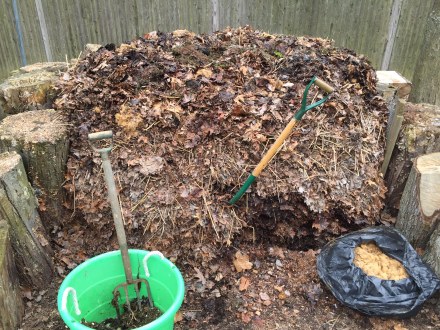

 My Pile