My Pile: Fire Works

I return home from work early this afternoon. It’s a getaway Friday, before the Fourth of July holiday weekend. I’m hoping to take a long overdue walk at the beach after work, in advance of the next night’s big fireworks display at the local beach, which each year attracts thousands of people.

First, I head out to the shed to grab the plastic barrel. Though the long hot days of summer have slowed the growth of grass in my yard, they’ve also warmed the shallow waters of the nearby Sound, leaving the local beaches awash with seaweed. I know from years past that the town tidies up the beach before the fireworks by dragging a mechanical sifter across the sand. I hoped I’m too late to do some beachcombing of my own.

The lawn is awash in blooms of white clover flowers, which I’m happy to leave uncut for the bees to sup upon. I don’t know how much more fresh hot “greens” my pile needs, but I like the idea of finishing off my pile as I started it – with “the best fertilizer there is” – seaweed from the beach.

As Mike McGrath writes in the “Book of Compost,” “Seaweed contains trace elements, micro-nutrients and plant growth compounds you’ll never find in any chemical fertilizer – or even in most organic ones. Research performed at Clemson University found that seaweed contained at least 70 trace elements vital to plant growth – in just the tiny amounts plants like best.

The plant-growth compounds in seaweed can speed up flowering and fruit production and help plants better resist stress—especially the stress of cold weather … . Seaweed can really boost yields as well—one study found that seaweed-fed plants produced a third more tomatoes than non-seaweeded plants; and in another study, seaweed increased strawberry yields an astounding 133 percent. Yow!

After my stroll along the sand I haul the barrel out to the high-water line and scoop up a load of rotting, pungent seaweed. I top off the barrel with a heaping of old seagrass stems, chopped by the surf into tangles of short, hollow straws. Once buried deep in my pile, the pixie-sticks of seagrass will also help aerate the innards and regulate the final decomposition of the compost.

“You want some heat,” advises Stu Campbell in “Let It Rot,” who adds, “heating can be tricky if it gets out of control. Earthworms are killed at 130 F, and they will not stick around and endanger themselves for very long in temperatures that even approach that figure. Azobacteria, the precious microorganisms that transform nitrogen gas into a form that plants can use, are killed at temperatures above 160 F. Excessive heat is far more dangerous than no heat at all.”

As I plan to use this year’s batch of humus to invigorate my lawn, I want all the nitrogen I can beg, borrow or steal. That’s one reason I’ve let the clover grow in patches across the lawn; their leguminous roots help lock up nitrogen. I can tell my grass could use more nitrogen – the patch of thick green grass below the hanging bird feeder tells me that. A winter’s worth of bird droppings has been well-received. And though my lawn could stand for mowing, I decide to wait, after seeing more bees than before hovering about the clover flowers that are springing up across the lawn. Besides, it’s more fun to walk the sea shore than the backyard behind a mower.

Returning home from the beach with plenty of daylight left, I find that my across-the-street neighbor, Craig, has mowed his lawn and heaped the grass clippings at the base of my pile. I set about my evening chores to mix in the grass and the seaweed, along with a week’s worth of kitchen scraps, into my pile. Having excavated the left side of my pile a week ago, today it’s time for the flip side.

As I prepare to dig into the right side of my pile, my neighbor Chylla comes by with a special request that makes the job easier. After several years of talking about creating a garden in her own yard, she has finally done it. She walks me to the side of her house, where she has dug up the ground along where the fireplace chimney, painted white, rises from the foundation. A small pile of unearthed shard of clay pots includes a set of horse shoes, crusted with rust. No doubt the play set had been set aside many years ago, and then lost to weeds and time.

She has already planted free seed tidy rows of baby swiss chard and spinach, and nearby are various pots containing herbs — I see sage and rosemary — which she wants to plant in the freshly dug ground.  It will make a fine kitchen and herb garden, but what it needs now is a generous helping of compost.

Wheelbarrows of raw compost from my pile make a welcome addition to my neighbor's new garden.

Wheelbarrows of raw compost from my pile make a welcome addition to my neighbor’s new garden.

It’s only fair: For years my pile has thrived on the voluminous scraps from her home-cooked kitchen, as well as raked leaves from her bare-swept front yard. In return, she has an open invitation to gather fresh pickings from the garden, and does so on a daily basis. But until now, aside from a few plant containers and clay pots to fill, she’s never had a place in which to share compost from my pile.

And that, I have in spades. Returning to my pile, I haul out the wheelbarrow and set in front of heap and plunge into the right front corner with the manure fork, turning out cavalcades of dark, rich proto-humus. My pile is more like dirt than leaves, and as with the wheelbarrow of compost I’ve already added to my own ripening vegetable garden, I’m happy to have reason to move the near-finished compost once.

I dig into the front right side of my pile, teasing out mature compost with the straight tine manure fork. The compost crumbles, and I use the spade to fill up with wheelbarrow. The only screening I do is to flick a few clumps of pressed leaves onto the top of the heap. I trundle the first load to the yard next door and spoon out compost across the new garden beds, and return twice more to leave my neighbor with her new garden beds chock-full of compost to work into the soil.

The borrowings from my pile have carved out a tunnel into the right front corner, revealing the dark inner core. To gain ready access to the cliff-face of compost along the rest of the right side of my pile I turn out the log wall, twisting and teeter-tottering them to the ground.
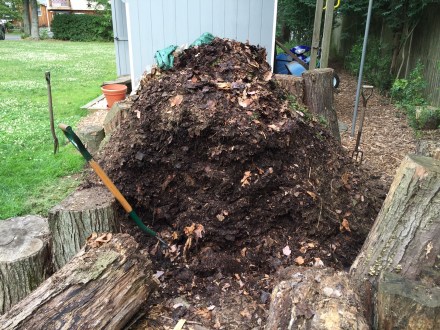
I've toppled the log walls that contain my pile to gain access to the right side.

I’ve toppled the log walls that contain my pile to gain access to raw brown material — mostly leaves from last fall — on the right side.

To slow walk my pile from one side to the other, I pull clumps of decaying leaf mold from the center of the pile up against the left side, creating space to heap more unearthed compost from the bottom right side, mixing in fresh scraps of grass clippings and pulled weeds. I use the short-tined pitchfork to tease out forkfuls of autumn leaves flecked with sand from the many loads of seaweed deposited last fall.

This is the cold-pressed part of my compost heap, which over the past six months has slowly decomposed under the press of leaves and mixings above it. I toss the cool, danks forkfuls of leaf litter across the growing mound on the left side of my pile, briefly exposing them to fresh air and sun for the first time since November before burying them anew under further heapings of more mature compost gleaned from the front and back sides. Much of my pile is now a rich mix of crumbly leaf mold and grass clippings. The few whole leaves that remain from last fall will soon succumb to the decay now going on at a fever pitch within the tossed sections of my pile.

All this work on my pile attracts the attention of my neighbor Craig, who wanders over to watch as I tuck his grass clippings deep within my pile. He volunteers to retrieve the remote thermometer sensor he keeps in the dashboard cubby of his car. He owns a foam-installation business, and uses the pistol-shaped device to measure radiant heat.

I dig out a small bore hole in the front face of my pile, and he clocks it with his temperature gun, the digital readings flicking 119, 123, 114, 124. Cool! I dig a little deeper and a 128 pops up. I fear for the safety of the earthworms but take some measure of pride in creating a hot-house of a heap.

My pile is chugging along quite nicely. Here I've clocked it at a toasty 124 degrees.

My pile is chugging along quite nicely. Here I’ve clocked it at a toasty 124 degrees.

I return to my excavations, and in short order my pile is reconstituted. The left side, newly infused with a rich mixture of grass clippings, seaweed and kitchen scraps, rises tall. The right side is a shear cliff-face of dark, rich leaf mold, which has been steadily decaying since last fall, a cold press of compost, which I’ll dig into after the next time I mow. Once exposed to fresh air and mixed with grass clippings, it will go on the fast-track of disintegration, joining the rest of the heap as crumbly compost, well on the way to fruition as humus. New soil, from old life.

As my pile burns through this combustible mix, soon I’ll trade in the pitchfork for a shovel, and my pile will be no more.

“I bequeath myself to the dirt to grow from the grass I love,
If you want me again look for me under your boot-soles.

You will hardly know who I am or what I mean,
But I shall be good health to you nevertheless,
And filter and fibre your blood.”

So wrote Walt Whitman wrote in Song of Myself.

I celebrate myself, and sing myself,
And what I assume you shall assume,
For every atom belonging to me as good belongs to you.

Do I contradict myself?
Very well then I contradict myself,
(I am large, I contain multitudes.)”


My Pile: Scratching the Surface

It’s a Friday in late June, a midsummer night’s eve to enjoy with some idle yardkeeping. In my backyard, cocktail hour is garden hour, and unwinding from the workweek by reconnecting with the ground I keep is a pleasure, especially at this time of year when the plants are intoxicated with new growth.

I stop by my pile before ducking into the shed to collect some pruning tools. I’m surprised at how little it has settled after the last big deposit and dig-out of the left side, even after a soaking rainstorm earlier in the week. My pile is in its cups as well, positively Falstaffian in its fulsomeness.

The leaf litter across the rounded surface is moist and crumbly, mottled clumps of caked-together leaves bound with layers of proto-dirt. My pile now has its own heft, and the whole lot is well on its way to recomposing itself as a matrix of new earth — humus — that I can shovel instead of pitchfork. In no small way, it’s something I don’t want or need to mess with right now. It is its own thing at the moment, a complete ecosystem of teeming life, best left to its own biological devices.

Especially when my pile is damp with rain, it takes only a scrape with a rake or pitchfork to uncover all manner of centipedes, rolly-pollies, skinny red worms and fat racers. It fascinates me to see how much life is contained within my pile, even just scratching the surface.

Each morning and evening when I let the dog out the back door, he makes a beeline for the back corner of the yard and circles around my pile. Sometimes he chases off a squirrel or sniffs out a chipmunk, but more often on these mid-summer days, morning and night, he gives flight to two or three robins that have taken to perching on the log walls beside the pile. I can see tell-tale signs that they flick about the surface of my pile, scattering flecks of leaf litter in search of easy pickings.

Not unlike the robins, I inspect the surface of my pile each time I visit, plucking out and flicking away the twigs and wood chips that continually bob up like corks to the surface. I seldom notice those woody chunks and stems when I rake up the leaves from the yard each fall. Maybe some fall directly from the overhanging maple that shades my pile; most get hoovered up when I pass the mower along the mulched garden beds. But still, these stray pieces remind me that a leaf really is just the tip of the spear, and the trees in my yard continually crop themselves by shedding bark and limbs and branches, which fall to the ground to be broken down further by hand or blade. I pick them off as a habit all through the winter and spring and toss the pieces to the side, their dark moist color standing out from bed of the sun-bleached wood chips spread between my pile and tool shed.

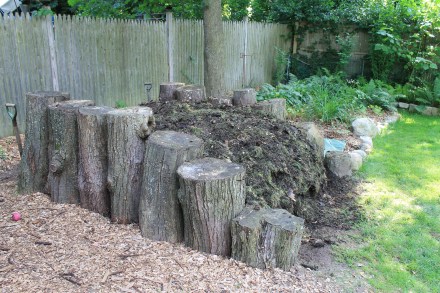
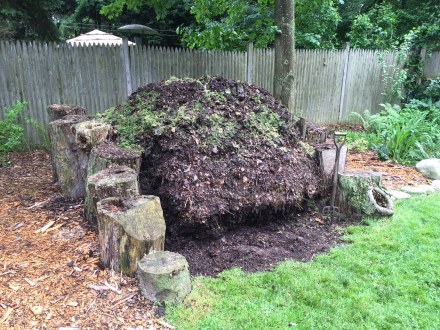
An oblique view of my pile from a couple years ago. At this point in the season it is a squat, rounded mound of nearly finished compost.

Each chip I toss aside is one less piece I’ll need to screen the finished compost come the time to disperse it across my lawn, a laborious task I rarely bother with anyway. Mostly such grooming is my way to stay connected with my pile, by hand, much in the same way I enjoy picking up seashells and curious rocks at the beach, or plucking rocks from the lawn heaved up by the spring thaw. A touch is sometimes all it takes to stay connected, bonded. Ask any chimp.

My pile gives me much pleasure, in the way that a backyard sandbox once entertained my boy, a world unto its own, full of imaginings and possibilities.

The recent hard-pounding rain has exposed, like it always does, a fresh smattering of wood chips and twigs gathered to flick away. Flotsam and jetsam from the beach constantly reveal themselves as well; the rubber heel to a flip-flop, a stretchy wristband and other scraps of plastic are tossed aside as well, to be taken back inside to the garbage can in the kitchen. Tonight’s surprise find is a salad fork, likely discarded from a dinner plate hastily scraped off by one of the neighbor’s girls and dumped into the waste bucket. Its tines are crusted with humus; I’ll stick it in the dishwasher before returning it, once again shiny and stainless, to the family next door. My pile is nearly done. I can tell that not by sticking a fork in it, but by pulling one out.

In no small way, I want to delay the end game, to string out my pile for as long as I can. Over the past six months I’ve mixed into the base heap of autumn leaves hundreds and hundreds of pounds of reclaimed green organics, from kitchen, lawn and garden, beach and barn. I’ve turned and aerated the top and front and back and left side. Next will I will plunge into the right side, squaring the circle that is my pile with pitchfork and rake.  It’s the final untouched quadrant of my pile, and once I turn it up and over, I will have handled most every inch of my pile, save for the very bottom core. Though I’ve scratched the surface of my pile through and through, deep inside it is a time capsule of compost undisturbed since late last fall. No doubt there will be new surprises to come across, along with a rich supply of humus I had no hand in making. My pile always does its own thing, and that thing is turning the rot of old life into living new soil.

I’ll harvest a small portion for the vegetable garden, adding shovels of nearly finished compost around the tomato plants and along the rows of salad greens to keep the weeds at bay and the soil from baking in the hot summer sun. The rest I will soon broadcast across the yard and mulch into the turf — a labor of love but laborious, too. And then, my pile will be no more.

So for now, I am content for my pile to stay itself, in all its glory.


My Pile: Hump Day

It’s hump day. This pleasant Wednesday evening in June marks the summer solstice as well. The Earth’s axis is now tilted as far as it can go toward the sun, which makes it hump day for the whole year. As far as daylight goes, it’s all downhill from here until the darkest, shortest day of December.

Tonight the solstice and full moon coincide—a rare event, The Old Farmer’s Almanac tells me, one that hasn’t happened in nearly 70 years. The Almanac further informs, “The month of June’s Full Moon’s name is the Strawberry Moon. June’s Strawberry Moon got its name because the Algonquin tribes knew it as a signal to gather ripening fruit. It was often known as the Full Rose Moon in Europe (where strawberries aren’t native) and the Honey Moon.”

I make hay of the longest day of the year by mowing the lawn after work, decapitating a galaxy’s worth of round white clover flowers and collecting three hoppers of grass clippings for my pile. Once again I mow around the several small island meadows left to grow in the middle of the lawn. The uncut stalks of grass have turned tawny brown and bow their seedheads with the breeze. I spot a bee or two hovering above the dense crop of clover that’s making rough green mounds of the meadows, and, nearby, a few butterflies nosing about in the garden to help with pollinating duties.

Tipping two logs to their sides gives me insider access to my pile.

Tipping two logs to their sides gives me insider access to my pile.

I consider my stout, rounded hump of a compost heap. Over the past few sessions I’ve thoroughly worked the front and back sides, strip-mining the flanks to aerate and mix it full of fresh clippings from the yard and kitchen and dried brown leaves gleaned from the corners. It’s time to shift my pile from side to side.

Having gouged out the lower corners of my pile for crumbly old leaf mold to cut the grass clippings with, I’ve already exposed most of the log walls, leaving only a reach of about three feet of untouched compost bound in by the two rows of stacked old logs.

I start in on the left side, digging along the log wall with the hay pitchfork, heaping the heavy clumps of pressed leaves onto the top center of my pile. I tease out a few pockets of tinder-dry leaves and pine needles, tossing them like confetti across the top of my pile, but most I pry out thick wads of leaf mold, damp and crumbly and well on the way to rot, which I mix in thin layers of grass clippings grow my pile ever higher and steeper.

I channel my way from front to back. My pile also feeds off the decay of the log wall that contains it, themselves well on the way to rotting. The deeper I go, the richer the compost.

My neighbor has brought by two large plant containers with the request to for me to fill so she can plant with basil. This rich dark leaf mold isn’t quite humus yet, nor a total substitute for planting soil, but will make a good amendment and filler for the bottom of these vats. I fill them near full and haul out my own wheelbarrow. This proto compost will make good top dressing for my vegetable garden. Consider it the first pour, a sample of all the humus to come.

This is the hard labor part of tending an active, hot compost heap, especially one that wanders in place. I’m happy to have to move this batch of compost only once, to my garden. I still have a lot of my pile to get into and move around, and a lot of grass clippings and kitchen waste to dispense with. It’s tough work, working in the cramped space between the log wall, to unpack the compressed leaf mold from underneath the crush of compost above it. I feel like a miner working a seam of coal, and I turn out clump after clump of peat-like proto-compost.

This where my inputs of manual exercise, my sweat equity, pay off. I divert the crumbliest to the wheelbarrow, and cast the coarser snatches across a new trench I’ve opened along the backside of my pile, mixing the cool dank mass with the week’s kitchen scraps and regular dousings of freshly clipped grass. Hump Day, indeed.

At last I create a foot-wide gap that spans the length of my pile and the log wall long stacked against it.  The left side is revealed in cross section, a thick stack of cold-pressed compost that begs to be teased out and turned. This Humpty-Dumpty of a pile needs a great fall.

I teeter to their sides two logs midway on the left side and standing perpendicular to the wall of newly exposed compost, I step in close with the pitchfork and gouge a hole starting from the inside middle. The bound layers of seaweed and leaves laid down early last fall are now compressed into a dark moist stack, like so much meat on a shawarma spit. I unbound the pressed leaf mold and turn it loose onto the top and backside of my pile.  I heap these leaves into a trench I’ve formed along the backside to bury the kitchen waste, mixing the oldest part of my pile with the newest.

I've dug a trench along the log wall that contains my pile to heap the near-finished compost on the top and back side of my pile.

I’ve dug a trench along the log wall that contains my pile to heap the near-finished compost on the top and back side.

At last I’ve chiseled deep enough into the bottom side of my pile so the overhanging matrix of leaves and past mixings collapse in a tumble. I set the two logs back in place and draw more of the newly expunged compost up against them, adding the rest of the grass clippings to the mix. I feel a bit like Beetle Bailey, digging a foxhole only to fill it back up.

With the rise of the full Honey Moon nearing, I scrape the last of the grass clippings from the front of my pile and toss them over the top and left flanks. I’ve carved out about a third of the left side of my pile and much of the backside, and backfilled it all with tossed layers of rotted leaves, fresh grass clippings and kitchen scraps. My pile now a slightly lopsided version of its former self, leaning to the right, though taller and much suffused with air and freshly mixed compostibles. It turns out you can put Humpty-Dumpty back together again, after all.

Rain is forecast for the weekend, which I hope will slake my pile’s thirst and ensure a further crop of lush green grass. The next time I mow the lawn and dig into my pile, it will be from the right side. Only the very bottom center of my pile will then remain untouched, as all else above and around it has been revealed and mixed into a mulch of old brown and new green, churning and burning with a hot riot of bugs and bacteria and all the other creative acts of biological decomposition. My pile is over the hump, and well on its way to fruition.


My Pile: Brush Off

Returning home to coastal Connecticut from drought-stricken Southern California, I’m struck once again by how lush and verdant this well-watered corner of southern New England is, especially in mid-June, the height of the growing season.

That happy fact brings my outdoors on a lengthy evening mid-week to tackle a related and recurrent backyard chore: pruning the bountiful growth of the shrubs, bushes and small trees that populate the property. Properly spaced and prudently tended, these plantings make up the bones of the classic suburban landscape. Among other attributes, they create a beautiful, shady backdrop for the flowering annuals and perennial plantings, provide screening from the street and neighbors and offer a wealth of food and shelter for all kinds of backyard birds and critters.

Left unchecked, this under story of big bushes and small trees would in a few short years overtake the property, turning it back into the state I found it 10 years ago: An uncivilized briar patch of brambles and brush and vines, all scrambling to crowd each other out.

The dynamic — some would say romantic — tension between chaos and cultivation in the garden was perhaps best expressed by Vita Sackville-West. As Sarah Raven writes in “Sissinghurst,” her biography of her mother-and-law and the garden she created from the ruins of an Elizabethan estate in the south of England, “Vita loved her borders to be packed. She hated the sight of too much mulch, criticizing Edwardian rose gardens with their ‘savagely pruned roses of uniform height, with bare ground in between, liberally disfigured by mulches of unsightly and unsavoury manure’.

“An enchanting garden like Sissinghurst is, I would say, at its most beautiful at precisely the point where its informality is about to tip over into chaos. I am with Vita and her desire for sprezzatura — a studied nonchalance, a balance of formality of structure with informality of planting.”

So tonight I browse across the yard with clippers in hand to help guide the growth of yard’s shrubs and bushes, pruning, tidying up the property and freeing up time for the coming weekend, Father’s Day.

Like parenting, pruning generally follows fairly well-established guidelines, in terms of where to cut, how much and when. I start tonight’s session with one of the more straightforward pruning tasks: Cutting the old-wood stems from the hydrangeas that bloom big and bold each summer. The bases of the plants — I have three in the perennial garden — are thick with fat green leaves emerging from the bloom buds. But rising from each plant are dozens of old-wood stems from last season, a thicket of stout, two-foot tall hollow shafts that end sharply with cuts from when I dead-headed the big blue flowers last fall.

Just the other day my son proudly showed off the scars he’d collected over the years; one a lasting scrape on his kneecap from falling off his bike, and another a puncture wound on his calf from trying to jump over a neighbor’s oversized hydrangea while playing some game of tag with with an older boy, which I’m reminded of as I snip off the dagger-like pickets of old wood.

A view of the side of the backyard, looking over the neighbor's hydrangea to the forsythia hedge along the street. In the shade of the maple tree is a growing pile of brush to be hauled off to the town yard-refuse dump.

A view of the side of the backyard, looking over the neighbor’s hydrangea to the forsythia hedge along the street. In the shade of the maple tree is a growing pile of brush to be hauled off to the town yard-refuse dump.

Tending a backyard, a garden or a compost pile is very much a paternalistic exercise. My goal to raise a yard that is sturdy, strong and resilient; one that is a product of its environment, yet individual, a unique creation that I can be proud of having nurtured along and to seasonal fruition, one that is not a danger to itself of others.

Though I prune with some impunity, to tidy things up around the edges, or remove a limb hanging over the house or power line, the backyard is shaped in its own image. It’s still thick with invasives that planted or took root long ago and that through pluck and perseverance, have become tolerated, even accepted, permanent residents of the local landscape. “It’s my nature, and I’ll do what I want,” the backyard continually reminds me, if not insists. I’ve grown to admire the scarlet show of the burning bush in autumn, and the edgy show of its angular branches in winter. The white blooms of the privet in spring are fragrant; the birds feast on their purple berries as they ripen over the winter. The yew and japonica alongside the house, likely planted by the first homeowners 50 years ago, have grown thick and massive. Each time I prune their tops and side branches that scrape against the shingles I have to take care not to disturb the two or three bird nests hidden within them.

These naturalized citizens of the backyard are especially profligate in their growth, in branching out toward the sun, in sending up suckers from the trunk, in seeding, by self and with help from birds. Regular weeding and pruning keeps them in check, and through the year I gather armful after armful of stemmy dead twigs and sweeping new branches. Hard to say what I pick up more after: My 15-year-old son or the plants, bushes and trees of the backyard.

Even the native shrubs and foreign ornamentals I prize as specimens need their growth guided by saw and shear. The rose of sharon I planted as sprigs near 10 years ago require reining in each spring, or else will flop over with the weight and drama of their late-summer blooms. Same with the fragrant lilac that grows outside the back door.

Early each spring I snip the flowering tops to capture their aromas in a vase indoors, but still it grows scraggly. A thunder shower passed earlier in the week, causing a main branch of the old lilac to droop over the limestone step of the stoop that leads to the kitchen door. I lop off the limb and trim the suckers at the base and add the lot to the brush pile I keep in the back corner of the yard, tucked under a maple tree beside the street.

Made up of all the branches and yard trimmings I drag to the curb for disposal, twice a year or so the messy sprawl grows to rival my pile in size. The tall trees that lord over the property shed bark, twigs and limbs with every storm, and after each I sweep the yard clean of the wind-blown debris. Today’s brief squall also brought down a thigh-thick stump of a branch from a maple beside the driveway. I could have sawed it down before, but left the snag aloft. It was riddled with holes made by the woodpeckers that picked at it for grubs. I drag it off to the brush pile as well.

I’ve thought keeping this refuse on site, perhaps by creating a second compost pile to serve as a starter for the next year. But backyard space is limited, as is my time to spend harvesting and recycling all the more readily compostible organic matter that my suburban yard produces each year. I could use the leafy branches whole as the bottom layer of next year’s pile, but know I’d be picking the woody stems out of my pile all through the next season, cursing as they tangle themselves in the tines of the pitchfork. I suppose I could chip the sticks and branches by purchasing or renting a shredder, though that’s a commitment and expense I’ve never been able to justify.

(I’m fascinated to learn that some English gardeners save the clippings from English yew (Taxus baccata) to donate them to companies that produce Taxol, an anti-cancer drug. “The potent medical effects of Taxol weren’t discovered in the West until the 1970s, though native American Indians had been using the bark of Pacific yews (Taxus brevifolia) for generations to treat ailments as diverse as rheumatism, scurvy, and lung and bowel complaints,” writes Sarah Raven.

Would that I could. I do whittle away at the brush pile through the fall and winter by breaking some of the the limbs and dead wood over my knee and burning them in the small firepit in the corner of the back patio. We make a special bonfire each January with the crackly remains of the Christmas tree. I add the ashes to my pile or cast them across the yard.

But when the stack of limbs gets big enough to cause me worry about it becoming an eyesore, I borrow the neighbor’s pull-behind trailer, a ramshackle contraption of plywood and rust, and haul the tangly mess off to the town yard refuse center behind my SUV. I make couple trips a year, usually one after this pruning of spring growth and another, in the fall, to tidy up the yard after a season of fulsome growth. Then there’s the occasional Nor’easter, a limb-snapping early snowfall or other weather calamity that requires a special cleanup. Nature culls as much from my backyard as I do.

The brush and tree trimmings I drag to the side of the road and haul off to the town yard-refuse dump.

The brush and tree trimmings I drag to the side of the road and haul off to the town yard-refuse dump.


But, yes, I prune. It’s a discipline, and disciplinary. After ordering my son off the trampoline in the backyard and inside to study for his final exam of the school year — which, coincidentally, involves writing an essay on Lord of the Flies, I tackle my biggest pruning project of the day, and the year: The long row of forsythia bushes that extend from each side of my driveway and along the street. (The main difference between gardening and parenting? The limbs you seek to prune don’t talk back…)

The hedgerows serve to give my yard privacy, especially in summer, when the green screen is thick enough to snag wayward frisbees and tennis balls. In winter, the hedgerow harbors flocks of sparrows, which use the bare branches as jumping off points for the nearby bird feeder. And in spring, its bare branches burst with electric-yellow flowers. But what was then a fairly uniform mass of plant has grown into a spiky riot of green shoots that angles every which way. It’s like the hair on a cartoon figure plugged into an electrical socket.

Trimming the forsythia hedge that shields the backyard from the street. In the distance is the brush pile I keep in the corner of the property.

Trimming the forsythia hedge that shields the backyard from the street. In the distance is the brush pile I keep in the corner of the property.

The untrammeled growth juts out into the street, blocks the street sign and thrusts upward into the lower branches of a young oak that I planted as an acorn in the wood chips on the lawn side of the hedge. I trim the forsythia with a pair of shears, selectively picking limbs to trim by hand. It requires extra effort, but I like the exercise for my hands and arms, and it keeps the hedge prim and proper in a natural, free form sort of way, not scalped roughshod by a mechanical trimmer.

I strive for a light touch to pruning, favoring a more natural, almost jungly yardscape. My backyard is no poodleized version of a topiary garden. Like my 15-year-old son, I keep most of the plantings on a long leash, and allow them to grow on the wild side, while trying to maintain some sense of order. Put another way, my backyard ideology is a mash-up of Father Knows Best and any of dimwit dad sitcoms you now see on TV. It’s a nature vs. nurture struggle for control that has played out over the centuries:

“The image of man’s dominion over nature is deeply rooted in Western thought,” I read in a paper by Eleanora Montuschi, a professor at the London School of Economics and Political Science, “Order of man, order of nature: Francis Bacon’s idea of a ‘dominion’ over nature.”

“It first appears, in different forms, in the Book of Genesis. It also reappears as one of the leading images of the emerging ‘new science’ in the 16th century…. Over the ages, Western thought has been variously concerned with the image of the ideal garden. At the same time, it has been rather eclectic in its illustration of what constitutes such an ideal. If we look, for example, at the planning and construction of gardens in the 17th and then 18th/19th centuries, we will soon and vividly appreciate these differences in conception.

“Starting from the 17th century, gardens were then designed as geometrical spaces. Plants and bushes were cut into triangular, spherical, conical, and pyramidical forms. Sometimes they were shaped as animals or human beings. In other words, nature was altered by imposing specific forms over her spontaneous ways of expression.

“Instead, in the 18th and nineteenth centuries, gardens were conceived in view of complying with nature. Nature was to be allowed to express herself in her own forms: she was at most to be ‘perfected’. An idea (or ideal) of cooperation between man and nature replaced the idea of human calculated planning and imposition of an external order on nature. Man was to improve on, not to transform, nature – that is, he was simply to respect whatever form nature might happen spontaneously to suggest.

“According to the former ideal, man is encouraged to think of himself as a conqueror of nature, as someone who succeeds in imposing an order over natural wilderness. According to the latter ideal, man appears rather as an ‘executor’ of a pre-given natural order, an order which at most needs to be brought to completion.”

That about sums up the duality of gardening and parenting: striking the balance between being a control freak to maintain order and letting things develop with a gentler guiding hand.

Nature, like a child, will always find a way to express itself, fully in “her own forms” and in keeping with the soil in which its offspring is nurtured and under the sun that shines upon them. The day I asked my son, “Do you want me to tell you what to do, or do you want me to let you make your own mistakes?” and he answered, “I’ll make my own mistakes,” was the day I realized I could no longer much “prune” him. And everything (I don’t recall what, exactly, mistake we were talking about) turned out fine.

Pruning, like raising a child, is about guiding growth in the right way, with a fair amount of culling in a never-ending pursuit for some sense of order and control. It’s also about knowing what not to cut. A plant doesn’t talk back to you when you prune it, which appeals to the parent-gardener in us all. An ill-treated plant will let you know when you’ve done it wrong. I still miss the thriving butterfly bush that I incautiously pruned at the wrong time of year; the next season it sprouted just a few meager branches, and this year refused to come back at all. Sometimes Father doesn’t know best. Earlier this spring I dug out the stump and added it to the brush pile.

Pruning, and parenting, is about letting go, and recognizing that not everything will fit into a neat package, or my pile. The truth is messy, a writing professor once told me, as is raising a child or tending a garden. The tangled stack of brush I leave at the side of the curb is ample evidence of that.

But both child and garden tend to work out as long as you keep serious problems from taking root, prune when necessary to help guide growth, ensure sufficient food and water — and always add as much compost as you can.

My Pile: Packed

Tomorrow I fly to Los Angeles for a long weekend to take part in the celebrations of my goddaughter’s college graduation and the high school graduation of her younger sister. The eldest girl was just a baby when I moved to Connecticut nearly 20 years ago, and I’ve tried to stay as close to the family as possible, given the continent that now lies between us.

Four days of intermittent rain has given way to sunshine, and getting home from work I debate letting the grass grow until I get back. It will be a jungle by then, and rain is forecast to start the coming week, but I’m inclined to put off mowing. It hardly needs it, as I don’t mind a shaggy yard or setting the mower on high. Besides, I have yet to pack, lock in care for the dog and cat and otherwise prepare to be gone from my house for the next few days.

Tidying up my cubicle prior to taking off from work, I’ve brought brought home a black plastic bag of shredded office paper that I keep under the desk. It’s now full, and I head out to the tool shed to set it inside, planning to add it to my pile with the grass clippings I gather upon my return.

Hanging from the handle of the tool shed door is a groaning plastic bag full of rotting food. I look inside to see half a watermelon gone bad, a dozen puckered-up Red Delicious apples and assorted other moldy fruit. I remember that a friend who lives down the street is moving, and had mentioned he needed to clean out is fridge.

I can’t find a spare bucket or bin with a lid, as my back-fence neighbor does, to stash the stuff. For a moment I consider adding the donated fridge leftovers to the compost bucket my back-fence neighbors keep and which I take off their hands, but pawning off such a cornucopia of spoiling fruit, even temporarily, is an odd bit of regifting, even for me.

My pile’s far enough along that I could simply dig a fence-post type hole to bury the rotting fruit, but then I spot the heap of grass clippings along the backside. My across-the-street neighbor has mowed his lawn and given me his clippings.

My backyard is neighborly. In the foreground is Craig, who loads me with fresh grass clippings; Don cleans out his fridge and gives me the leftovers, and I share my garden bounty with the family next door and in return get their kitchen scraps and rabbit hutch gleanings.

A view from my pile of a neighborly backyard. In the foreground is Craig, who loads me with fresh grass clippings; Don, on the patio, gives me leftovers from his fridge and feasts; and in the garden are Chylla and her daughter Katlina, with whom I share my garden bounty and in return get their family’s kitchen scraps and other compostibles.

So I decide to give my lawn a quick mow, figuring I’ve got just enough daylight to collect a bag of clippings and make an impromptu insertion to my pile with my collected recyclables before I go away.

If not a true pet — I often treat it like one — my pile and the care and feeding and tending I lavish upon it and the suburban backyard that supports it, certainly makes it my pet hobby.

The dog, as usual, torments both the mower and me, setting his tennis ball in its path. It’s a game of chicken we’ve played for years, and now I’ve mostly trained him to set the slathery ball in the just-cut grass for me to retrieve without pausing, to toss it again.

I stop twice to empty the grass catcher of its load of clippings and tree dander, adding the loads to the collection of grass left by my neighbor with the lawn on steroids and leaving behind a thick trail of clippings. After about 40 minutes of fast-paced mowing, the lawn is once more clean-cut.

I have about an hour left of daylight to work my pile. After excavating and then filling the back and front with the past two loads of grass clippings and kitchen recyclables, I consider tackling one of the sides. But that would require more effort. So I quickly carve out a wide hole in the top, sprinkling grass clippings as I excavate the rich moist leaf litter outward to the sides. Like a miner following a vein, I tunnel deeper in two spots toward either side, teasing out the compacted leaves of winter.

The bottom corners of my pile hide reservoirs of dried leaves to mix with the freshly cut grass.

The bottom corners of my pile hide reservoirs of dried leaves to mix with the freshly cut grass.

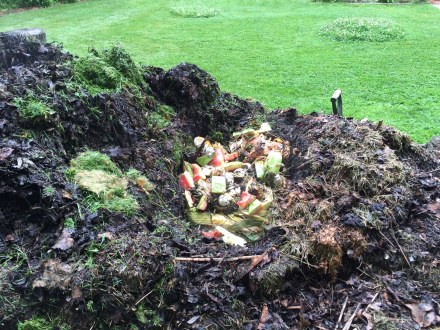
Stopping about two, three feet down, I toss in the stemmy cilantro that grows like weeds throughout my kitchen garden, then add my friend’s fridge clean-out, not bothering even to chop up the foot-long wedge of past-prime watermelon. I scrap a layer of wholish leaves from various spots around the outer perimeter of the pile, depositing them on top of the kitchen slop, add another layer of fresh grass clippings, then spread a blanket of the bright-white shredded office paper. I repeat, upending my own kitchen bucket, and mix it with more old leaves and new clippings, and top it off with the rest of the paper shreds.

To back fill, I borrow wholesale from the bottom front and back of my pile, loping off the steppes front and back to layer the clippings and waste. Having aired out over the past couple weeks, this crumbly mix of leaf mold makes a fine, breathable lid over my pile.

My pile is now packed for the long weekend, even if I am not yet. It now almost teeters in its verticality. I’ve taken my pile as far as it can go front and back; next I will work my way into the dark center from the sides.

My pile, packed high with the latest stuffing of compostibles.

My pile, packed high with the latest stuffing of compostibles.