My Pile: Cover Crop

My pile continues to surprise me. Yesterday I stuffed it anew with fresh grass clippings and food waste from kitchen, as well as a risky batch of near-rancid seaweed from the beach.

I turned its inner reaches to aerate it as best I could, resculpting the tumbled outer walls to pile snatches of dry brown leaves from the edges and backside  to the top, as you’d add an armful of kindling to stoke a smoldering fire. Tucked deep inside the fulminating heap are six months worth of compostibles, hundreds of pounds of nitrogen-rich greens and grinds and a grab-bag of dead and decaying organic shreds and scraps, clippings and cullings, and other windfalls to be recycled into new living soil.

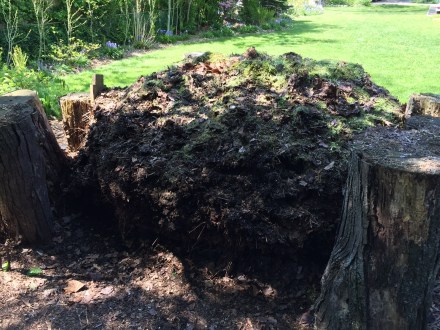
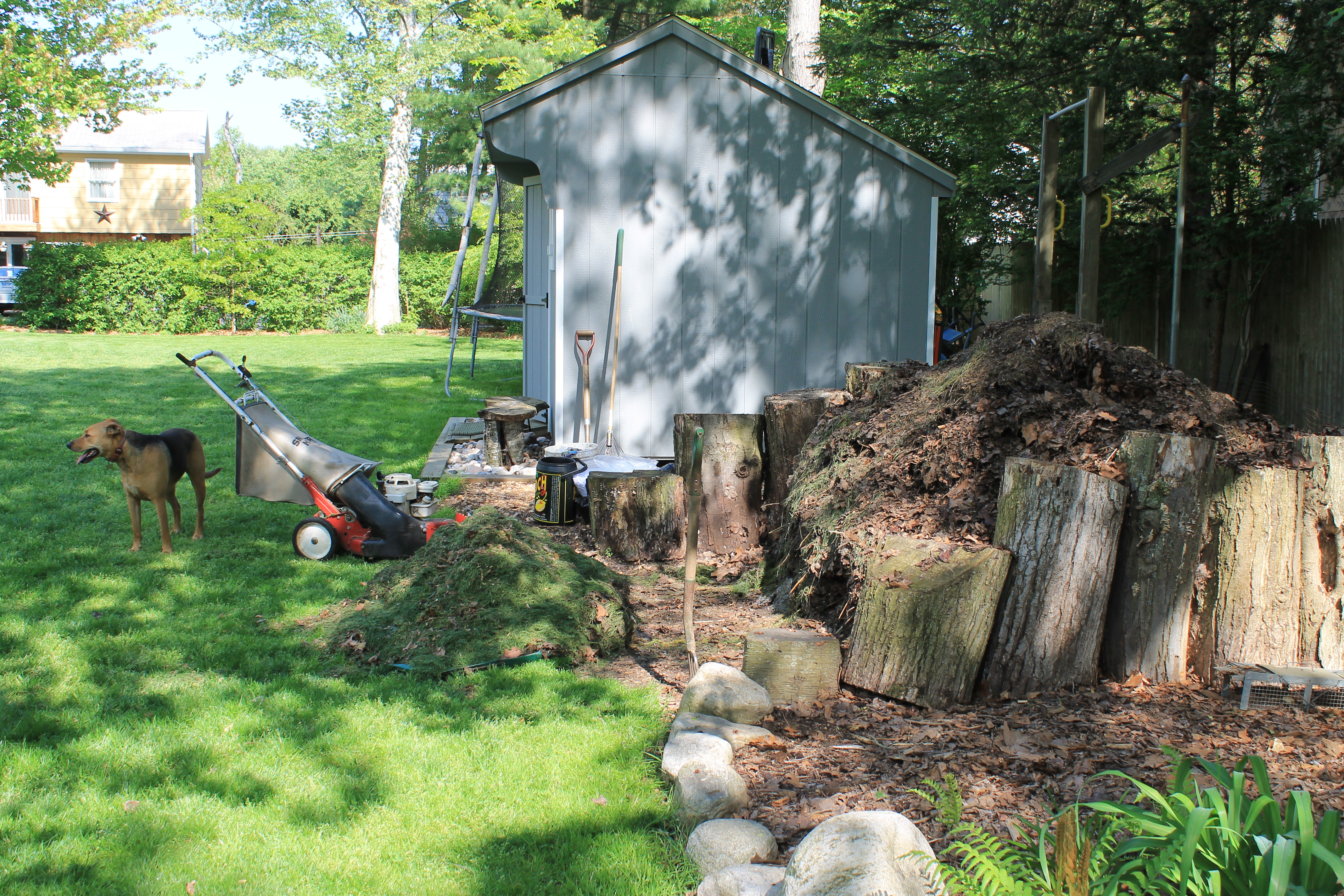
My pile began as a sprawling mess of loose leaves that spilled over the log walls and pressed against the wire fence that sought to contain it. Every few days I scoop out its middle, add more glugs of stuff and gulps of air to my pile and fluff it back up. Now, when I look at my pile, I see a 20-foot tall pyramid of compost pressed down by time and gravity and rot into a stout stack four feet tall and twice as wide, front to back and side to side.

The word “sarcophagus” derives from the ancient Greek words for “flesh-eating” and “stone,” and came to refer to a particular kind of limestone that was thought to decompose the flesh of corpses within it. That’s what my pile is, a crypt that encloses, and decomposes, the remains within.

Yesterday I gave up on my pile. Like a tomb-robber, I sought to raid the riches it secretes. I know it’s in there; but it’s just out of reach. The sarcophagus that is my pile seems more Chernobyl-like, an impermeable shell. Behind that containment wall is not yet “afterlife,” but matter measured more by half-life. Apparently the buried remnants are not yet decayed enough to use as I’d hoped, as finished compost to add to the just-planted vegetable garden.

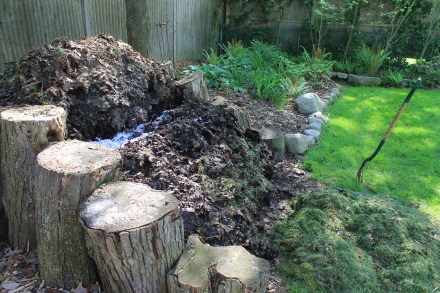
That was then. This morning I visit the backside of my pile and discover that a cleft in the backside wall has calved off and spilt itself in a cascade of mint-conditioned compost for the garden, right at my feet. The tomb has cracked open, just a bit, to provide me an offering that is as unexpected as it is welcome. I can only surmise that after all my digging under and around the rear edges and bottom row, I’d stopped just short of uncovering a pocket of cooked compost hidden just behind the thin wall of pressed leaves it contained.

Overnight, my pile has breathed and coughed up a supply of ready-made compost, in just about the exact proportion as what I need for top dressing among my rows of newly planted vegetables and herbs. Humus, like hope, springs eternal.

I scraped away the raw backside of my pile, and divulged a pocket of near-finished compost for me to add to the vegetable garden.

Unbidden, my pile has divulged a cascade of near-finished compost for me to add to as top-dressing for the vegetable garden.

After scaring away a robin and two grackles that have come to feast on the unearthed deposit, I bend over to examine the scree more closely. It’s pockmarked with seashells, so it must be from a pocket of seaweed I’d added to my pile last fall. I also spot a flat mosaic of eggshell, its crushed fragments still connected by the membrane. I toss it back atop my pile, along with a shard of avocado husk, still clinging to its stick-on sku label. I pluck a shiv of tree branch and a wood chip or two and toss them aside. A fragment of horseshoe crab shell goes back into my pile as well, along with the dozens of red worms that cling to the loamy earth tucked inside its carapace.

The clutched layers of rotted leaves strewn across the ground are likewise rife with red worms. The stoutest chunks I toss atop the pile, but there’s enough thick, dark, crumbly proto compost let loose by the avalanche to scrape up with the pitchfork and fill the wheelbarrow. Tossing the lot into and against the metal walls of the well is enough to fracture clumps into shards. I finish by scooping up the crumbly rest with the garden spade, and trundle the heavy load of moist, dark organic matter — new soil — across the yard and through the wired gate fence to my vegetable garden.

Famed garden writer Vita Sackville-West mused about the ideal recipe for top-dressing and potting soil: “Goose guano and the soil thrown up my moles both had their advocates” in the eighteen and nineteenth centuries. “Today, the John Innes compost is recommended: two parts sterilized and sifted loam, three parts peat, two parts sand, to which you may add an ounce of hoof and horn per bushel, and some crushed charcoal.”

I shovel my own special recipe of compost, sans hoof and horn powder, in and among the recently planted tomatoes and basil, and along the rows of sprouting lettuce, arugula and kale, which I’ll soon have to thin. I lift up the elephantine leaves of the rhubarb to spoon more compost underneath, close to the ruby-red stalks, which look just like celery.

I tuck more compost around the self-seeding flowers that are growing tall enough for me to recognize form weeds and leave be: the cleome, coreopsis and coneflowers. I keep a mental map of other recent plantings in mind as I shovel more compost across the bare ground. A neighbor has brought by a bag of potatoes from her cupboard, pockmarked with pale sprouts emerging from the eye buds. I’ve planted a few cut-up wedges in the loamiest part of my garden and will add the rest of the bag of wrinkled, sprouting potatoes to my pile.

I’ve taken the soggy egg carton from the window sill in the kitchen and transplanted the tender shoots of corn, peppers and cukes sprouting in the 12 little cubicles. I’ve also poked holes in the loamy soil nearest the fence poles with my finger and placed a seed a piece from the crinkled pods of runner beans and sunflower seeds culled from last season’s harvest.

Another neighbor came by to share a bag of gladiola bulbs, given to her by her daughter for Mother’s Day. She didn’t have space for all the bulbs, and I take several handfuls to bury with the trowel in the corners of the vegetable garden, figuring the deer would snack on any I plant outside the garden fence. These patches I cover with the last few shovelfuls of compost and hope for the plants to emerge from underneath in due time. Top-dressing a garden bed provides cover from weeds, while allowing these more vigorous plantings to sprout. Other benefits are more long lasting.

“In gardening, many products are called organic matter,” I read on Cornell’s School of Horticulture‘s gardening resources website. “Often such products are composted, rather than used directly, and the compost is used in the garden. Compost can be made at home from kitchen, garden, and yard wastes, or it can be produced by an industry or local municipality.

“Organic matter is used in the garden and landscape for many reasons, beginning with its effect on soil structure. Organic matter helps soil particles bind together into aggregates, or clumps, which makes it easy to dig or penetrate. We often call this quality tilth. In this way, adding organic matter helps all poor soils, whether they are too sandy or made of too much clay. A soil with good tilth also has good nutrient-holding and water-holding ability.

“In addition, organic matter improves soil by stimulating or feeding the life of the soil. It provides nutrients to bacteria, fungi, earthworms, and other organisms in the soil, which in turn recycle the nutrients into forms that are readily available for plants to absorb through their roots.

“Organic matter also helps to prevent soil and wind erosion by binding sandy soil particles together. Organic matter also prevents caking, cracking, and water run-off that occurs when clay soil dries out. Experienced gardeners often consider soil building or soil re-placement, i.e. bringing in and incorporating organic matter, nearly half the work of gardening.”

A top-dressing of fresh humus looks tidier, too, almost a crop of its own, but there are some caveats to amending garden soil with raw compost. More from Cornell: “When immature compost is added to the garden, its bacteria compete with plants for nitrogen in the soil. The result is unhealthy plants with symptoms such as yellow leaves or stunted growth. If compost is still hot, smells like ammonia, or you can still recognize the original form of organic matter, then it is not ready to use. When in doubt, let compost mature longer.

“Compost made from food (fruits and vegetable scraps, fish residues, coffee grounds, brewery and bakery wastes) is typically richer in nutrients, but may have high salt content. Soluble salts are actually chemically charged particles (ions), usually from dissolved fertilizer and irrigation water, but may come from the composted material itself. While not a human health concern, concentrated soluble salts can cause problems in plant growth.”

Points well taken. I finish by unspooling the garden hose to douse my garden and compost. The tender plants can use  a drink and watering in the compost will allow it and those living things it contains to meld with the soil it’s landed upon. It may also dilute any excess of soluble salts, especially from this particular batch of seaweed-enriched compost.


Richly alive and loaded with nutrients, this top-dressing of fresh compost will be a boon to the vegetables and herbs rising in the garden.

Richly alive with bacteria and microbes and loaded with nutrients, this top-dressing of fresh compost will be a boon to the vegetables and herbs rising in the garden.

Over the years I’ve added many inches of new earth to these raised beds by trucking wheelbarrows full of compost from my pile, so much so that I’ve had to raise the pavers and untreated lengths of lumber that give it structure. A square piece of ground that fills in a corner of my house, the little fenced-in plot was once a unused and unloved patch of weeds; the ugly backside of the property. It is now a highly productive private nook that grows dense with fruits and berries and greens to pick for much of the summer.

There’s a direct link between my pile and this garden, and after covering it once again this spring with a crop of fresh compost, I walk the empty wheelbarrow back to its resting place behind the shed next to my pile. There is more to come from my pile, that’s for sure. It truly is the gift that keeps on giving.


My Pile: Lord of the Flies

My pile remains a work in progress. I dig into it today, the second Sunday of May, with the need to dispense with the regular compostibles and add those nourishments to its rotting bulk, but also with the hope of harvesting a measure of more finished compost as top dressing for the newly planted vegetable garden.

It didn’t turn out the way I expected, and that has me and my pile thoroughly bugged.

I start with the hay pitchfork, pulling a row of ashen-white clumps of fermenting grass clippings a week old, mixed with the rotting leaves of last fall, forward along the sagging front, which has been soaked by recent rains. Behind this new bulwark is a smoking trench of smoldering organic stew. The herbal exhaust released by my diggings is pungent, earthy and gives me a whiff of a memory of the barley-drying room of a distillery I once toured among the peaty moors of Scotland. The sweet ferment is just on the edge of intoxicating and revolting.

My pile is rather like a moonshiner’s still, a backyard distillery for making terra vitae. I plunge the pitchfork deeply into the mix, giving gulps of oxygen and creating space for the next mix of freshly rotting ingredients and gathered snatches of old leaves from the edges of the heap.

I have a week’s worth of scraps from the kitchen, my neighbor’s grass clippings, a few days old now and soaked by rain. I’ve also brought home a bucket of seaweed from the beach. The recent rains that have saturated my pile and garden came with a storm that also piled up thick mats of seaweed at the high-water mark. It seemed a shame to let it go to waste, so I put the plastic barrel and three-pronged hand rake in the back of the SUV and swing by the beach for some compost beachcombing.

It’s a scavenging trip I may regret. The seaweed has baked into a crusty film covering a green slime of jello-like consistency that is flecked with wriggly, white rice-husks of beach-fly larvae. It’s downright revolting. I considered aborting my mission, but scrape up a half-bucket full and haul the barrel back to the car. The extravagance of the seething riot of life and rot was compelling, though making the short drive home without gagging on the putrid stench was touch and go. Both the dog and I leaned out the windows for fresh air.

I admit to stretching the capacity of my pile to absorb such magnificent rot. I add the putrefying seaweed to bottom of the newly excavated pit, tossing in the food scraps from the kitchen and mixing it with the decaying grass clippings and  leaf mold. I bury it all further with layers of fresh grass clippings from my neighbor and heapings of dried leaves excavated from the back side of my pile. I wager that the larvae will be cooked and consumed before hatching and emerging to plague me.

“One of the most important problems in composting is controlling flies,” I read in Compost Fundamentals, a website maintained by Washington State University’s Whatcom County Extension. It seems a good time to consider the issue, for the prospect of tending a backyard compost heap only to have it serve as a breeding ground for nasty nuisances like flies is no doubt a top concern of any composter. Here’s more from the ag experts from Washington State:

“Fly breeding can be controlled in composting operations during the fly season, with little more effort than is normally necessary for good sanitary composting….However, much of the material is infested with eggs and larvae in various stages of development, sometimes even at the pupal stage, before arriving at the compost site. Therefore, material must be prepared immediately for composting and placed in compost systems where high temperatures and environmental conditions are unsatisfactory for continued emergence of flies.

“The predominant species of flies encountered in composting will vary with the area and with the type of material. The variety of materials available for composting offers satisfactory breeding conditions for many different species, but generally speaking, the compost operator does not have to worry about the particular species, since the most satisfactory control measures in composting apply equally well to different species.

“Some procedures, particularly grinding, turning, and systematic cleanliness, which are useful in providing compost of good quality and in destroying parasites and pathogens, are also effective for controlling flies. Initial shredding or grinding to produce material more readily attacked by bacteria also destroys a large number of the larvae and pupae in the raw material. Also, the texture of material shredded to a maximum size of 2 inches is not as suitable for fly breeding.

“Studies at the University of California on mixed garbage and refuse demonstrated that after raw material containing considerable numbers of eggs and larvae had been ground and placed on the pile, no fly breeding took place using normal composting procedures of turning every 2 to 3 days. Apparently, the destruction of the larvae by grinding, mixing, and the structural changes caused by grinding, results in garbage that is no longer attractive to flies. Heat quickly generated in compost piles effectively stops flies breeding in refuse containing a considerable proportion of garbage.”

That’s my plan, at least, and I’m sticking to it. Some avid composters even seek out fly maggots to add to their compost. A google search turns up a Flickr account of images from Glenn Cantor, a self-described “skeptical optimist” from Princeton, N.J., who uses soldier maggots to make what he describes as the richest compost.

These soldier fly maggots are said to be quite beneficial additions to a healthy compost pile.

These soldier fly maggots are said to be quite beneficial additions to a healthy compost pile.

He writes: “At first, I was disgusted to discover myriads of maggots in the worm bin that I use for composting our leftover vegetables and fruit. But then I learned that these are considered beneficial insects. They’re called black soldier flies and they are super composters. They can break down a watermelon rind into black, lush soil in only a few days. Some people even buy them to add to their compost or to raise for chickens or pet reptiles. They seem to get along well with the red worms, and they eat so many bacteria that my worm bin doesn’t smell at all anymore.”

I have to hand it to Glenn for advocating for maggots, and serving as a hand model. I wouldn’t touch those creatures with a 10-foot pole; the working end of my pitchfork is as close as I want to get.

All squirmishness aside, my pile does have its share of creatures that take flight in and around it. Most are benign and short-lived, and not interested in flesh, like the hover flies that dance on shafts of summer sun. The adults flitting about feed on flower nectar, but I further read that the larvae eat aphids and the larvae of scale insects, so that’s a good thing.

My pile is not moist enough to encourage many mosquitoes, doesn’t have any meat or feces in it to attract house flies, and the food waste is buried deep enough to deter most fruit flies. Wasps, hornets, yellowjackets and other backyard abominations I deal with personally and with extreme prejudice. Ticks I fear most of all, especially since my pile has log walls and no doubt a resident population of hosts. Though I’ve seen no hide nor hair of my rodent intruder of a month or so ago, I am sure my pile is habited by various mice and moles and voles, which I’ve read are the most common vector hosts for lyme disease. Perhaps I can thank my cat and the local raptors for keeping them in check.

Likewise, I’ve always felt that the finished compost  I heap on my lawn and garden in leiu of store-bought pesticides encourages the cool insects to prosper — dragonflies, fireflies, butterflies and ladybugs, among them, are all well represented in my backyard and prized. The honey bees and bumble bees I worry about more and more, and do what I can to attract them. And this summer I await the curious drones of the cicada locust, which I hear are making appearance in these parts after 17 years underground.

Back to my pile, which I chisel away at by taking moist forkfuls from along the top of the back edge and along the bottom edges to bury the squirming seaweed, food scraps and grass clippings as deeply as I can.  My pile is now less a round mound than pyramid, the backside steadily mined for the deposits of dried, dessicated leaves untouched by me or any rot from within.

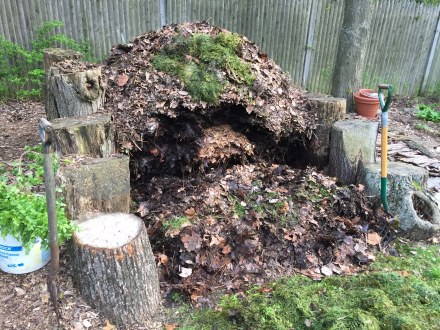
I'd hoped to harvest some near-finished compost from the backside of my pile, but it doesn't seem ready to give up its riches.

I’d hoped to harvest some near-finished compost from the backside of my pile, but it doesn’t seem ready to give up its riches.

I had hoped to dig deeply into the back edge of my pile to reach a pocket of more finished compost to extract and add as top dressing to my vegetable garden. But I am stymied by what seems to be an impermeable wall of raw brown organics not yet ready for distribution.

It’s not often I give up on my pile, but it seems to be too much work to dig into fully enough for the time I have to give it today.

I clean out the kitchen buckets and put away the tools, planning to leave my backyard still of a pile for another day, when I can fully plunge into the backside the next time I mow and need to bury within it a fresh load of grass clippings. It will also need turning and aerating to keep both the grass clippings from turning into a stinking mess of anaerobic rot, and the flies at bay.

The garden will have to wait for its top dressing. As Orson Welles once proclaimed for a California vintner, my pile will serve no compost before its time.

My Pile: Green Machine

A backyard is by its nature a passive, back-of-mind kind of place. But sometimes it demands attention, like this week, which is unfolding with the full bloom of spring.

After days of drizzly rain, the sun now dominates a cloudless sky, kickstarting the greenest of growth across the landscape. The leaves on the maple trees have burst out, the garden ferns have unfolded and the grass is thickening and surging upward.

They say you can almost see some types of grasses, like bamboo or switchgrass, grow in real time. The same seems true of my own lawn, and over the past few days the grass has grown so quickly and lushly that I fear waiting until the weekend to cut it. Besides, there’s more rain in the forecast.

So after getting home from work I haul the mower out of the shed and fire it up. It’s a pleasant chore on a pleasant evening. It’s not like having to mow the lawn on a sweltering August day, sweating through the baking sun and buzz of mosquitoes.

The dog’s delighted when I trundle the lawnmower out of the shed. His sport is to drop the tennis ball just outside the path of my mower, entreating me to retrieve it and toss it yonder for him to fetch. It’s a sport for both of us; I try to bend down to grab the ball without pausing or forcing the mower offline. When he drops the ball in front of me he waits for my reaction – if it’s in the path of the coming lawnmower blades a hand gesture from me is all he needs to dart in and grab the ball without slowing me down. In all the years of us playing this game, I’ve only mowed over a couple tennis balls.

Aside from learning how to throw a ball, ride a bike, swim, and perhaps read, I’ve been mowing as long as any other thing I’ve done in my life. I jumped at the chance to show my dad I was big enough to take over mowing duties for him as a kid, and as I grew older made spending money by taking care of some neighbors’ lawns each summer. By the time I left high school, I mowed four or five lawns. Mowing a lawn was my first job, and it probably will be my last.

Mowing is a simple, rewarding task that I enjoy doing. It’s fair way to get some sun and some exercise, especially if you never bother to fix the belt that once self-propelled the rear wheels. The unit is now just dead weight, if not a hand brake. Just the same, I wheel the trusty red Toro around the yard like a matador, raising the front wheels just so to skim an exposed root or pass over and along a rock border so I don’t have to edge with the hand shears or electric trimmer — or bust the whirring blade.

I don’t know what may be on, say, Forrest Gump’s mind when he’s atop his riding mower, but I’m right there with him. Walking behind a mower invariably leads me down interesting paths of thought. It’s a rolling Buddhist prayer wheel of a meditative act, a squared off labyrinth that leads to a vanishing point — the final strip of ankle-high grass that gives way to a uniform plane of green etched by the tracks of the mower wheels. I always feel better about myself after I’ve finished mowing the lawn.

Mowing is another form of hand-crafting, like watering with the hose or weeding with the tip of a digger or hoe. I can’t imagine hiring out for such tasks, though can understand why others do, because of time or inclination. To each his own.

Many gardeners fret about giving over precious backyard space to turf, but my lawn is as well-trod as center field at Fenway — by the dog and me playing our constant game of catch or, ever-rarer these days, a session of Frisbee with my son. Close-cropped grass makes all the difference; the ball bounces high and true, our footfalls are firm, and no doubt the robins have better luck procuring worms for their chicks in the nests of nearby bushes.

The aesthetics of a just-mowed lawn are pleasing, too. A freshly mowed lawn looks bigger. It’s also a fine counterpoint to the helter-skelter growth of the perennial beds. And as this being the second cut of the season, the rest of the lawn has caught up to the eye-jarring tufts of hot-spot grass, and my linear passes around and up and down the lawn produces a uniform spread of manicured green — except a trio of circular patches I leave to thrive as micro-meadows.

Two of the sculpted spaces are thick with clover, for the bees; the other is a curious patch of fescue fast going to seed, for me. My lawn is a motley mix of sun- and shade grasses, and most are thrusting up slender spikes of grain. The poa annua is by far the most profligate, but here and there are more curious strains, and I plan to let this particular patch of fetching grass mature and harvest the seeds. I let most of the rest of the plantings in my backyard come to fruition, and it seems only fair to allow this little bit of turf to do the same.

Aside from mowing around a patchwork of micro-meadows of uncut turf, sometimes I try to re-create the artful designs of those who mow major league outfields. I like the geometry of this particular form of American landscape art, and my lawn is a backyard fascimile of the fields of dreams I see on sports TV, or from the small oval window of transcontinental jet flying over the swath of the American Heartland divided by quarter section and ruled by massive combines, tractors and center-pivot irrigation. I’ll mow on the diagonal one week, back and forth the next or in concentric squares the next. The best visual effect is the on-off sheen of the mowed turf, which comes from the rotation of the whirring motor that flattens the grass blades to shimmer in the sun, or not, according to the path taken, up or back. My efforts are very much bush league; mostly I concentrate on not cutting off a toe or knicking a shin with a thrown rock, or chewing up a tennis ball or scalping a prize planting along a garden edge. The border of the lawn, the fringe of anything, is where you run into the most trouble.

Even with the blade set on the second-highest setting and “grasscycling” wide swaths with the grass-catcher once full, I gather four bags full of clippings to park at the base of my pile.

Fresh fodder for my pile -- the gathering of grass clippings from a fast-growing lawn.

Fresh fodder for my pile — the gathering of grass clippings from a fast-growing lawn.

Over the past week, since stuffing it full of plucked spring weeds and unwanted sproutings from the garden, and being soaked by rain, my pile has settled in on itself, like it always does. My goal with this latest batch of moist green clippings, which are already heating up and fragrant with ferment, is to play hide and seek.

I want to tuck all the grass into my pile and seek out snatches of dried leaves from its fringes to mix within. First I fluff up the top to take in the first few handfuls of clippings, releasing a pungent aroma of the over-wintering cilantro I’d culled from the garden a week ago. Next I dig into the back of my pile with the pitchfork to tease out pockets of virgin contributions from the fall — smatterings of white shredded paper and rotted stems of salt marsh hay gathered from the beach last fall, a chunk of sunflower stalk, and tightly compacted layers of last year’s leaves, as dry as the day I swept them up. It’s a time capsule, my pile, and now I’m mixing past and present, fresh green and old brown, to create something all together new.

The back of my pile remains a stout wall that can withstand my borrowings from underneath. In my mind’s eye, my pile is ever-more like a bowl of chowder served in a crusty round loaf of bread. For months now I’ve added a stew of food waste from the kitchen, coffee grounds and seaweed and more to the middle part of my pile, which is rotting into a melange of composting leaf mold. Now I am mining the outer crust and base for its raw material, untouched by my compost mixology.

I borrow snatches of pressed dried leaves from the bottom of my pile to mix with the grass clippings, effectively turning my pile inside out and upside down.

I borrow snatches of pressed dried leaves from the bottom of my pile to mix with the grass clippings, effectively turning my pile inside out and upside down.

I’m turning my pile upside down and inside out as I excavate. I’m getting ever closer to the moist, dark inner reaches of more finished compost, which I hope to add to my vegetable garden when I plant it this weekend.

I finish by tossing the last grabs of grass clippings across the top of my pile and bury them by cleaning up around the perimeter. I step back to consider my pile, newly restored and resupplied with fresh green fodder when my neighbor comes over with a wheelbarrow full of clippings of his own.

My pile will take it all in. It’s a green machine, a backyard biofactory getting ever closer to turning out its finished product of new living soil.


My Pile: Going to Seed

It’s a fine time of year to be a gardener in these parts, the southwestern corner of Connecticut, along the shores of Long Island Sound. The landscape is alive with lush green growth. The oaks and maples and other hardwoods are beginning to leaf out, casting their pollen far and wide, coating cars and nostrils alike. The showy blooms of flowering shrubs and trees, the pink and white dogwood chief among them, dazzle along the roadsides, in enough profusion to prompt an annual festival. The local garden clubs and historical society host hidden garden tours and plant sales.

I tend to my yard on a cool, damp Saturday, nipping and tucking the perennial azaleas, rhodys and butterfly bushes, spot-weeding the garden beds and lawn. With the grass bright green but slow to grow, I’m not overly tasked, and can wander across the yard plotting future transplants among the perennial beds and pondering what to plant this year in the vegetable garden.

Usually I stroll along with a dandelion digger in hand, gazing about the ground in a sweeping, non-focused manner, like a beachcomber. When a weed catches my eye, I stoop to flick as much of the taproot as I can get from the soil, leaving the plant to shrivel in the heat of the sun before the seeds mature. One of my earliest memories is of heading out to the backyard with a paper grocery bag and digger; it was my first chore — and job. My mother promised me the lordly amount of one dollar to fill up the bag with dandelions. I’m pretty sure I made money off the same dandelions all summer long.

Hand-weeding is a meditation on foot, a touchpoint that appeals to both the hunter and gatherer in me. It’s a fair amount of exercise, the bending and squatting, and over time my perambulations have allowed me to avoid using chemical treatments. I admit to keeping a spray bottle of Ortho Weed-B-Gon on hand to spritz any poison ivy that’s taken root, or the worst of the perennial weeds that creep up on both me and the lawn. Wild strawberry, chickweed and creeping charlie are all part and parcel of my lawn, but sometimes spread so malignantly, if not maliciously, they must be terminated with extreme prejudice.

Tomorrow is Mother’s Day, by tradition the date by which it’s safe to plant the season’s annuals without fear of having them succumb to frost. I’ve already seeded several rows of lettuce and kale in the garden, which are sprouting nicely in the cool spring weather. But with days of cold rain in the forecast, I decide to wait until next weekend to head to the local nursery to bring home the flats of tomatoes and herbs that grow to fill my vegetable garden each summer.

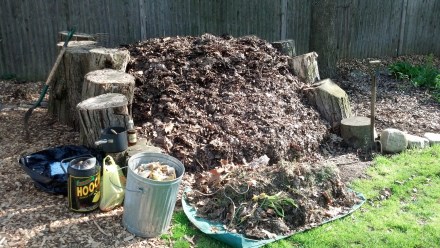
To prepare for planting, I clear the small patch of weeds and self-seeded herbs — the cilantro is profligate this spring — filling a small plastic tarp that I drag over to my pile to add to the materials I’ve already gathered. My kitchen bucket of food scraps and soggy coffee filters is nearly full, as is the lidded ash can my backyard neighbors keep outside their back door for me to collect weekly.

Across the street my neighbors weed the tidy flower bed beside their front door. Each spring, they plant trays and trays of begonias, petunias, alyssum and other hothouse annuals, but first must clear the way of the springtime weeds and grasses that perennially jump the Belgian brick block from their lawn. They’ve filled two blue recycling bins with ripped-up weeds, and I stroll across the way to offer to take the dirty mess off their hands. The bins are heavy with the culled clumps of fast-growing, opportunistic plants, most still clutching a dense filigree of dirt in their veiny roots.

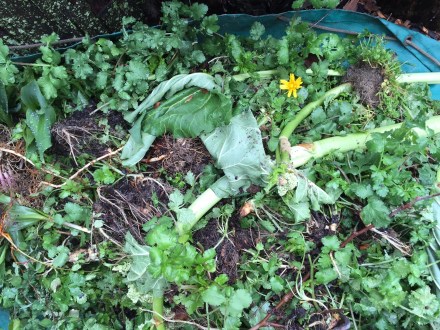
A collection of soily spring weeds and self-starters culled from the garden, mostly fragrant cilantro, are added to my pile.

A collection of soily spring weeds and self-starters culled from the garden, mostly fragrant cilantro, are added to my pile.

It can be a gamble to add spring weeds to a compost heap. They’re prodigious in producing massive amounts of seed in short order, which keep developing even after being uprooted. And once mature, the hard-coated seeds can last for years in the soil, just waiting for the right conditions to ripen and propagate anew, like locusts.

Garlic mustard is particularly pernicious. A native of Europe, this noxious weed now blankets Eastern lawns and woodlands. In its first year it grows as a stubby rosette, producing ankle-high stems loaded with slender capsules of seeds — up to 600 a plant, I read in a New York Times article by Dave Taft, “Garlic Mustard: Evil, Invasive, Delicious.”

True, some foragers collect the leaves to add to spring salads; I typically gather up handful of plucked sprouts and drop them straight through the iron grate of the storm drain along the side of the road. The seeds, Taft reports, can “linger for five or more years, awaiting suitable conditions.” Though my fingers do smell faintly of garlic, I read further that the leaves contain traces of cyanide, adding to its toxic standing in my yard.

But I’m confident my pile will cook and consume most of the weedlings I uproot on my wanderings, which makes this load of heavyweight organic green matter a welcome addition to my pile. Weeds are spring-loaded with nutrients snatched from the soil, and to recycle their ill-gotten gains through my pile and return them as fresh, weed-defeating humus, is only fitting — just desserts, as it were, for composting duties.

As I’m digging a hole in the steaming center of my pile to bury, in layers, the messy weeds, along with the kitchen scraps, another neighbor comes by while walking his dog, a female pit bull that is vigorously friendly with my own mutt.

The weeds, already loaded with seedheads but also heavy with roots loaded with dirt and nutrients, are buried deep in my pile.

The weeds, already loaded with seedheads but also heavy with roots loaded with dirt and nutrients, are buried deep in my pile.

My property, being a double lot on a corner, stands out among the postage stamp yards of most of my neighbors for the size of its grassy space on which to roam. Having a sociable dog who’s often out and about in the yard with me makes our yard a popular waystation, part dog park, part playground. The trampoline is also open to the neighborhood kids, and it’s not uncommon for me to come home from work to find a mom or nanny sitting on the picnic table next to the trampoline watching the kids jump and tumble around, getting tired for bedtime. Fortunately, over the years there’s been only one broken arm among the young bouncy set, and, to my relief, no lawsuits. And any squabbles among the dogs usually involve a tussle over a tennis ball and are soon broken up.

As the pit bull sported with my dog, my neighbor watched me work my pile. He said he had his own pile of leaves raked up into a pile in the corner of his backyard, and added that he kept a bucket half-buried in the ground nearby into which he put some kitchen scraps. But he’d never combined the two elements and so was interested in my efforts.

Set alongside the tool shed and trampoline, my pile has grown in size and stature over the years and is now a fairly prominent hardscape feature in the backyard. I like showing it off, though having someone watch as I disgorge buckets of kitchen scraps and pitchforks of weeds into the backyard heap makes me a bit self-conscious, like having someone watch you clean out the fridge. My pile has long been more of a Private Idaho than public performance art. But I enjoy delivering what amounts to a compost tutorial, a podcast for one.

Whether to humor me or bide his time while his dog got tuckered out, the neighbor stayed through to see me top off my pile with gleanings of old leaf litter from the front and back sides, restoring the ying-yang balance of old browns and fresh greens. Will he return home and commit to turning his own pile of leaves into a real-life compost heap? Or will he tell his wife over dinner about the eccentric down the street who stuffs his rotting garbage in a backyard dump of a landfill as if it’s something to brag about?

Hard to say. My pile will remain on display, in all its humble glory, at least for another couple months, when it once again will disappear by being dispersed across my lawn and garden beds. But for now, it rises anew, suffused with the green growth of spring.

My Pile: The Big Dig

It’s May Day, and my pile is now fully six months old. In November, it rose, phoenix like, from the remnants of last year’s heap of compost, which had been whittled down through the late summer and fall to a small starter mound of rich, dark humus and scrambly stalks and stems harvested from the vegetable garden.

My pile soon swelled with the onslaught of fallen leaves, supplemented by layers of sandy, sinewy seaweed and salt marsh hay beachcombed from the nearby shore and with grass clippings from a lawn revived by the balmy, sun-dappled days of autumn. As the season turned and I finished the yard cleanup before the cold set in, the heap of mostly dry chopped leaves received the spent growth of perennials culled from the garden beds, dried needles of pine and fir, and regular infusions of kitchen scraps, coffee grounds, shredded paper and other organic compostibles. It drank eagerly from the business end of a garden hose, and exhaled a steady stream of vapors from its midst.

For two months, my pile carried a burden of thick insulating snow, before thawing with the strengthening sun of early spring. Despite receiving hundreds of pounds fresh fodder along the way, from a barrel of horse manure to bag catchers full of sycamore seedballs scarfed up from the dormant winter lawn, as well as my efforts to toss and turn it, my pile has steadily settled in upon itself. I’ve trimmed its edges; tidied up the corners and poked and prodded its innards. By volume, it’s shrunken by nearly a third, and by look is now more composed stack than overstuffed heap. From a distance it still seems a big mess of decomposing leaves.

As much as the first half-life of my pile is dominated by dead brown leaves, the ever-quickening race to its fruition as finished compost will be now driven by mass infusions of hot green grass clippings.

Today, a Sunday, is the day I mow the ever-thickening lawn and add its surplus trimmings of minced green blades of grass to my pile. True, over the past three weeks I’ve stuffed it with my neighbor’s artificially enriched clippings, as well as a batch of more naturally nitrogen-spiked grass, courtesy of the resident deer and dog’s urea. But those contributions are just appetizers for the main course of fresh greens. Today marks a literal tectonic shift for my pile, in shape and composition.

Even with the newly sharpened blade set on high, the Toro’s catcher fills quickly. I mulch back into the lawn most of the clippings, yet stop a half-dozen times when the mower chokes to detach the hopper from the mower and dump the moist, fragrant clippings at the base of my pile.


The fresh grass clippings and other recyclables will soon be mixed deep within my pile.

The fresh grass clippings and other recyclables will soon be mixed deep within my pile.

As usual, I set out my other fixings – a week’s worth kitchen scraps from next door and of my own, as well as two small plastic bags of shredded paper from the office. I figure the crinkled white strips, laboriously processed from wood pulp, would make a fine counterbalance to the finely chopped blades of lush green grass. Add too much grass to a compost pile without mixing it with drier, brown materials and a compost heap that’s humming along into a stinky, anaerobic mess.

“Not all grass clippings should be removed from the lawn; when left after mowing, their nutrients enrich the lawn itself, without the application of chemical fertilizers,” I read in “The Rodale Book of Composting.” “However, most lawns do not need as much enrichment as a full growing season’s clippings will provide. Collecting grass clippings also helps reduce weed growth by removing weed seeds from the lawn.

“Freshly gathered green clippings are exceedingly rich in nitrogen and will heat up on their own if pulled into a pile. But, because of their high water content, they will also pack down and become slimy. This can be avoided by adding grass clippings in thin layers, alternating with leaves, garbage, manure and other materials, thus preventing them from clumping together.

“Clippings that have been allowed to dry out will have lost much of their nitrogen content but are still valuable as an energy source and to absorb excess moisture….Grass clippings and leaves can be turned into finished compost in 2 weeks if the heap is chopped and turned every 3 days.”

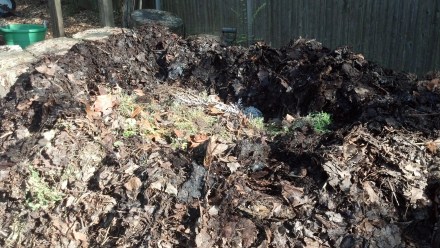
So here I stand, pitchfork in hand, to at long last begin to unearth the hard-pressed beginnings of my pile from back when. I stick the pitchfork, upside down, into the front edge of my pile to pull a wedge of moist, matted leaves from underneath. My previous working of the pile have helped create a nearly vertical wall, which I undercut by pulling chunks forward to form a front line of decayed, crumbly leaves. It’s the first light of day these leaves have seen since the fall. Each forkful writhes with squiggly worms and glistens with flecks of mica from the beach. Any trace of the seaweed they traveled in on is long gone.

I dig as far under the front wall of compost as I dare, until it threatens to collapse forward under its own weight. I toss a layer of grass clippings into the newly made trench, then cover with several pitchforks full of dried brown leaves gleaned from the corners of the log walls. They appear as fresh as the day they tumbled down from the top of my pile last fall.

I cleave a few more pitchforks of dark, rotted leaf mold from the bottom center of my pile, then stand back to watch the front face of the pile tumble down upon itself. I spread the avalanche out across the new front of my pile to create what amounts to a moraine.

As I excavate further into the center of my pile, I unearth a pocket of pristine leaf litter. Bone dry and compressed into a tightly wadded stack, the leaves lie underneath the digging I have done through the winter. Bound by the weight of all that is above it, the clutch of leaves has repelled any intrusion of water or rot, and now resists even the tines of the pitchfork. I tease the leaves apart bit by bit, and spread them across the newly created trench and cover them with a combination of grass clippings, white shredded paper and moist gatherings from the sides of my pile. Released from their state of suspended animation, they will now fully join the fungible, seething mess of rot and transmutation that is my pile.

IMG_2397

Digging out the deepest layers of leaf mold to pull them out to the front of my pile, I uncover a pocket of dry, hard-pressed leaves untouched by the rot that surrounds it.

I dig further into my pile, nearing the heart of it. Again it collapses, and I add more grass, as well as the kitchen scraps, deeply, mostly to play hide-and-seek with my mysterious rodent interloper. Its furtive trail has gone cold, and I can only hope that the mass of grass clippings added to the mix, easily a hundred pounds or more, will mask any scent of food waste to scavenge.

Essentially, I’m stepping my wandering pile forward, according to my plan of turning it inside out and upside down, largely in place. Its front has moved forward about two feet, hard by the edge of the lawn, and is a crumbly mix of nearly finished compost. I make note of using it as a top-dressing for when I plant the vegetable garden, once the risk of frost is past.

I portion out the rest of the grass and shredded paper, tucking it deep within a third trench. I can no longer reach down to ground, but I’m close, and far enough into the center of the pile to come across the barely discernible remains of my earliest insertions of kitchen recyclables and such. I spot a broken egg shell and the skin of an avocado, still adorned with the supermarket stick-on label. The pitchfork snags a seashell, then a wadded up section of soggy newspaper, the bottom of the rabbit hutch from before the snows of late January, I figure. I tease it apart with the tines of the pitchfork and bury it anew with the last of the grass clippings.

To cover the rest of the clippings, I scrape the hard-tine rake across the top of my pile, pulling the outer layer of sun-baked leaves forward, releasing volumes of vaporish steam from the rot taking place just below the surface. I cover it all with fat forkfuls of more raw compost from along the back side, tangly with the rotting stems of the salt marsh hay that insulated my pile through the winter. In short order my pile is newly restored to its customary height. Its front half, at least, is newly suffused with fresh mixed greens and rotting brown.

Next time I mow, I’ll repeat this process, working from the back of my pile, then I will dig inward from each flanking side. It will take me another month or so to get to the very bottom of my pile, the small mound of humus reserved from last season that served as the activator for rot and decay to come. But from today to harvest, my pile will be a most active compost heap, suffused with high-octane grass clippings. Keeping it aerated now becomes my chore, and it will be good hard exercise as I work to expose the compressed leaves deep within my pile and tease them apart to allow my pile’s “Friends of Distinction”*  – the worms, the creepy-crawlers, the mold-makers and microbes – to finish the job.

* The allusion seems fitting to me, for this group recorded a ’60s hit — “Grazing in the Grass” — that makes a great soundtrack for backyard composters:

Grazin’ in the grass is a gas, baby, can you dig it
What a trip just watchin’ as the world goes past
(Grazin’ in the grass is a gas, baby, can you dig it)
There are so many good things to see
While grazin’ in the grass
(Grazin’ in the grass is a gas, baby, can you dig it)
Flowers with colours for takin’
Everything outta sight in the grass
(Grazin’ in the grass is a gas, baby, can you dig it)
The sun beaming down between the leaves
(Grazin’ in the grass is a gas, baby, can you dig it)
And the bir-ir-ir-irds dartin’ in and out of the trees
(Grazin’ in the grass is a gas, baby, can you dig it)

Everything here is so clear, you can see it
And everything here is so real, you can feel it
And it’s real, so real, so real, so real, so real, so real
Can you dig it
Whooo-oooh

I can dig it, he can dig it
She can dig it, we can dig it
They can dig it, you can dig it
Oh, let’s dig it
Can you dig it, baby
I can dig it, he can dig it
She can dig it, we can dig it
They can dig it, you can dig it
Oh, let’s dig it
Can you dig it, baby