My Pile: A Soak and a Poke

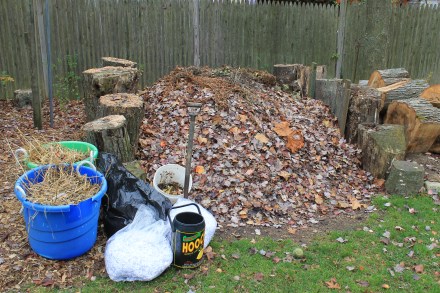
My pile now sits, Buddha-like, in the backyard.

Over the past two months, I’ve made a dozen or so roundups of leaves, topping each new load on my pile with layers of grass clippings, seaweed, kitchen scraps, rabbit litter, coffee grounds and whatever other ready-to-rot organic filler I come across.

After all those additions, each followed by a fresh exhalation of air, my pile has assumed its winter repose. Its bulk seems permanent, immutable save for the tendrils of steamy vapor that waft up from its mounded summit on cold mornings.

I know underneath its mantle of damp brown leaves and flecks of seaweed, my pile is stewing. Left to its own devices, it will slowly cook, a crockpot of compost, through the winter.

But as they say, a watched pot never boils, and I can’t resist tinkering with my pile’s inner workings to stoke the process of turning its raw ingredients into a finished product of a new living soil called humus.

Over the winter, I’ll continue with my regular deposits of kitchen scraps and such. I carve out a hole in the pile with a pitchfork, upend a container of slop into the mix, then backfill the hole with a plug of leaves raked up from a corner of the yard.

These contributions are helpful, mostly for housekeeping, but only scratch the surface of my pile. And fully turning my pile with a pitchfork will have to wait until the spring, after my pile has had the still time of winter to cook down into a heap that’s more manageable in size.

What my pile needs now right now are big gulps of water and air. Without these essential elements and agents, the chemical process that is decomposition will slowly grind to a halt.

“The amount of water in your compost pile is fairly critical, but you have plenty of leeway in which to work,” writes Stu Campbell in “Let It Rot! — the Gardener’s Guide to Composting” (Storey, 1998). “If the moisture content is much greater than 60 percent, you run the risk of having an anaerobic pile; if it is much less than 40 percent, organic matter will not decompose rapidly enough because the bacteria are deprived of the moisture they need to carry on their metabolism. Of course, you can’t monitor the percentages, so in general try to make sure the materials in your pile have the moisture content of a well-wrung sponge.”

“This is COOKING, not BAKING, and you have a lot of wiggle room,” Mike McGrath fairly shouts in his “Book of Compost” (Sterling Publishing, 2006). “Not bone dry, not soaking wet; in the middle is just right. And if the Goldilocks method doesn’t work for you, purchase a moisture meter — you can get these inexpensive electrical probe devices online and at most garden centers. They’re great to have around if you have a lot of houseplants…”

The rains this fall have been plentiful, and regular. I try to time my yard cleanups in advance of a coming storm; even a modest shower tamps down the leaves atop the pile so they don’t skitter back across the yard when the front blows through. “Rainwater is the best kind to put on compost. It picks up lots of oxygen, minerals and microorganisms as it falls through the air, giving your compost an added boost,” Stu Campbell counsels.

But even the heaviest rain soaks down into my pile only a matter of inches, absorbed by the nearest layer of seaweed and chopped leaf mulch and repelled by the first strata of whole leaves with their waxy coatings.

Through the fall I’ve taken care to add as much moist material to the beginnings of my pile as possible; grass clippings, damp leaves and musty seaweed, and I’ve dampened the lot from time to time with a spritz from the hose. But I know from the vapors rising out of the top that the steam engine that is my pile is boiling off the water it has stored up inside.

My pile is thirsty.

This morning, a Sunday, is dry and warm for December – about 40 degrees. Just warm enough for me to turn on the garden hose and unfurl its stiff coils across the lawn over to my pile.

My pile burns through the water in its midst, even on a cold December day. Time to water it before the winter freeze sets in.

My pile burns through the water in its midst, even on a cold December day. Time to water it before the winter freeze sets in.

I stick the nozzle of the hose into my pile, jabbing it in as deep as it will intrude.  It’s always a deep mystery where the water goes and what unseen path it follows through the matrix that is my pile. Every minute or so I stub the end of the running hose into another spot underneath the leaves.

I calculate flow rates in my head. If my hose pours out a gallon every 30 seconds, that means eight pounds of liquid will weigh down the pile. But what path is the water taking? What will absorb it?

Usually by the time I can come up with some sort of answer, a trickle of water is wetting my feet at the pile’s edge. My pile needs water, but seems impervious to it. You can lead a hose to a compost heap, but you can’t make my pile take a drink.

I extract the hose and plunge the tip into another section, then another. It’s like dabbing a turkey with a baster, no matter how deep I stick the hose into the voids of my pile, the coursing water seems to find its way out back onto the ground surrounding it. My pile is not the sponge I think it is.

What my pile needs now is air.
My Pile: Waste Not, Want Not

Urban Dictionary defines a Connecticut Yankee as “someone who is so cheap with money, they use both sides of the toilet paper … A Connecticut Yankee will serve the same exact meal to house guests two nights in a row to finish the leftovers.”

Guilty as charged, at least as far as the leftovers are concerned. And like any good Yankee homesteader in these Connecticut climes, I make busy through late fall stocking the larder that is my pile with leftovers of leftovers. The entry bar is low: Most any old vegetative matter that the lower parts of the food chain can make a meal of will do. It can be as bland as shredded white paper from the office or as rich as a bouillabaisse of washed-up seaweed and shells plucked from the beach.

I also abide by the old saw that a good compost heap is 80 percent dead brown stuff — fallen leaves, in abundance — and 20 percent green materials — things that biodegrade with some alacrity and without malice. I have no interest in adding cat litter or dog doo to my pile, or meat, though some bones of various critters or crustaceans may be tossed in on occasion. I hear they are rich in calcium and other minerals.

The easy pickings are grass clippings from the yard, until they peter out with the waning autumnal sun. Filtered coffee grounds from a local caffeine shop are always free for the asking, or taking, and my pile is the end stop for all the remains from my kitchen and that of the family next door. Seaweed gathered from the local shore takes more effort, but a jaunt to the beach with a bucket in tow is always worth the trip, whether I bring back a pungent load of wet sandy gleanings or not.

A certain amount of scavenging suits me and my pile. My goal each fall is to find the time and wherewithal to add a layer of something “green” to most every load of leaves I gather from the yard and dump upon it.

At this point in my pile’s life cycle, there’s always way more leaves than anything else. The more fresh rotting green I can contribute to my pile at this formative stage, the hotter it will cook through the winter months and the sooner the mass of leaves and compostible whatnot will boil down into a finished batch of loamy new humus that enriches my lawn and garden.

There are not many rules to building my pile, more like guidelines — and opportunity.

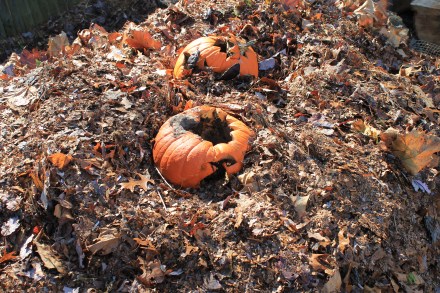
I see value in every garbage can and recycling bin, and scrounging up these leftovers pays off in a very modest way as a local environmental good and a micro investment in my property. Each year’s compost heap adds a lot of fresh, healthy biomass to my yard, and stands as a convenient destination for organic discards. Time to toss the Halloween pumpkins? The puckered-up ol’ Jack O’Lanterns on the porch do cannonballs straight into my pile.

Jack o' Lanterns get tossed into my pile each fall.

Jack o’ Lanterns get tossed into my pile each fall.

Cover with a rounded-up mess o’ leaves, and repeat. Next with a bagful of gleanings from the bottom of a rabbit cage, courtesy of my next-door neighbors. Or a dusting of wood ash from my fireplace, or the tired-out dirt from an old flower pot, upended into a tsunami of fall leaves. It all adds up, into the distillation that is my pile.

I’m sure other compost compilers in other places have their own localized routines and recipes. I’ve seen lists of all the things you can compost, and it’s an impressive array, from dryer lint to hair swept from the floor of the barber shop.

It’s a dirty, messy  and inconvenient truth that we waste an untold amount of green biomass, mostly food but a lot of other things made from nature or manufactured by man. Most of the composting books I’ve perused include charts of the sundry materials that can be safely composted, and the listings are impressively creative and diverse.

In “Let It Rot,” Stu Campbell includes such items as feathers (very high in nitrogen and phosphoric acid), tobacco dust and stems (a rich source of potash) and bat guano (pretty much the richest manure around).

Cardboard and “‘Zoo Poo’ made from elephant, rhinoceros and other herbivorous animals’ poo,” make the list in Nicky Scott’s “How to Make and Use Compost — the Ultimate Guide.”

The silliest thing I will admit to adding to my pile is a gathering of fingernail clippings, cupped in my hand until I ambled outside to my pile. My pile makes work for idle, if manicured, hands.

I also once visited a work colleague who lived in a beautiful apartment in a stable house at a Connecticut estate and, much to her bemusement, brought home with me a bucket of horse manure. The horses she lived above were worth millions, and their droppings added value to my pile as well.

Such inputs are a very modest offset to the magnitudes more of soil that is lost each year across the living skin of the earth.

The United Nations proclaimed 2015 as the “International Year of Soil,” I read on biocycle.net, a website maintained by the “organics recycling authority.” What’s more, Dec. 5, is World Soil Day, my monthly issue of National Geographic reveals. “Soil, in which nearly all our food grows, is a living resource that takes years to form. Yet it can vanish in minutes …

“Each year 75 billion tons of fertile soil are lost to erosion. That’s alarming — and not just to food producers. Soil can trap huge quantities of carbon dioxide in the form of organic carbon and prevent it from escaping into the atmosphere. Over the course of 25 years, healthy soils can absorb an estimated 10 percent of human-generated carbon emissions.”

Writer Kelsey Nowakowski supplies more factoids:

  • Soil is now eroding up to 20 times faster than it is being developed.
  •  Since 1980, one-third of the world’s arable land has been lost to erosion.

“If we protect and sustainably manage soils,” says Ronald Vargas of the United Nations Food and Agriculture Organization, “we can combat climate change.”

Think globally, garden locally. As Douglas W. Tallamy writes in “Bringing Nature Home,” “Gardeners enjoy their hobby for many reasons: a love of plants and nature, the satisfaction that comes from beautifying home and community, the pleasures of creative effort, the desire to collect rare or unusual species, and the healthful benefits of exercise and outdoor air…

“But now, for the first time in history, gardening has taken on a role that transcends the needs of the gardener. Like it or not, gardeners have become important players in the management of our nation’s wildlife. It is now within the power of individual gardeners to do something that we all dream of doing: to ‘make a difference.’ In this case, the ‘difference’ will be to the future of biodiversity, to the native plants and animals of North America and the ecosystems that sustain them…

“I needn’t elaborate on the many things our garden do for us,” Tallamy continues. “Properly designed, gardens tie our homes to the surrounding landscape as well as provide an outlet for artistic expression and a source of natural beauty that be enjoyed year round. Our gardens also offer us refuge from an increasingly hectic and unpleasant world. But because gardens are, in essence, groups of plants, they also have the potential to perform the same essential biological roles fulfilled by healthy plant communities everywhere.”

Tending my pile offers me plenty of good ol’ fashioned outdoor exercise. It serves as a crunchy-granola hobby, it keeps me at home and out of trouble further afield, and it all costs next to nothing.

If that all sounds simple and skinflint, know that the payoff is profoundly rich and complex. A garden that is healthy — diverse, well-balanced — begins with and is sustained by regularly replenishment of newly minted soil that is commensurately rich and complex and wholly in sync with the native ground from which it comes.

That’s compost. That’s my pile. Decomposers also “play a vital role in keeping the [plant and animal] in balance,” adds Tallamy. “Most decomposers are insects, and they can be present in fantastic numbers, ready to recycle the nutrients in dead plants and animals for later use by the living. Decomposers are also important components of the terrestrial food chain and help provide the energy required by higher trophic levels.

By adding the richness of organic compost to my garden, I can forsake the costly herbicides and pesticides required to keep most suburban gardens perky and pest-free. “Would we not better achieve our goal of a pest-free garden if we employed nature herself to look after things?” asks Tallamy. ” We have spent the last half-century proving beyond the shadow of a doubt that a sterile garden does not work. It is a high-input enterprice requiring more time and money than most of us would like, or are able, to devote or spend.”

Bottom line? I think there’s a bit of the Connecticut Yankee in every composter, wherever their backyard heap may be.

Some kitchen scraps, a half bucket of seaweed, and a bag from the neighbor's rabbit hut. All good to go!

Some kitchen scraps, a half bucket of seaweed, and a bag from the neighbor’s rabbit hut. All good to go into my pile.


My Pile: An Endless Source of Fodder

I have long wanted to collect my thoughts, feelings and findings about the compost pile I have tended to, in various backyards around the country, for the past 25 years. My pile is an endless source of fodder, materially and spiritually.

A compost pile is wonderfully useful to a suburban gardener. It’s recycling in its most elemental, home-brewed form; a hand’s-on effort at sustainability that sustains me with plenty of manual exercise the year-round.  Set in the corner of a verdant backyard lot in the wooded suburbs of Fairfield County, Connecticut, my pile is well-situated. What my land and life produces and consumes, stays on the property, by and large. My pile also has the capacity to take in the organic remains and vegetative cast-offs from my neighbors, my work place, the coffee shop I frequent. It also reaps the rewards of the nearby seashore and local farms and stables.

There are four full seasons to this land at its privileged latitude, and my pile continually stimulates me and my backyard as a bio lab of a project in which the profundity of one year’s bounty turns into the next year’s wellspring of continued growth. Each fall I gather the freshly dead ingredients of the growing season. Over the winter and spring the collection melds and molds and is amended into something new. Each summer I spread loads and loads of wheelbarrows full of finished compost across the garden and lawn, which in time returns its bumper crop of harvested life back into my pile.

My pile weathers the seasonal swings in temperature, drawing strength and sustenance from the sun through the spring and summer and feeding off its own inner resources over the long cold months when everything else is dormant. My pile is a power plant, an internal combustion engine that produces enough heat to stoke it through the coldest stretch of winter.

My pile is also blessed by regular dousings of water, as vital as air. Nearly 50 inches of precipitation falls upon this landscape each year, on average. Sometimes it’s in the form of a gully washer of a thunderstorm, other times it’s a foot-thick blanket of snow. Generally, though, this essential ingredient comes in nearly weekly doses of about an inch of water throughout the year.

Making compost is an act of creation through destruction. Part plant, part animal, the domain of the multitude of microorganisms that make up the preponderance of life as we know it, my pile is an endlessly looping live performance that plays out through the seasons, according to my humble inputs and its own internal rhythms and processes.

My pile is more than the sum of its parts, a process that in the end produces something that scientists are still trying to describe, much less exactly define. My pile is not dirt, exactly, nor fertilizer. “Soil amendment” hardly covers what some scientists call Humus, from the Latin word for “earth” or “ground.” Wikipedia says humus is “the fraction of soil organic matter that is amorphous and without the “cellular structure characteristic of plants, micro-organisms or animals.”

How do you define something that by definition is amorphous? Wiki takes another stab: “In agriculture, humus is sometimes also used to describe mature, or natural compost extracted from a forest or other spontaneous source for use to amend soil.”

For my pile, I suppose the “spontaneous source” could refer to the trees that lord over my backyard lawn and garden, the dumpster bin full of coffee grounds, the beach lined by seaweed — or me.

If you can’t exactly define something, the next best thing is to describe it, and in that regard, my compost pile is truly a little bit of everything.

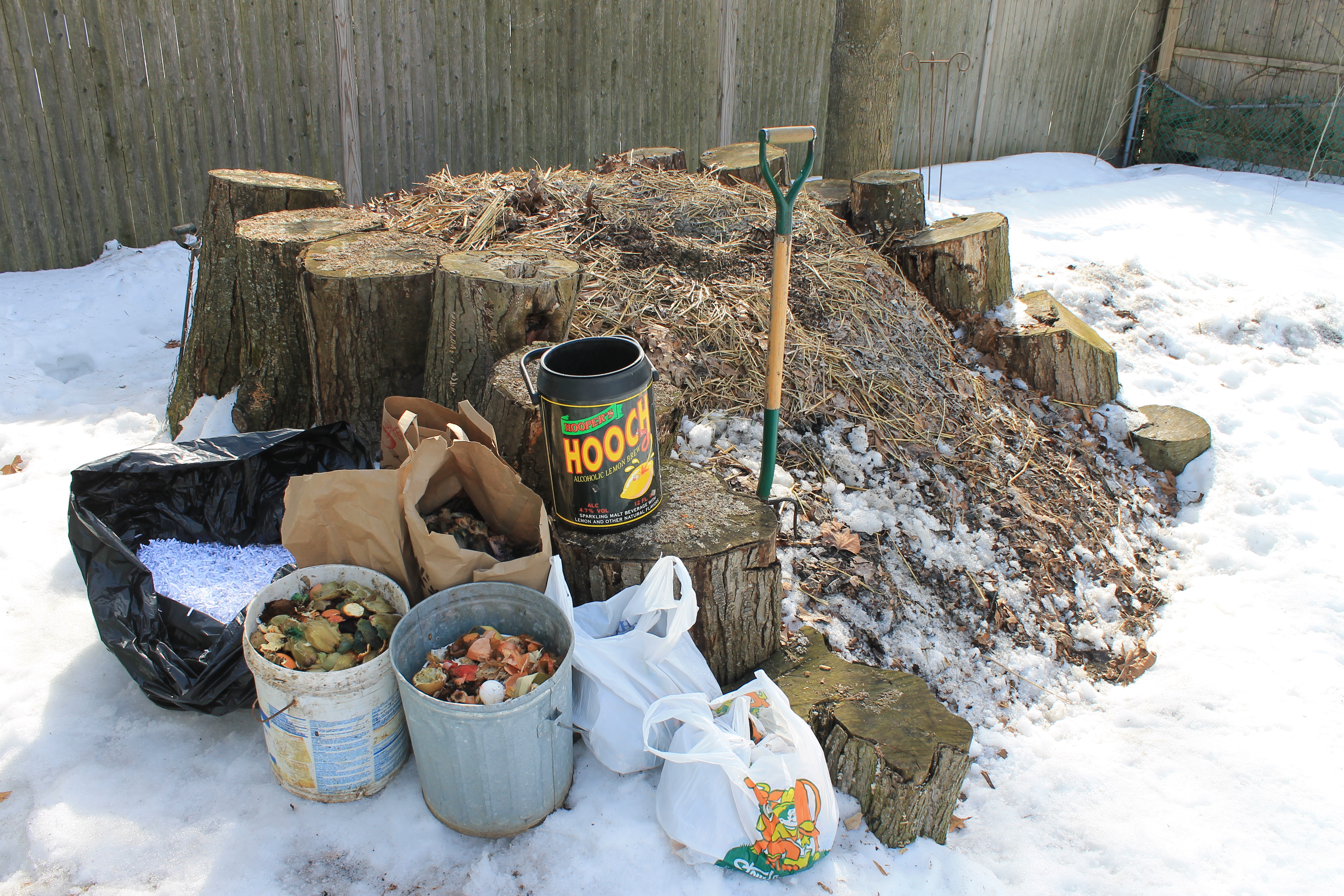
My pile is made of many things, like all these ingredients stockpiled through a winter storm and about to be added to the mix.

My pile is made of many things, like all these ingredients stockpiled through a winter storm and about to be added to the mix.

There’s no exact recipe for making compost, and managing a compost pile is like being a baker who doesn’t have to follow a recipe to turn out finished product that by happenstance is somehow always just right.

What a compost pile is and ends up as depends on where it’s made and what it’s made from. This weekend, I dumpster-dove for coffee grounds because the seaweed I gather from the high-tide line of our local beach is in short supply. It’s been a delightful fall; no early Nor’easters, just a steady decline in temperatures and daylight that have allowed the leaves to flutter to the ground at a steady pace.

Each fall I construct my pile like I’m making lasagna, in layers. The pasta is the fall leaves, and these sort themselves out accordingly to their own schedule. The maples shed their leaves first, followed closely by the sycamores; last are the oaks.

My favored form of leaf cleanup is to rake the leaves into a slouchy heap, lay an old bed sheet beside it, then pile the leaves over it until just the four corners of the sheet are visible. I gather them together and, like Santa Claus, sling the makeshift bag over my shoulder and haul it over to the heap I keep in the back corner of the yard. If the leaves are heavy with dew, then I have to drag the damp sheet across the ground. Either way, it’s quick and easy, and in short order — a load or two or three — you’ve got a clean sweep of a lawn and that much more organic material stashed atop my pile.

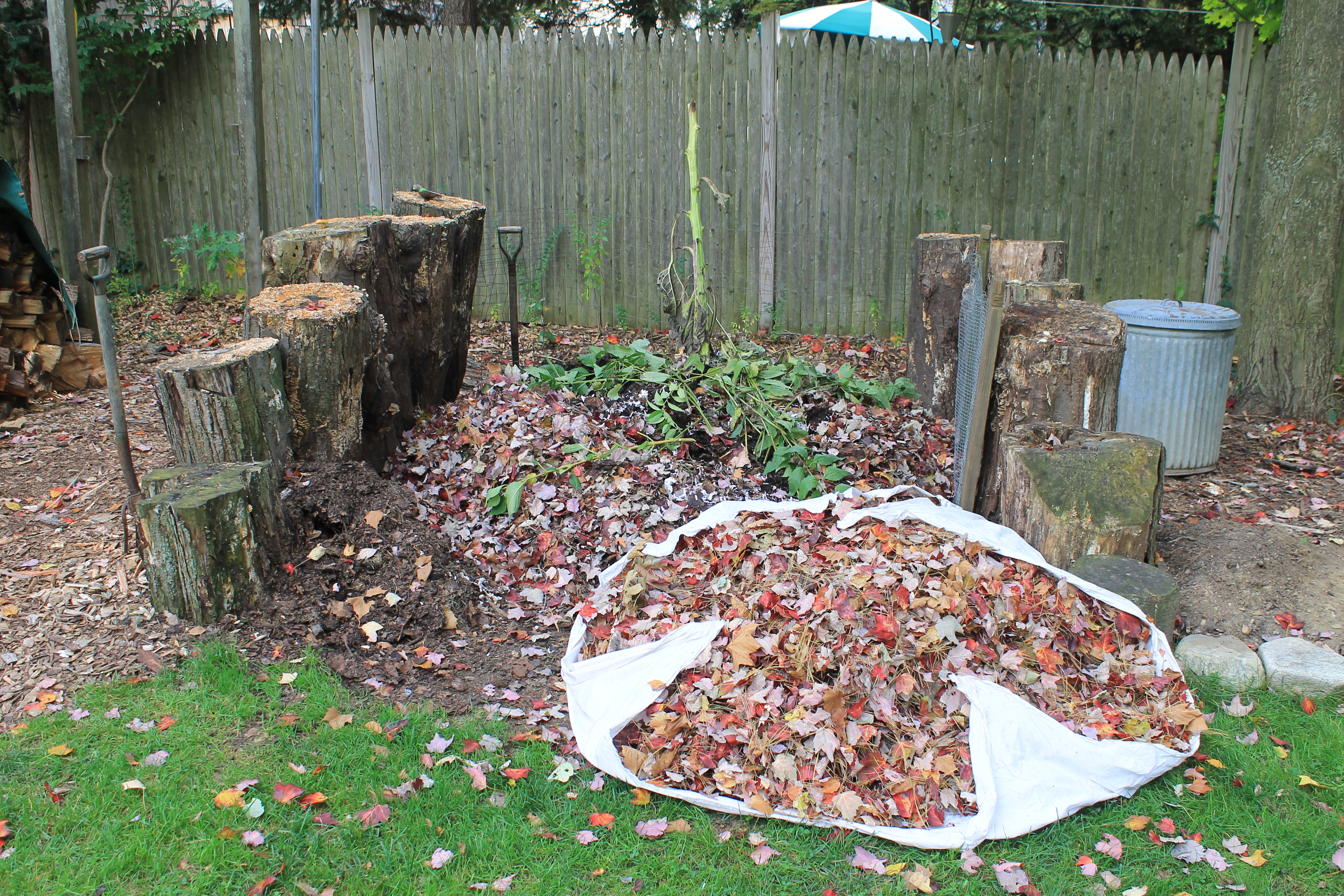
A sheetful of leaves swept up from the yard and ready to be added to the beginning of my pile in mid-October. I've already tossed in the spent vines and stems from the vegetable garden, along with sunflower stalk. As it decomposes, the hollow stem will serve as a passageway for air and microorganisms, from top to bottom.

A sheetful of leaves swept up from the yard and ready to be added to the beginning of my pile in mid-October. I’ve already tossed in the spent vines and stems from the vegetable garden, along with sunflower stalk. As it decomposes, the hollow stem will serve as a passageway for air and microorganisms, from top to bottom.

But compost heaps don’t thrive on leaves alone — at least not mine. True, a pile of leaves alone will in time — a year or two in these parts — turn into leaf mold, a very good and basic kind of compost, to be sure. But where’s the fun, the art, in that?

So along with every fresh deposit of leaves, I try to add a layer of some sweetener, a catalyst of high energy to inspire my pile to be more than humble leaf mold. In early fall, grass clippings are still in good supply, and what I don’t mulch back into the yard, into the pile it goes.

Between mowings, there’s seaweed, hauled in big plastic buckets from the beach, or coffee grounds. Kitchen scraps, from my home or from one of my neighbors. Manure, brought home by the bin from a local nature center, nearby rescue shelter or riding stable out in the country.

My compost pile is not mine alone; over the years my neighbors have gotten in on the act. The family of six next door contributes their kitchen scraps; the neighbors across the street have learned that it’s easier to haul their leaves over to my pile than to stuff them all into big paper bags for the town to pick up.

The neighbors to the other side have a rabbit, and from their hutch I get a steady supply of rabbit litter. Manure is about the most potent source of nitrogen you can add to a compost pile, and the end product of a little bunny is more convenient to work with than, say, what comes out of a cow. It’s also a whole lot easier to find than bat guano, which tops the charts in containing the three main ingredients of commercial made fertilizer, nitrogen, phosphoric acid and potash, according to Stu Campbell in “Let It Rot — The Gardener’s Guide to Composting.”

In my experience, it’s the rabbit bedding — shredded paper, soaked in bunny pee — that is the favorite foodstuff of earthworms. When I turn the pile over I sometimes come across a remnant of recycled rabbit litter being feasted upon by a mass of wriggly red worms. Of all the living things in my pile, worms are my biggest allies. It’s funny to think of a worm as an apex predator, but they exist near the top of the food chain that is my pile. It’s humbling to know that it is their digestive tracts that in large part produce what becomes of my pile.

So, in it all goes, layer upon layer, soldier after soldier. Water, air, sweat and the toil of countless things seen and unseen that eat and fight and live and die in situ. It’s all fodder for my pile.