My Pile: ‘The Best Fertilizer in the World’

I’m blessed to live within easy reach of the ocean, and it’s to the beach I go to bulk up on the greenest of green for my pile, seaweed.

This is not a new idea in these parts, as I discovered through an exhibit held some years back at the local historical society. “A Bunch of Farmers” detailed the area’s agricultural roots, beginning in the 1830s, which over the generations developed richly with the “successful maritime exportation of fish and produce to New York, Boston and beyond. By the Civil War, Westport was the leading onion supplier to the Union army, and onion farmers used nutrient-rich seaweed as fertilizer.”

Onion blight, along with the invention of modern food production and preservation technologies, did away with the farming of onions in the loamy, sandy fields here in coastal southern Connecticut, which gave way to second-growth woodland and tracts of suburban housing, ranging from gilded manor and weekend New York retreat to postwar cape and modern McMansion.

My one-story, two-bedroom cottage was built in the early 1950s and sits squarely in the center of a flat, one-third-acre corner lot of coastal marshland long ago dredged and drained into farm fields for those onions and later filled in to develop as postwar housing.

Driving to work or errands along the narrow, winding road my house sits on, each day I pass by two old onion barns. The smaller was long ago converted into a house; the larger, two-story wood structure tucked into the side of a hill, is still pretty much a barn and now used as what looks like a pool house for the modern home it sits behind.

My home is just a mile or so away from several public beaches strung along the northern shore of Long Island Sound in a collection of rocky coves, sandy beaches and tidal-river marshland. I drive to one of the local public beaches often in the fall, with the dog sniffing sea breezes out the side window and a washtub-size plastic bucket in the back cargo space of my SUV.

My dog and I both prefer low tide — him for chasing a tennis ball over the tidal flats and me for searching out the easiest pickings of washed-up seaweed and salt marsh grass.

Gathering seaweed in the fall at a local beach.

Gathering seaweed in the fall at a local beach.

Depending on the season, the weather and the wind, high tide usually leaves a long scraggly line of flotsam, most of it a motley salad of different kinds of seaweed and scraggly reeds of salt marsh grass turned to hay. The wrack line, they call it.

Today’s catch was good; a recent storm had pushed up a dense patch of detritus along a rock jetty close to the parking lot.

The seaweed is yellow and brown and green and chopped by the waves into small mushy pieces, the edges crinkly like lasagna. The layer I set upon is a half-foot deep and flecked with all kinds of seaborne detritus, a Sargasso Sea at my feet. I turn the plastic tub on its side and scrape the briny mix into the bucket with a three-tined hand hoe.

Caught up in the tidal ebb and flow are dismembered crab legs and carapices of baby horseshoe crabs. Shells of mussels, clams and oysters dot the mix, and in they go, too. The clattering seashells, which slowly break down into their basic components of lime and calcium, offset the acidic mulch of all the leaves in my pile. (I’ve also heard that seashells give tomatoes more flavor, and I flick stray shells from the seashore straight into the vegetable garden. Like tossing a penny into a fountain, I wish for tasty tomatoes next summer.) I always have to separate out a few bits of styrofoam or plastic — a broken fork, a bottle cap, snags of fishing line or deflated mylar shell of a helium party balloon, with string.

I love bringing this bit of the beach back home with me. The bucket smells like part wet swimsuit, part low tide, and all pure summer.

Seaweed gathered from the local beach is a rich stew of ready to rot greens.

The town opens up its beaches to dogs on Oct. 1, and I bet I’ve made 10 trips back and forth since then. It’s always a good day when you are at the beach, and on most visits within an hour or so I can tire the dog out and fill up a keg-sized bucket with 30 or 40 pounds of fresh, ripe seaweed or, just as good, a lighter mix of salt marsh hay. My dog’s in great shape, and so is my pile.

“Seaweed garden nutrients are relatively low in nitrogen and phosphorus,” I read on gardeningknowhow.com, “but contain about 60 other trace elements, as well as fungal and disease preventatives. Using seaweed for compost improves soil consistency and increases water retention in sandy or grainy soils and may be used as a top or side dressing. Composting seaweed speeds up the compost process.”

Erik Hoffner, writing for grist.com, adds that “besides being full of necessary nutrients, [kelp seaweed] also contains growth hormones (auxins, gibberellins, and cytokinins) which are readily taken up by plants and put directly to use.”

“Talk about magic seaweed,” writes noted journalist David Kirby in a fascinating article published in late 2016 on takepart.com, wonderfully titled, “How to Stop Farts From Warming the Planet: Feed Cows Seaweed.”

“A single type of seaweed could cut greenhouse gas emissions, fight ocean acidification, removed invasive species, restore fisheries, and help coastal economies around the world,” Kirby writes.

“Researchers in Australia have discovered that the seaweed, Asparagopsis taxiformis, when mixed with livestock feed in small amounts, reduced methane emissions from sheep by up to 80 percent.”

All those burps and farts and manure add up to a huge amount of methane — more than 5 percent of all global greenhouse gas emissions, Kirby quotes a researcher, “The total contribution from land transportation is 10 percent, so we’re talking about the equivalent of half of all the vehicles in the world. It’s not a trivial number.”

I worry about the amount of methane, however negligible it may be in the greater scheme of things, my puny pile may fart out. So I take comfort in knowing that the seaweed I stuff into it may also be a solution to a far greater problem. Evidently, the seaweed contains a compound that helps disrupt enzymes used by gut bacteria to produce methane, which has up to 36 times the global warming potential of carbon dioxide.

We may be only just now finding out how basically good seaweed is, in situ and on my pile, but this new reporting makes me appreciate it even more.

Garden writer Eleanor Perenyi, in “Green Thoughts,” her classic account of gardening along the Connecticut coast in Stonington, also sought out seaweed, which required hiring “a man with a pickup truck and the willingness to scramble over wet rocks wielding a pitchfork, not a combination I find every day.”

“The ultimate mulch is, of course, compost and if I had enough of it I would need no other. But one never does have enough—wherefore the salt hay and, increasingly of late, seaweed.”

Perenyi also cites salt hay as “a good source of trace minerals and decomposes without depleting the soil of nitrogen.” Added to my pile it also helps aerate the mixture of other rotting organic material, and any bucket of seaweed I haul home from the beach is usually suffused with the straw of salt marsh grass.

“Like compost [seaweed] is a fertilizer as well as a soil conditioner, one of the oldest known to man. All marine peoples have used it. In seventeenth-century France, royal regulations established the kinds to be gathered and how they were to be used. It has twice the potash content of barnyard manure, making it perfect for beets, potatoes and cabbages, the potash lovers. More than that, it has the power to unlock minerals in the soil; it contains growth-inducing hormones that will increase the yields of tomatoes, corn and peppers. Plants given seaweed are better able to endure a light frost, and some are made more resistant to insect and disease attack. With those remarkable properties (some of which, it is true, have only lately been established by research), and given the high cost of commercial fertilizers and pesticides, you might expect to see the gardening citizenry of both coasts swarming over the rocks and beaches. You don’t, partly because no high-level interest exists to care to tell us.”

Another inspiration for adding seaweed to my pile is The Field, a fine if unsettling film by Jim Sheridan, made from a stage play in 1990 with a stellar cast, starring Richard Harris, John Hurt, a young and menacing Sean Bean and Tom Berenger as the rich, handsome Ugly American. The title role is played, with convincing Irish charm, by an acre or two of lush green pasture enclosed by a rim of ancient stone walls.

Bull, inhabited by Richard Harris, has tended the rented vale his entire life, turning it from barren ground to most productive pasturage, where he raises fresh hay and straw to feed his livestock for market. To Bull, his field is my pile a hundredfold.

The movie begins with Harris and Bean, as his mulish son, collecting heaping strands of giant kelp fronds from a rocky beach, packing the lot into wide-mouth wicker baskets on their backs and schlepping the harvest of seaweed over hill and dale back to their Field.

Their arduous trek plays out wordlessly over the opening titles. Cresting the last slope between the sea and the field, Harris plops down his basket. Gazing over the valley to his field, he says to his son, “God made the world, and seaweed make that Field, boy.”
the-field-richard-harris
“It’s the best fertilizer in the world,” Harris adds as they dump their wicker backpacks atop a pile of seaweed-infused compost, an Irish version of my pile.

It’s a tragic movie, and near the end, old “Bull” Harris tells the American, Berenger, who wants to buy the land out from under him, “It’s my field. It’s my child. I nursed it, I nourished it, I saw to its every want…”

If not to the same morbid end, I feel the same way about my pile.

Seaweed adds a rich mix of nutrients and minerals to my pile.
Seaweed adds a rich mix of nutrients and minerals to my pile.

My Pile: Waste Not, Want Not

Urban Dictionary defines a Connecticut Yankee as “someone who is so cheap with money, they use both sides of the toilet paper … A Connecticut Yankee will serve the same exact meal to house guests two nights in a row to finish the leftovers.”

Guilty as charged, at least as far as the leftovers are concerned. And like any good Yankee homesteader in these Connecticut climes, I make busy through late fall stocking the larder that is my pile with leftovers of leftovers. The entry bar is low: Most any old vegetative matter that the lower parts of the food chain can make a meal of will do. It can be as bland as shredded white paper from the office or as rich as a bouillabaisse of washed-up seaweed and shells plucked from the beach.

I also abide by the old saw that a good compost heap is 80 percent dead brown stuff — fallen leaves, in abundance — and 20 percent green materials — things that biodegrade with some alacrity and without malice. I have no interest in adding cat litter or dog doo to my pile, or meat, though some bones of various critters or crustaceans may be tossed in on occasion. I hear they are rich in calcium and other minerals.

The easy pickings are grass clippings from the yard, until they peter out with the waning autumnal sun. Filtered coffee grounds from a local caffeine shop are always free for the asking, or taking, and my pile is the end stop for all the remains from my kitchen and that of the family next door. Seaweed gathered from the local shore takes more effort, but a jaunt to the beach with a bucket in tow is always worth the trip, whether I bring back a pungent load of wet sandy gleanings or not.

A certain amount of scavenging suits me and my pile. My goal each fall is to find the time and wherewithal to add a layer of something “green” to most every load of leaves I gather from the yard and dump upon it.

At this point in my pile’s life cycle, there’s always way more leaves than anything else. The more fresh rotting green I can contribute to my pile at this formative stage, the hotter it will cook through the winter months and the sooner the mass of leaves and compostible whatnot will boil down into a finished batch of loamy new humus that enriches my lawn and garden.

There are not many rules to building my pile, more like guidelines — and opportunity.

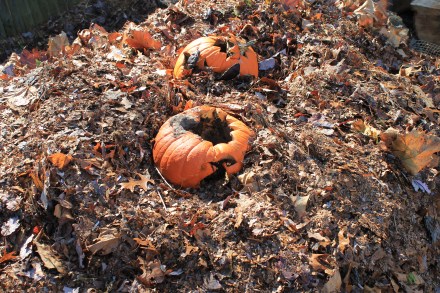
I see value in every garbage can and recycling bin, and scrounging up these leftovers pays off in a very modest way as a local environmental good and a micro investment in my property. Each year’s compost heap adds a lot of fresh, healthy biomass to my yard, and stands as a convenient destination for organic discards. Time to toss the Halloween pumpkins? The puckered-up ol’ Jack O’Lanterns on the porch do cannonballs straight into my pile.

Jack o' Lanterns get tossed into my pile each fall.

Jack o’ Lanterns get tossed into my pile each fall.

Cover with a rounded-up mess o’ leaves, and repeat. Next with a bagful of gleanings from the bottom of a rabbit cage, courtesy of my next-door neighbors. Or a dusting of wood ash from my fireplace, or the tired-out dirt from an old flower pot, upended into a tsunami of fall leaves. It all adds up, into the distillation that is my pile.

I’m sure other compost compilers in other places have their own localized routines and recipes. I’ve seen lists of all the things you can compost, and it’s an impressive array, from dryer lint to hair swept from the floor of the barber shop.

It’s a dirty, messy  and inconvenient truth that we waste an untold amount of green biomass, mostly food but a lot of other things made from nature or manufactured by man. Most of the composting books I’ve perused include charts of the sundry materials that can be safely composted, and the listings are impressively creative and diverse.

In “Let It Rot,” Stu Campbell includes such items as feathers (very high in nitrogen and phosphoric acid), tobacco dust and stems (a rich source of potash) and bat guano (pretty much the richest manure around).

Cardboard and “‘Zoo Poo’ made from elephant, rhinoceros and other herbivorous animals’ poo,” make the list in Nicky Scott’s “How to Make and Use Compost — the Ultimate Guide.”

The silliest thing I will admit to adding to my pile is a gathering of fingernail clippings, cupped in my hand until I ambled outside to my pile. My pile makes work for idle, if manicured, hands.

I also once visited a work colleague who lived in a beautiful apartment in a stable house at a Connecticut estate and, much to her bemusement, brought home with me a bucket of horse manure. The horses she lived above were worth millions, and their droppings added value to my pile as well.

Such inputs are a very modest offset to the magnitudes more of soil that is lost each year across the living skin of the earth.

The United Nations proclaimed 2015 as the “International Year of Soil,” I read on biocycle.net, a website maintained by the “organics recycling authority.” What’s more, Dec. 5, is World Soil Day, my monthly issue of National Geographic reveals. “Soil, in which nearly all our food grows, is a living resource that takes years to form. Yet it can vanish in minutes …

“Each year 75 billion tons of fertile soil are lost to erosion. That’s alarming — and not just to food producers. Soil can trap huge quantities of carbon dioxide in the form of organic carbon and prevent it from escaping into the atmosphere. Over the course of 25 years, healthy soils can absorb an estimated 10 percent of human-generated carbon emissions.”

Writer Kelsey Nowakowski supplies more factoids:

  • Soil is now eroding up to 20 times faster than it is being developed.
  •  Since 1980, one-third of the world’s arable land has been lost to erosion.

“If we protect and sustainably manage soils,” says Ronald Vargas of the United Nations Food and Agriculture Organization, “we can combat climate change.”

Think globally, garden locally. As Douglas W. Tallamy writes in “Bringing Nature Home,” “Gardeners enjoy their hobby for many reasons: a love of plants and nature, the satisfaction that comes from beautifying home and community, the pleasures of creative effort, the desire to collect rare or unusual species, and the healthful benefits of exercise and outdoor air…

“But now, for the first time in history, gardening has taken on a role that transcends the needs of the gardener. Like it or not, gardeners have become important players in the management of our nation’s wildlife. It is now within the power of individual gardeners to do something that we all dream of doing: to ‘make a difference.’ In this case, the ‘difference’ will be to the future of biodiversity, to the native plants and animals of North America and the ecosystems that sustain them…

“I needn’t elaborate on the many things our garden do for us,” Tallamy continues. “Properly designed, gardens tie our homes to the surrounding landscape as well as provide an outlet for artistic expression and a source of natural beauty that be enjoyed year round. Our gardens also offer us refuge from an increasingly hectic and unpleasant world. But because gardens are, in essence, groups of plants, they also have the potential to perform the same essential biological roles fulfilled by healthy plant communities everywhere.”

Tending my pile offers me plenty of good ol’ fashioned outdoor exercise. It serves as a crunchy-granola hobby, it keeps me at home and out of trouble further afield, and it all costs next to nothing.

If that all sounds simple and skinflint, know that the payoff is profoundly rich and complex. A garden that is healthy — diverse, well-balanced — begins with and is sustained by regularly replenishment of newly minted soil that is commensurately rich and complex and wholly in sync with the native ground from which it comes.

That’s compost. That’s my pile. Decomposers also “play a vital role in keeping the [plant and animal] in balance,” adds Tallamy. “Most decomposers are insects, and they can be present in fantastic numbers, ready to recycle the nutrients in dead plants and animals for later use by the living. Decomposers are also important components of the terrestrial food chain and help provide the energy required by higher trophic levels.

By adding the richness of organic compost to my garden, I can forsake the costly herbicides and pesticides required to keep most suburban gardens perky and pest-free. “Would we not better achieve our goal of a pest-free garden if we employed nature herself to look after things?” asks Tallamy. ” We have spent the last half-century proving beyond the shadow of a doubt that a sterile garden does not work. It is a high-input enterprice requiring more time and money than most of us would like, or are able, to devote or spend.”

Bottom line? I think there’s a bit of the Connecticut Yankee in every composter, wherever their backyard heap may be.

Some kitchen scraps, a half bucket of seaweed, and a bag from the neighbor's rabbit hut. All good to go!

Some kitchen scraps, a half bucket of seaweed, and a bag from the neighbor’s rabbit hut. All good to go into my pile.


My Pile: All the Trimmings

It’s the day after Thanksgiving, Black Friday as they now call it. My shopping today will be all for my pile, and I don’t have far to go to collect it.

My pile is freshly stuffed with a new supply of seaweed gleaned from the local beach after a pre-feast walk. The compost bucket is full of kitchen trimmings and plate scrapings. I heap the leftovers of the leftovers and turn to top off my pile with a fresh and final gathering of leaves.

A fresh batch of seaweed, spiked by sea grass, tamps down my pile on Thanksgiving day.

A fresh batch of seaweed, spiked by sea grass, tamps down my pile on Thanksgiving day.

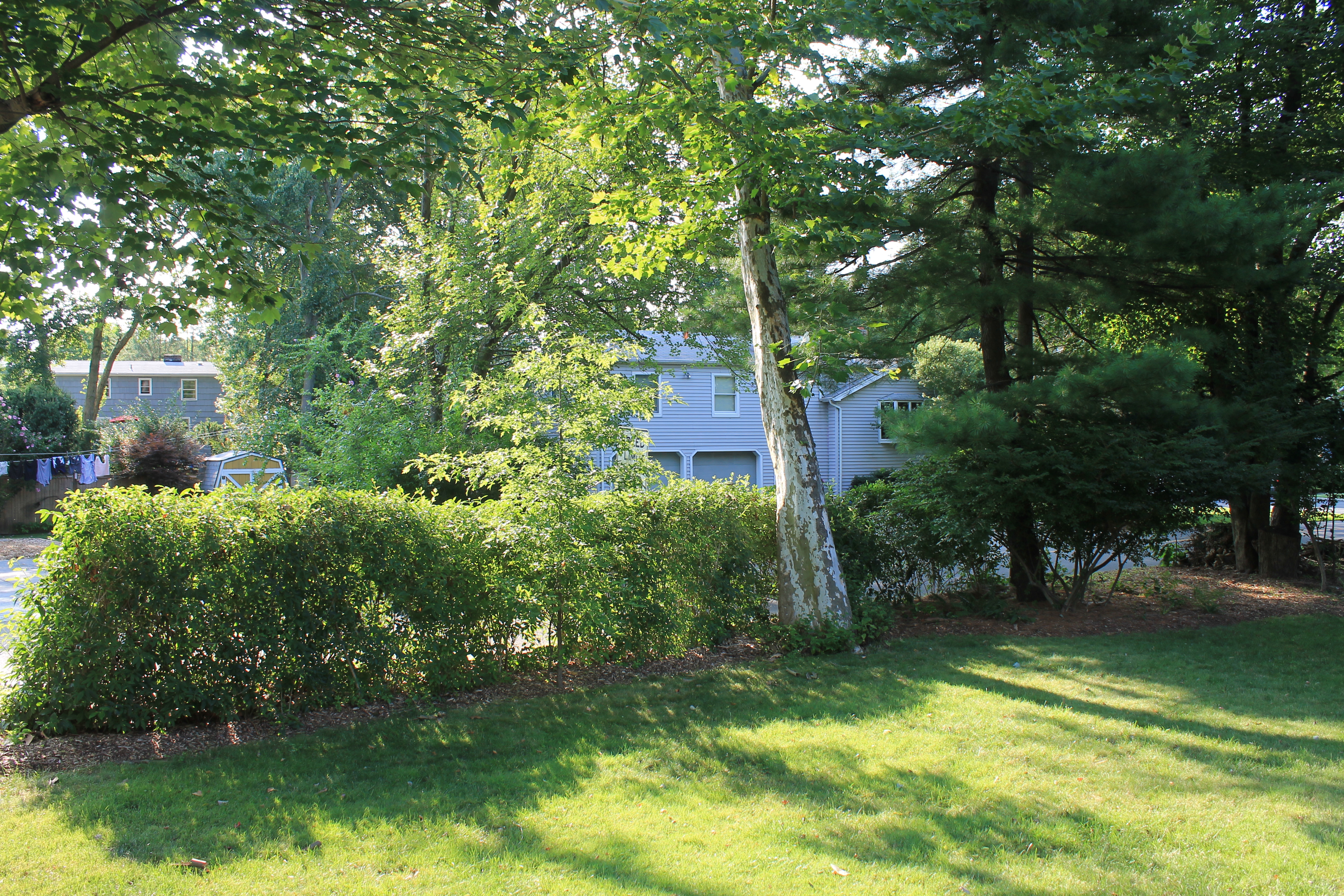
On the north side of my corner lot, two 30-foot strips of forsythia bushes line the road, flanking either side of the driveway.

I prize the forsythia hedge for shocking my yard back to life each spring with its vibrant display of small yellow flowers that spark upward along spiky stems, exploding like fireworks above the more dainty crocuses and daffodils poking up from the wood chips underneath.

Come summer their profuse cloak of growth creates a privacy screen for my house and yard, impenetrable to even the dog chasing after a muffed tennis ball. The deer don’t touch their small oblate leaves, and their pick-up-sticks matrix of stems give perch and refuge to the flocks of dusky sparrows and colorful chorus of finches and wrens and cardinals that flit back and forth from the bird feeder I’ve hung from the lowest branch of a nearby maple.

Rooting out a mess of leaves from the tenacious limbs of the forsythia hedgerow is always among the last tasks of the fall cleanup.

I keep these tangly hedgerows trimmed about head high, just wide enough to reach over the middle with my clippers from either side.

Not only does the forsythia usher in the growing season with its burst of spring yellow and prolific growth, it’s about the last deciduous planting to give up its leaves for the year.

Being set along the road and within the spread of a sycamore, four maples and a pine — and a gust away from a cluster of ancient oaks nearby — the forsythia also serve as catch-all windrows that snag all the leaves blown their way. By the end of each fall, the spiky shoots that form the base of each forsythia bush have trapped a deep layer of rotting leaves. Papery sycamore and waxy oak leaves are suspended mid-air like so many plastic bags stuck in a tree along a highway.

Extracting this leafy mess is a chore, and some years I don’t even bother. I either leave the detritus to settle into itself or cover up the base with shovelfuls of wood chips tossed into the hedgerows. But having assiduously raked or mulched up the rest of my leaves this fall, and having some newfound capacity in my pile, I decide to plunge in.

First, I tease out the top layer of leaves with a rake, the tines bucking and bowing with each thrust and parry into the tangle of limbs.

With the easy pickings gleaned with the rake, it gets down to hand-to-hand combat. I’ve tried blowing out the leaves by poking at the leaves still locked in the base of each arching bush with the nuzzle of my leaf blower. But it’s a noisy job and success can only be achieved by a scorched-earth sort of blowing to blast out the holdouts.

I’ve found it’s just as well to kneel down to grab the wet leaf mold and pluck the stray leaves by the handful. I wear a heavy work jacket, but have no defense against the springy broken branches that whip back up into my face, aside from my eye glasses.

That lack of protection has hurt me before. As a high schooler, I made pocket money by mowing and tending the lawns of a half-dozen neighbors. One yard I cared for had a similar hedgerow, and one fall I was raking leaves from out of the bushes when the tip of a branch poked me in the eye. It hurt, then kept hurting. After a few teary days, my mom took me to the doctor. He took x-rays and showed me the film, which revealed that a tip of a branch had penetrated my eye socket, broken off and was lodged behind my eyeball. I still remember the sight of the x-ray, showing the ghostly image of a perfectly formed bud tucked behind the orb of my eyeball.

I also still remember quite vividly the experience of the surgical procedure to remove that bud from behind my eyeball; the pinchers forcing my eyelids apart; the slender needle of anesthetic poking into my eyeball, bending; the brusque bending of the eyeball itself as the surgeon got behind it to remove the fat splinter. And I remember going to my high school football coach, wearing an eye patch, to say that I would have to miss the Friday night game. I was a receiver, and he asked me if I could still play if I could just line up “on my good side.” He was a very winning coach, but that game I sat on the sidelines.

Forsythia doesn’t give up its leaf litter without a fight. But it’s worth it for my pile.

The two rows of forsythia produce four long rows of heavy, wet leaves, thick with rich crumbly leaf mold and studded with broken branches flicked up by the aggressive raking.

This collection is too heavy and too “sticky” to move with my old bedsheet, so I use a small plastic tarp, about 3 ft. wide, 5 ft. long and rimmed by a clothesline laced through  grommets along its edges.

I rake the dense leaf and shrub litter onto the tarp and drag it over to the pile, six loads in all. It’s good stuff — a heavy topper of veteran brown stuff that, once moved, will now resolutely refuse to be scattered about again by any winter wind storm. It will easily absorb the rain and blankets of snow that will come. This thick layer of leaf mold and half-rotted wood chips gives my pile reassuring bulk, a fine addition to the freshly deposited Thanksgiving scraps, seaweed and the last big harvest of leaves.

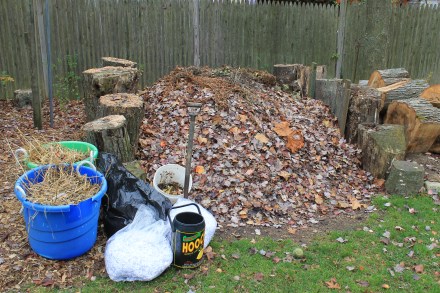
The dark top portion is from underneath my forsythia hedgerows.

The dark portion of leaves atop my growing pile is from underneath my forsythia hedgerows.

My Pile: It Takes a Village

The Latin origin of compost is “compositum,” which can mean a few things, among them “made up of little pieces.” The word “compost” as we know it today, a “mixture of leaves, manure, etc., for fertilizing land,” stems from an Old French word, composte, the roots of which are “bring” and “together.”

My pile defines all that and more, both in and of itself and because of the way it brings together the small community that is made up of my nearest neighbors. It’s been said that it takes a village to raise a child, and the same is true of my pile. I’ve come to share its building up with these neighbors, and we share alike the disbursement of the homegrown bounty that is its final result.

A good thing, too, because my pile now needs a little help from its friends. In recent years I’ve lost four rotted old swamp maples in my yard, undermined by the slow, pernicious work of carpenter ants and then toppled by the sudden coup de grace of a Nor’easter or hurricane. Gone, too, is a tulip magnolia in the front yard that in a future post I will take blame for killing with too much love in the form of a smothering load of wood chips. (I still mourn that specimen of a tree for its blossoms in the spring, less so for its waxy leaves that seemed immune to composting.)

Still, that’s five or more tall trees full of leaves that have gone missing from my pile. So much, that for the first time early this fall, I gave some thought to not having enough leaves and stuff of my own to fill my pile as it now stands between its twin log walls.

Good thing that my pile now takes in an ever greater supply of leaves and other compostibles from the neighboring homes that surround my corner property, four in all. In their own ways, my neighbors have come to value my pile, as a convenient depot for their own garden and kitchen waste, as well as a source for potting soil and refreshment of topsoil for their gardens. And that’s a very good thing for my pile.

The family whose home is to the back, southern side of my property nowadays simply rakes their leaves in their front yard into a big pile; they know before long I’ll be by with my handy bedsheet to drag them all away. They also keep their kitchen scraps in a lidded bucket by the back door for me to collect on a weekly basis. A homespun family of six that rarely goes out to eat, their kitchen contributions to my pile far outstrip that of my own.

An older, empty nest couple lives on the western side of my corner lot, and for them I haul away the leaves of the sycamore tree on my side of the fence that collect in messy drifts in their driveway. You could argue (and I think they do over the dinner table) that all those leaves are my responsibility anyway. I don’t mind; they are sweet super seniors who are ever-friendly when talking over the short fence that separates us, and who often bring over home-baked goods.  Besides, I’ve read that sycamore leaves make particularly good leaf mold.

My pile is gluttonous, and I have no problem spending a few minutes cleaning up their yard in the fall or shoveling snow from their steps in winter. My pile is a mix of altruism and self-interest, which is another way to define community.

My other neighbor across the street, to the north, donates grass clippings from his mower basket all summer long; he also gives me a shopping bag full of rabbit bedding and pellets every week or so, from the family pet. In the fall he bags most of his leaves, though I’ll pitch in when he cleans the leaves from along the street we share, and drag a load over to my pile.

The fourth adjoining neighbor, a retiree who lives with his wife in a home she grew up in across the other street of my corner lot, to the east, used to spend hours sucking up leaves from their small, tidy lawn with a vacuum attachment to his electric leaf blower. It would take him an afternoon to fill a garbage can or two with pureed mulch, which he would then load into his pickup truck to take to the yard-waste center.

We’re friendly, and I was only too happy to take the burdensome can of finely chopped leaves off his hands. It always made a fine addition to my much more fulsome heap of whole leaves.

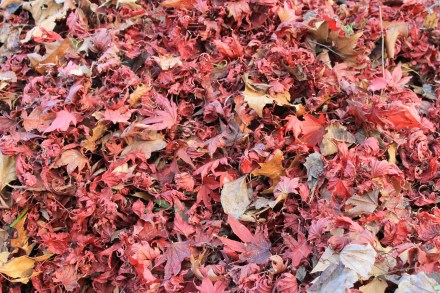
Most prized are the contributions from the two large Japanese maple trees in his yard, which drop their vibrant crimson leaves late each fall, in a shudder like Harry Potter’s whomping willow. I covet those delicate, star-shaped leaves each fall like no other, and over the past several years have gladly crossed the street with my rake and bedsheet to sweep them up and add them to my pile, icing on a cake.

A closeup of the Japanese maple leaves, a prized addition to my pile.

A closeup of the Japanese maple leaves, a prized addition to my pile.

It’s the color that attracts me, though I am intrigued to find that I might be swayed by more basic instincts.

Joanna Klein explain things further, both the poetry and the science, in a New York Times article, “Why Does Fall Foliage Turn So Red and Fiery? It Depends.”

“Leaves scream their final cries in color before dropping to the ground. Their shouts — in golden, crimson or scarlet — eventually fade to brown bellows, and their lifeless bodies dry up on the forest floor. It absorbs their crinkly corpses and that’s it — worm food. The fall of a leaf in autumn is an orchestrated death. A complex, brilliant, beautiful death.

“When you think of it as watching the death of leaves, it sounds morbid, but it’s captivating nonetheless. Does the way some turn red in the process serve any purpose?

“Leaves actually start out yellow. Chlorophyll, the chemical responsible for giving leaves their green appearance and converting light to energy during photosynthesis, just overpowers it in the spring and summer. But when temperature, daylight and weather events like rain or drought cause leaves to die in the fall, chlorophyll breaks down and reveals the yellow or orange helper chemicals known as carotenes or carotenoids that were there all along.

“Red is another story, because it’s made on purpose. As some leaves die, they produce chemicals called anthocyanins (also found in the skin of grapes and apples) from built up sugars. These chemicals produce a red pigment that can combine with green pigments left from chlorophyll and display different shades of red.”

“How bright this red is depends on what species the leaf belongs to, its inherent genetics and the environment around it …. but the question still remains: Why do some leaves use precious energy to turn red right before dying?

“According to a 2007 paper, published in The Botanical Review, red and yellow fall leaves could be flashing arrows that attract birds and mammals to a tree’s fruits. Animals that stop by for a bite will then do what animals do, dispersing the seeds as they go, thereby aiding in the species’ survival. On the other hand, colored leaves could work like the wings of the monarch butterfly, warning others about bad-tasting defensive poisons or chemicals that tend to be in red leaves.

“But this could be wrong, too. Pests laying eggs in the fall might prefer drab plants rather than bright ones, leaving the bright ones to survive. “It may be an ‘I’m super-healthy, don’t bother’ signal to potential insects, pests, or parasites that they should look elsewhere,” Kerissa Battle, a community science educator at Community Greenways Collaborative, wrote in an email. But then again, she said, the red color could also signal that a leaf is on its way out, and there’s not much healthy stuff left to eat before it drops.”

For me, red in a leaf is like a matador’s cape to a bull — an irresistible signal to gather what I can, while I can, from wherever I can, for my pile. And when the delicate, scalloped, deep scarlet leaves of the Japanese maples fall upon my neighbor’s lawn, I’m there to catch them practically before they land. Otherwise, I’ll miss out on them if not altogether, then at least as a whole.

Over time, my neighbor wore out his little blower turned leaf sucker. He now mows his leaves into mulch on the ground, rakes them onto a big blue tarp and drags the load across the street over to my pile. If I’m around, I’m happy to help. My neighbor is very happy with our arrangement, and now spends a fraction of the time he once did in cleaning up his yard each fall.

There’s actually a fifth neighbor who comes into play with my pile. My neighbor’s neighbor across the street is a single woman who lives with her elderly father; her house is lorded over by several large oak trees, many of which fall on the street side of her white picket fence. I still have the thank-you card she kindly sent me after a buddy and I swept her leaves along the street onto my bedsheet and dragged them over to my pile. The card reads, “Anyone can be cool, but awesome takes practice.

Since the late 1980s, Connecticut towns have been required to recycle a number of things, including all leaves. Most of the yard waste is collected at a town-run facility on the other side of town. I’ve heard that the town’s yard waste used to be composted locally, but some years back the local recycling operation was blocked by neighborhood opposition to the thought of mold spores emanating from the facility.

So the town shut down the composting facility and sold off its machinery. (Once nearly denuded of trees, our part of the Northeast is now heavily wooded, and I can’t imagine how you’d make the argument that a local compost yard would produce any kind of mold that’s different from what comes out of all the other woods and bogs and fields and yards that make up our part of the world, but that’s NIMBY for you.)

In our neighborhood, the composting is very much an IMBY affair. Aside from generating lots of nice neighborly feelings, I figure my pile now takes in the bulk of leaves from nearly a three-acre reach of suburbia, counting pavement. That’s six homes that have gone “off the grid” of the town’s fall leaf cleanup.

My pile is awesome…


My Pile: Full of Sheet

My father introduced me and my brother to the convenience of using an old bed sheet for gathering up autumn leaves. We lived in Kentucky at the time, on a two-acre lot with a parkland spread of mature hardwood trees that produced copious amounts of leaves each fall.

We’d rake the leaves into big piles, spread a sheet across the just-swept ground next to the pile and rake and “kick-walk” the leaves high onto the sheet.

Of course, this process works only if you have a nearby place to dispose of the leaves en masse, and we did – across the street was a wooded ravine that sloped down to a creek, too steep to develop as a home lot.

Gathering together two corners each, like a king-sized hammock, we’d drag the sheet, bulging with leaves, across the street and unfurl it down the steep slope that began just past the pavement.

I’ve used the same old bed sheet in my much smaller yard for the past four or five years. It’s battle-scarred, ripped by sticks, stained by mud and tannins and sporting a duct-tape patch over a tear in the middle that a few years threatened to render it useless. The tear has been joined by a few new small rips, but the sheet is still serviceable.

I rake a patch of lawn or the side of the street clear of leaves and spread the sheet downwind of the pile. I cover the sheet with leaves, pluck up the four corners and twist them together, then sling the bag over my shoulder. I feel like Santa Claus delivering the bag of leaves to my pile.

It’s quickest and easiest to move leaves by staying close to the ground with a bedsheet, blanket or tarp.

Depending on the amount of moisture within the leaves, or whether the piles I’m making are from mulching with the mower, each sheet-load weighs, I’d guess, 50 pounds or so. Sometimes it’s light enough for me to swing off my shoulder and fling up onto the pile, more often I clamber up the log staircase on one side of the pile and drag the sheet up to the top. I release the bottom two corners and pull the top two toward me. With a little fididdling, I can usually draw the emptying sheet toward me to drop its payload on just the part of the pile I want.

To my mind, it’s far easier and rewarding to gather up my leaves in this way and keep them on-site. My old bed sheet does the trick; I also have a 3 ft. x 5 ft. rope-rigged plastic tarp for smaller or heavier jobs.

The alternative: stuffing a dozen or more tall brown bags with leaves each time I’m out in my yard, holds little appeal. For one, it’s hard to grasp a mess of leaves. And jamming leaves down the throat of an open-ended brown paper bag is a frustrating lesson in proving the 90-percent air theory of leaves; it takes forever to stuff a bag full, even if you don’t rip it first with a stray branch or wayward tine.

I know most people are happy for the town to take all those bags off their hands or hire out a service and be left with a blown-clean yard, but I see both as a colossal yearly waste of municipal resources, and my own.

The yearly cleanup of leaves is a costly burden to communities across the nation. Pick a suburban town at random, say, The City of Oak Park, Michigan. The town runs a leaf-pickup program in which residents rake leaves from their property into rows along the street. Crews come by once a week in October and “generally” every two weeks in November and December.

Leaves raked to the gutter line of a street in Oak Park, Mich., at a high cost to the town.

Leaves raked to the gutter line of a street in Oak Park, Mich., at a high cost to the town.

Its website reports: “With municipal budgets being squeezed further each year, the expense of leaf collection/composting programs is being scrutinized as well. One study reported the average cost of a municipal leaf collection program per 1,000 population of $2,353.41.”

Tallying up the cost of equipment and labor, Oak Park spends about $370 per mile of curb to vacuum up leaves each fall.

“Since before 1995 when the Federal Solid Waste Management Act eliminated the disposal of yard waste in landfills and the Clean Air Act simultaneously became more stringent regarding burning of tree leaves, homeowners have become accustomed to raking leaves to the curb for collection. However, ongoing research at Michigan State University, Purdue University and others has demonstrated numerous benefits to mulching leaves on-site including, improved soil organic matter, nutrient levels and reduced presence of broadleaf weeds.”

I’ll get around to explaining what my pile allows me to return to the yard each season later, but to take all this material away from its source, midstream in the life cycle, seems a clear-cut loss to me. No wonder companies sell so much fertilizer each spring, after so many consumers spend so much paying to have it taken away from their homes each fall.

Mark Gilliland, writing for the New York State Conservationist, spells out the situation in more detail and offers a solution for New Yorkers to “Love ‘Em and Leave ‘Em”:

“To maintain a healthy lawn, fall’s leaves must be managed in some way. If you live in a city, town or village, many of these municipalities provide a service to pick up the leaves and take them to a compost facility. Often a portion of this compost is made available to residents. Compost can be used as mulch, tilled into the soil or spread in a thin layer on the lawn. It retains soil moisture, adds nutrients and beneficial microorganisms, and improves soil structure.

“While collecting leaves and composting on a large scale is great, in densely populated suburban areas this may not always be a cost-effective and available option, and it can have drawbacks. For municipal pickup, leaves are frequently raked or blown into piles on the curb. Sometimes these piles spread out, creating a safety hazard for drivers and pedestrians. Leaf piles can also wash into storm drains, clogging storm sewers and causing flooding. Some communities require homeowners to put their leaves into bags by the curb. Aside from the amount of effort it takes to move bagged or loose leaves to the curb for pick up, where destination facilities are distant, the transportation takes a lot of fuel and generates emissions.

There is another option for property owners to deal with fall’s bounty of leaves: an initiative that the Village of Irvington in Westchester County and some local municipalities have instituted. It’s called “Love ‘Em and Leave ‘Em.” Simply put, the idea is to mulch (shred) your leaves in place. It’s an easy practice to do, and has a number of benefits, including:

  • Keeps your property healthy: Leaf mulch recycles nutrients into your soil to feed your plants, improves soil health, helps retain moisture (reducing the need for watering in dry spells), and provides additional winter coverage for plant roots.
  • Saves money: Helps keep your taxes down by reducing municipal leaf pickup and costs associated with municipal composting or disposal.
  • Saves effort: Many homeowners (and landscapers) find that mulching leaves in place is easier than raking or blowing them to the curb or stuffing leaves into bags.
  • Helps the planet: Avoids the energy use and air emissions associated with transporting leaves to a distant composting or disposal facility.”
A common sight in these parts each fall; seems to me a waste of labor and resources.

A common sight in these parts each fall; seems to me a waste of labor and resources.


I do admit to having some envy for the lawn maintenance crews that use a vacuum hose to scarf up leaves and shred them to pieces into a big wooden box in the back of a pick-up or two-ton. What use I could make of all that finely chopped leaf litter!

But my homestyle method works for me and my pile, and a few sheetfuls helps all the way around. I know my pile will soon settle down into itself. I always try to add a layer or two of green stuff between loads or at the end, and I know I’ll be able to repeat the feeding in a day or two.

As Henry David Thoreau wrote, “It is pleasant to walk over the beds of these fresh, crisp, and rustling leaves. How beautifully they go to their graves! How gently lay themselves down and turn to mould! Painted of a thousand hues, and fit to make the beds of us living.”