My Pile: Falling Into Place

It’s a Saturday in the lingering warm autumn days of mid-November, the weekend before the Thanksgiving holiday. With a soaking rain due to arrive on Sunday, high time to do the final fall yard cleanup and fully stuff my pile.

Leaf season in these parts lasts about six weeks, beginning in early October when the first leaves start to flutter down from the tops of the maples and sycamores that ring my yard. Some fall on the lawn and garden and gutters; many seem to find their way to the street, where they are then blown to the curb by passing cars and delivery trucks.

I focus on the street leaves first, as they’re easy to rake up in piles to transport wholesale to my pile. It keeps the gutters and storm drains from clogging and makes me look like a good neighbor, in a curb-appeal sort of way. And my pile, its coffers emptied, will take in all it can get.

As the trees withdraw their stores of energy from the canopy down to their roots, they shed their colorful crop in measured doses, spiked by a blustery fall storm or cold snap.

This steady retreat is halted at ground level, where the plantings extend their growing season until the last possible moment. Most autumns, the lawn kicks in with a burst of renewed growth, spurred on by warm days, cooler nights and fall rains; in flush years I have to mow it weekly through the fall. The kitchen garden hangs on with its diminishing returns until the first hard frost, usually in late October. The perennials and small shrubs and ornamental trees that now crowd my garden beds hang on to their color and berries nearly till Thanksgiving.
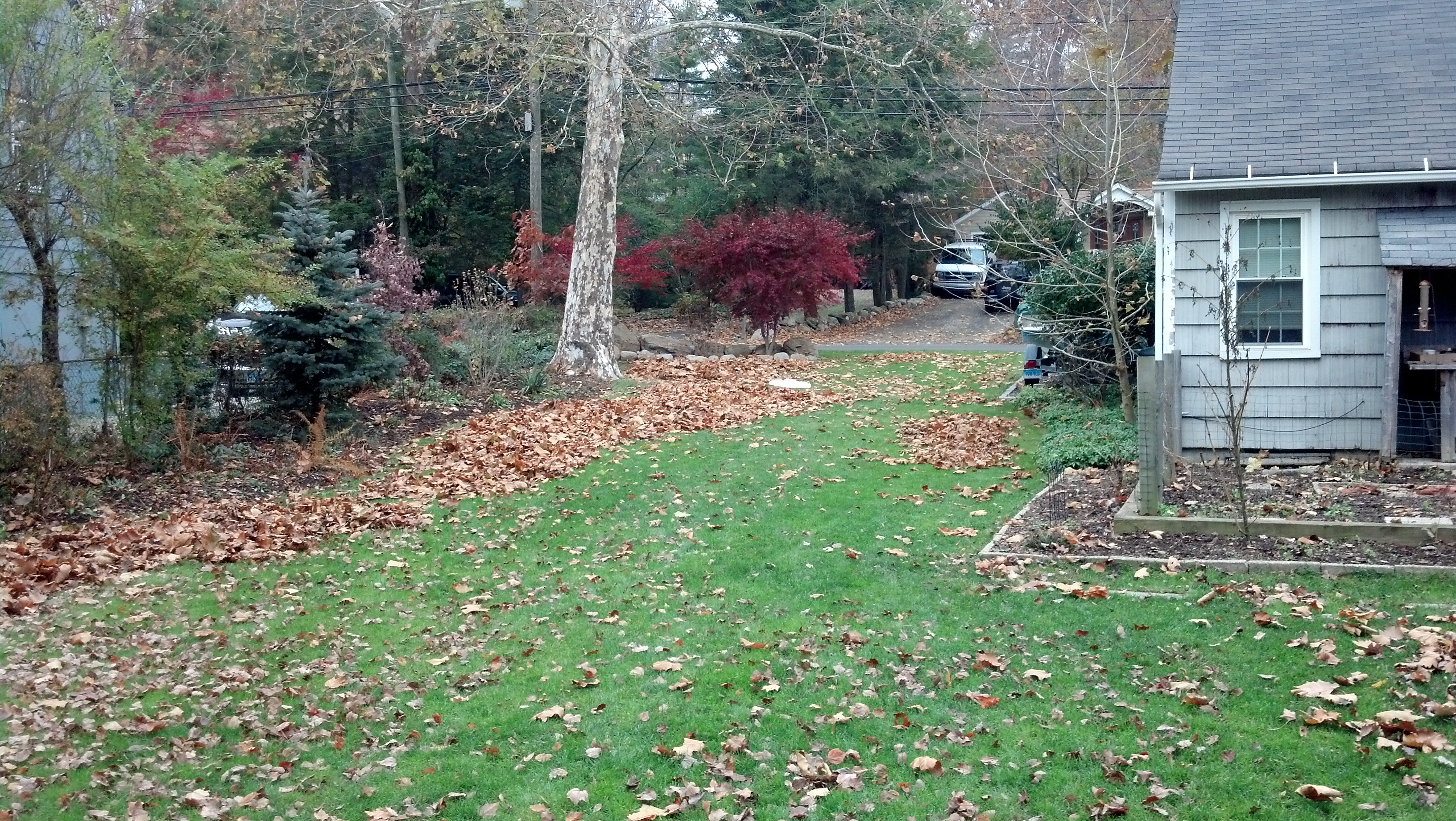
By mid-November, the big trees have shed their leaves, while other parts of the yard hang in there.

By mid-November, the tall trees have shed their leaves, while the shrubs and bushes cling to their season’s growth.

All of this seasonal growth is dispatched to my pile according to its schedule, and my own, which turns out to be exactly what we both need. The process of putting my lawn and garden to bed for the winter and filling up my pile is one of my favorite times of the year. It’s certainly the most active, a race to harvest the year’s outpourings and put them to a creative, productive end use. And what better time to be outdoors and soaking in the daylight of a lingering Indian summer before the long New England winter sets in.

For a very cool look at how this seasonal cycle of growth plays out on a global level, check out this NASA animation of the yearly cycle of plant life on the land and in the water. The place I hold on this map turns from brown to green and back again.

My pile follows a yearly cycle of growth, as this NASA animation of the earth's biosphere attests. (Click on image to see it play out.)

My pile follows a yearly cycle of growth, as this NASA animation of the earth’s biosphere attests. (Click on image to see it play out.)

Green grass and brown leaves are the two main components of my suburban backyard pile, by bulk. As I start my pile each fall, it’s easy to add heaping layers of each – an after-work session of leaf raking, followed by a weekend mow. At its most basic level, the most productive compost pile is one with a healthy proportion of fresh green things and dead brown material. A pile of cut grass cooks itself into a rotten mess; a pile of leaves just sits there. Mixed together, they have real chemistry.

As much as I can, I add a host of other ingredients to my pile, mostly aimed at following a layered approach to building up my pile for an active winter season of internal combustion of green and brown.

Here’s how it plays out in my backyard: If I rake up a batch of leaves one day after work, the next day I’ll take the dog for a run on the beach. I bring with me a plastic bucket – the kind you use to set a beer keg in and fill with ice – and scrap up a bucket-full of seaweed from the high-tide line to take home with me back to my pile. In my town, dogs are allowed back on the public beaches on Oct. 1; he loves chasing after a tennis ball, and I’ll take every chance I get to collect seaweed while we’re at it.

Later in the week, I’ll hit another spot in my yard or the street for more leaves, then add a bucket full of kitchen scraps, from both my house and my neighbor’s; or perhaps another neighbor has left a shopping bag full of shavings and poop from their rabbit hutch. Or I’ll stop by Starbuck’s for a groaning bag of coffee grounds.

“The word harvest comes from the Old Norse word haust meaning “to gather or pluck,” I find on dictionary.com. “The season we call fall was once referred to simply as “harvest” to reflect the time when farmers gathered their crops for winter storage, roughly between August and November. Astronomically, the season lasts from the end of the September until December, between the autumnal equinox and the winter solstice in the Northern Hemisphere.”

“In the early 1600s as more people started moving into cities, the word harvest fell out of use. Instead, city dwellers began to use the phrase ‘fall of the leaf’ to refer to the third season of the year when trees lose their leaves. The word fall comes from the Old English word feallan which means ‘to fall or to die.'”  (The word autumn comes from the ancient Etruscan root autu- and has within it connotations of the passing of the year. It was borrowed by the neighbouring Romans, and became the Latin word autumnus. As more people gradually moved from working the land to living in towns, the word harvest lost its reference to the time of year and came to refer only to the actual activity of reaping, and autumn, as well as fall, began to replace it as a reference to the season. Evidently, I read further, nowadays only the British use “autumn.”)

In any event, and at last, inexorably, every autumn my pile falls into place. Each harvest of pluckings gathered from kitchen, beach or dumpster is topped off by the latest collection of fallen leaves. If mulched into pieces, all the better.

The “at last” of leaf drop varies from season to season, though the timing is increasingly much up in the air. “As the seasonal change creeps later into the year, not only here but all across the northern United States and Canada, the glorious colors will last longer,” writes Craig S. Smith in The New York Times in a 2016 article, “How a Changing Climate Is Shaping a Leaf Peeper’s Paradise.”

“We only have to read Henry David Thoreau to know that climate change is pushing the changing colors into the year,” Smith continues. “In his 1862 essay, “Autumnal Tints,” the naturalist wrote: ‘By the twenty-five of September, the Red Maples generally are beginning to be ripe. Some large ones have been conspicuously changing for a week, and some single trees are now very brilliant.”

Nowadays? “‘In general, peak leaf color in Concord and the surrounding Boston area for these maples is now more typically a week or two later,’ than what Thoreau observed, said Richard Primack, a biology professor at Boston University.”

In fact, Smith cites data that sound even worse. Looking at autumn color in a central Massachusetts forest studied form 1993 to 2010, he predicts that “the duration of the fall display would increase about one day for every 10 years.” That’s a week per lifetime, and may explain why I feel like I’ve been raking leaves for a lifetime this fall, and will continue into December.

The point is, this slow-motion fall does give me time to add that many successive layers of sundry green additions, which contribute their own energy and froth to the mix. Though after every work session with my pile, as much as I tell myself that this is no garden-variety pile that I am making, it always ends up looking the same – a big, boring old heap of dead leaves.

Until, that is, the first hard freeze of fall, when this multi-layered approach gives the unmistakable sign that my backyard bio-engineering is paying off: On frosty mornings a vent of steam rises from the crown of my pile like the tell-tale plume of a brewing volcano. I won’t much disturb this big fat brown cocoon until early spring, and then only to add fresh hot compostibles to it. Until then, I know my pile will be cooking under its own weight and energy. It’s taken in everything that I can throw into it, and will now make that lot its own.

Proof that my multi-layered approach pays off; steam rising from the depths of my pile in late fall.

Proof that my multi-layered approach pays off; steam rising from the depths of my pile in late fall.

My Pile: A New Home Base

Some years ago I relocated from Los Angeles to Connecticut, landing a better gig with a golf magazine, and looking forward to a change of scenery. I plunged into marriage, then homeownership, buying a tidy little Cape in Westport with a sizable yard of trees and grass and not far from Long Island Sound.

At last, I had a compost pile that I could call my own. We had a son, and it was nice while it lasted. Then things fell apart, and I ended up buying a smaller, cottage-style house nearby for me and my 5-year-old boy.

It was an old widow’s home, with a seriously overgrown yard on a one-third acre lot studded with tall trees, including several different types of maple, two large sycamores, a pair of mulberry trees, a big white pine, a pretty tulip magnolia in front and an ancient, bedraggled willow tree in back. I knew I would buy it the moment I pulled into the driveway to meet the realtor. I was sold on the yard, a reclamation project that I knew would keep me preoccupied while rebuilding my own life.

I heard later from a neighbor that the woman of the house once enjoyed gardening, but after losing her husband and contracting Lyme disease, she gave up on maintaining the property. As she aged in place, a shut-in, the invasive vines and trash trees slowly took over, encroaching from the tree-lined edges of the yard, rolling over her garden borders until only a narrow moat of grass was all that separated her house from a suburban jungle.

When I moved in, the property was the neighborhood eyesore. I couldn’t wait to reclaim the yard from decades of neglect and make it my own.

Closing on the house in May, I spent the summer clearing the property of 20 years of unchecked growth, hauling away truckloads of brush. Spending so much time outdoors, I got to know my neighbors, who would stop by to appraise, and praise, my efforts at overhauling the blighted mess.

The property was so untended that when I was grubbing out the tangled mess of vines in the back corner of the yard, I came across tramplings and scat from deer that had overnighted there in seclusion, though my neighbors’ houses were less than 30 feet away on either side. I also had to encourage the fat and happy groundhog who lived under the back porch to take up residence elsewhere.

After a summer’s worth of sweat equity, the bones of the property were revealed, and they were good.


The west side of the yard, looking from the street to the back corner, where my pile makes its home.

The west side of the yard, looking from the street to the back corner, where my pile makes its home.

A corner lot yet not quite square, the yard had what English garden creator Vita Sackville-West called “minor crookedness.” Plotted from an onion farm that was developed in the postwar years into a modest neighborhood of capes and split-level ranches, the yard slopes from the road in front about a foot in grade, with the back corner the lowest point, tending toward the mucky. The neighborhood is less than a mile from Long Island Sound and just a few feet above the mean high tide line, which means that in wet times the water table rises up to nearly ground level.

A friend in the tree business tackled the trees that needed to come down – a pair of old mulberry trees that draped over two sides of the house, carpet-bombing the roof with purple berries; a slender maple tree fatally wrapped and warped by hairy tentacles of poison ivy that reached far up into the canopy; a bigger, rotted old maple that stood at the center of the new grass lawn I envisioned for toss-and-catch games with my young son.

I recall it being a handsome tree, but it was a swamp maple, considered a junk species by most arborists, and its roots spread far across the ground. Swamp maples sprout early in the spring. Their dense leaves block the sun in summer and come fall their weak, over-extended limbs often fall victim to storms, usually across power lines. Swamp maples are becoming the dominate tree species in the Northeast, unchecked by humans and aided and abetted by deer, turkey and squirrels, who chomp away at oak saplings and acorns and have no use for swamp maple.

Dominating the backyard was an old willow tree, a good three feet thick at the base. It had three main branches, each lopped off about 25 feet off the ground. Years of second growth had sprouted from the topped ends, giving the tree a ragged if still majestic crown. It was a dramatic sight, thickly cloaked in heavy strands of English ivy. I considered keeping it as I worked my way across the rest of the yard, rooting out truckfulls of brush, daydreaming of elaborate treehouse constructions to place atop its thick trunk and tripod arms.

Willow trees, too, are considered second-class citizens of the modern suburban landscape – fast-growing but unruly, messy and weak. They generally don’t age well. I suppose the old widow had the money to trim it but not the cash or will to take it down entirely.

Likewise, I resisted my tree guy’s entreaties to put it out of its misery. Cutting down the huge old willow would nearly double my tree-clearing bill; I got a deal on the maple because it made good firewood to be hauled away as logs, but the soft, spongy wood of the willow wasn’t good for anything. It would cost a small fortune to haul off, even if you could figure out a way to load it into a truck.

Chris, my tree guy, made the decision for me, and I came home from work one day to find it prostrate on the ground, in massive, chopped-up pieces.

It was those chunks of willow that I used to construct the new home base for my pile. I rolled them to the corner of the yard, upending two of the biggest pieces about eight feet apart. I hoisted two more logs atop them each, rejoining the pieces of the limbs so that two logs stood as one across the backside of my pile, about chest high.

I stacked two twinned smaller logs next to the first pillars, pleased to find them about six inches lower than the cuts of the anchor logs. For the third row I used two logs, each about six inches shorter in length than the stacked logs before, and finished with two squat logs of park-your-butt size, creating a wooden crib with twin barked sides that stepped from two feet high to about four feet.

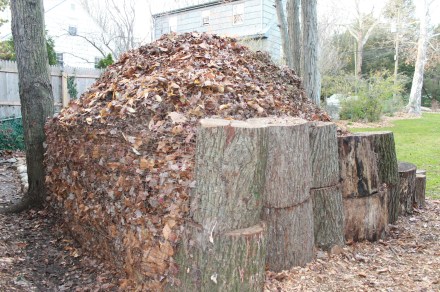
The side wall of my pile, made of logs from an old willow.

The side wall of my pile, made of logs from an old willow.

The whole logs made a decent, if rustic enclosure. I nailed an 10-foot section of wire garden fence, caged from a neighbor, across the back end to complete the three-sided enclosure. I filled the crib with its first batch of leaves and dirt and debris left over from the cleanup of all the brush and tree limbs.

By the time the leaves of the trees left standing began to rain down upon my newly seeded lawn, that first flush of yard waste was well on its way to being cooked. I had a new patch of ground with plenty of green grass for my son to play on, freshly prepared garden beds to plant the coming spring, and a sturdy new home for my compost pile to call its own.

Five seasons later, the willow logs are now encrusted with fungus and molds and sprout mushrooms after rains. They look like old pilings, rotting away as they age in place. But they’ve done their job containing my pile, and adding to it. The log walls harbor billions of fungus spores and bacteria that launch themselves into each year’s new pile, just like my son once did.

Mushrooms sprouting from the rotting log sides of my pile.

Mushrooms sprouting from the rotting log sides of my pile.

My Pile: Gourmet Beginnings

A gardener is very much an editor.

That sensibility has played out over a career largely spent writing and editing for a mix of national magazines. It also might help explain my fascination with the pleasure and the process that is composting.

“The perpetual regeneration of forest parallels the timelessness of literature,” Richard Fortey writes in “The Wood for the Trees: One Man’s Long View of Nature.” A noted paleontologist at the Natural History Museum in London, Fortey retired to a four-acre patch of woodland in Oxfordshire; his book is a closely drawn account of what he found in those ancient woods over the course of a year. “The wood is as old as, or even older than, the great Anglo-Saxon poem Beowolf, proving the endurance of art can be tracked by the life of trees.”

My pile begins as a load of raw if purposeful rubbish that over time and with some effort is refined into a finished product put to immediate use. As such, it is of incremental, temporary value, more ephemeral than lasting. A heap of fresh compost pales in comparison to a stately old beech tree that stands and delivers for generations; my pile is not literature; more like yesterday’s news in search of a better end than as bird-cage liner or a wrapper for Mr. Fortey’s fish ‘n’ chips.

There’s no exact recipe for making compost; it’s a creative, unscripted act, yet its production plays out in a time-honored format and fashion. My pile is very much a magazine; at its root, the word refers to a collection or storage location, like a gunpowder artillery magazine. My pile is the Guns & Ammo of gardening.

My vocation as an writer and editor and my avocation as a backyard gardener and composter go hand in hand. I often mull over writing projects while busying myself with the pruning and curating and transplanting that can keep a suburban backyard gardener preoccupied. I also sometimes plot out garden and landscaping projects while idling myself at work.

I’ve kept a backyard compost pile since my days as a writer/editor with a food magazine in Los Angeles in the mid-1990s.

It was a wonderful job in many respects, chief among them the twice-daily tastings in the test kitchen. Every recipe that ran in the magazine, and then some, were prepared in-house by our chefs, with assists from other staffers and guest editors.

The tastings were held three days a week, the first at 10 am and the second at 2 pm. I was invited to attend not because I had much culinary expertise but because for much of my tenure at the magazine I was the designated male among an office-full of women. Maybe my boss figured that my taste buds, if not discriminating, were at least different enough to give me a seat at the table.

In truth, the dishes were almost always delicious because the chefs could turn even the sketchiest handwritten recipe from some homemaker in Omaha into something to savor.

I’d hang out in the test kitchen as much as I could, watching and listening and smelling all that went into their work while avoiding the stack of recipe transcripts and manuscripts in my inbox.

This was in the early days of modern comfort food, just as the artery-clogging, cholesterol-laden recipes of old were being replaced by Mediterranean menus, featuring lots of vegetables simply prepared and seasoned not with rich sauces but with fresh herbs and garlic. Lots and lots of garlic. I ate amazingly well from 9 to 5, and couldn’t get a date for the better part of three years.

I don’t recall how the subject of me taking home all the trimmings the cooks threw out each day came up, but once they knew of the modest compost heap I’d started in the side yard of the duplex I rented, they happily and conscientiously loaded me up with all the kitchen scraps I could take home at the end of each day.

kitchen scraps

It was gourmet stuff – floppy green carrot tops and big bottoms of fennel bulbs. Pounds of flicked potato peels, whole volumes of papery onion skins. Lots of shrimp shells, as I recall  — all in all, enough, usually, to fill two paper grocery bags every test-kitchen day.

Each issue of the magazine included about 100 recipes, which every month found its way into a million or more kitchens. Food-waste expert Jonathan Bloom, writing in his blog, wastedfood.com, continues the math by reporting that 95 percent of the food waste produced in the U.S. that could be composted actually ends up going into a landfill or incinerator.

Food waste accounts for some 28 percent of all this trash, though Bloom argues that the total amount of food wasted in the U.S. is actually closer to 40 percent when you take into account farm loss or waste between farm and retailer.

Even though a minuscule amount of food and other organic material ends up being composted, overall the recycling or composting of organic material, including paper products and yard trimmings, “prevented 87.2 million tons of material from being disposed in 2013, up from 15 million tons in 1980. Diverting these materials from landfills prevented the release of approximately 186 million metric tons of carbon dioxide equivalent into the air in 2013—equivalent to taking over 39 million cars off the road for a year,” according to an EPA report Bloom cites.

It didn’t occur to me at the time, but I suppose my LA compost pile offset its fair share of the smog I created driving back and forth to work each day, to help produce a magazine made of many acres of wood pulp.

“When we throw away food we don’t just throw away nutrients,” points out David Owen in The Conundrum, “We also throw away the energy we used in keeping it cold as we lost interest in it, as well as the energy that went into growing, harvesting, processing, transporting, and preparing it (assuming we got that far), along with its proportional share of our staggering national consumption of fertilizer, pesticides, irrigation water, packaging, and landfill capacity. According to a 2009 study, more than a quarter of U.S. freshwater use goes into producing food that is later discarded. And rotting food is the main source of the methane — an especially worrisome greenhouse gas — that leaks from landfills.”

I lived in a Spanish-style duplex perched on a knoll at the base of the Hollywood Hills. On the edge of the back patio was a tall Ponderosa pine, its lower branches trimmed so the trunk branched upward and outward into a wide canopy sculpted like a statuespue standard poodle.

It was a gorgeous tree, especially in the evening when the setting sun over the Pacific and across the Los Angeles basin nearly lit it from underneath, making its orange-red bark glow and the waxy green needles sparkle. A patch of ivy covered the slope below it, and there, in the bottom corner of the yard, I carved out my first compost pile, digging steps into the terraced hillside to reach it.

Our landlord actually owned two properties on the narrow lot; our two-story unit and, behind it, a small bungalow that faced the next street over connected to our back patio by a pathway. The bungalow’s backyard was taken up by two old olive trees that shed copious amounts of long slender leaves and a rich rain of black olives.

Alongside the duplex was a sliver of grass bordered by a boxwood hedge beside the walkway to the street. The tiny lawn gave way to a small rose garden perched above the street, with an impenetrably huge hedge of brilliant magenta bougainvillea fronting the sidewalk and running alongside the downhill side of the property.

Though small and set on a hillside, the yard produced enough growth throughout the long California growing season to keep my compost pile in business. I especially liked scooping up piles of the day-glo petals of the bougainvillea to add to the heap, as thin as the breath strips you put on your tongue and just as fast to decompose.

Profoundly spoiled by the chefs in the test kitchen, at times my pile was more kitchen scraps than yard refuse. It was a turbocharged stew of vegetable matter, with just a few rakefuls of pine needles, scratchy live-oak leaves, a dose of grass clippings and a dollop of homegrown rotting olives for me to contribute.

My landlord was happy that I took ownership of the yard, and my downstairs neighbor was pleased, too, that she could clip flowers for her apartment as she wished, and happy to have me puttering about in the yard.

Being a monthly magazine, we worked off an editorial calendar set several months ahead of real time. In October we tested our Christmas menus, which meant that our fattest issues hit at the tail end of California’s dry season and just before the winter rains began. The test kitchen worked overtime in those months, producing turkey after turkey to taste, and more important, all the trimmings for me to take home.

Pound for pound, there wasn’t a more fecund compost pile in all of Los Angeles. I’d pitch my LA compost pile as two hours of a great movie, produced from miles of raw film.

Over the course of several years of magazine issues, my gourmet compost pile helped turn a rented patch of compacted, hardpan dirt into a lush backyard oasis. When the fall rains came, the garden soaked up every drop, and the roses and bougainvillea and rosemary thrived in the California sunshine. And I became a composter.

That all changed when my downstairs neighbor got a baby pot-bellied pig for Christmas…

My Pile: Raking It All In

The capacity of my pile to absorb ever more never ceases to amaze me. It is not so much a bottomless pit, as a topless one.

Over the years, I’ve fine-tuned my fall cleanup. Given the size of my backyard and the time and inclination I have to give to it, I find it simplest — quickest and most efficient, quieter, too — to rake up a batch of leaves by arm and hand rather than to mow and blow and mulch with motorized implements. I figure about half of each season’s leaves goes straight into the pile, wholesale, by gathering up sheets of leaves scraped up from across the lawn and garden beds with a spring-tined metal rake.

Some people hate the very idea of raking leaves, or yard cleanup of any kind. I find it a pleasant excuse to spend time outdoors doing some meditative busy work, crossing a chore of home ownership off the list without having to write a check. For a gardener, raking provides a tactile connection to the ground you tend. I like touching virtually every square foot of my property, at least once a year. Sweeping the ground clean of fallen leaves is a peculiar cross between vacuuming the carpet and giving the dog a scratchy massage.

Heavy lifting? Hardly, if you pace yourself and the ground you sweep clear. A single leaf, untouched by rain or morning dew and dried to a crisp by the sun of an Indian summer, weighs next to nothing. A pile of leaves amounts to more air than anything else. As if to prove the hack golfer’s axiom, a tree really is 90 percent air, even — especially — when its canopy of leaves is splayed flat across the ground.

Every few days through the fall, I try to make time to collect and deposit loads of this ephemeral fluff up across the top of my pile until it spills over the sides, strains against the wire fence stretched across the back and cascades down the open front, each leaf finding its own angle of repose.

Every load gathered up in an old bedsheet is a cottonball of dry, crinkly fluff. It takes only two or three sheetfuls and 20 minutes of time to both tidy up my small tree-lined suburban yard and to fill my pile to capacity for the day. It’s a rhythm that I keep throughout the fall. I enjoy the exercise and the satisfaction of sweeping up such easy pickings.

By volume, the size of my pile is limited by the two rows of logs on either side and the length of wire garden fence, about 9 feet, stretched between the two logs on the back.

Culled from a large maple in my backyard that fell to a Nor’easter a couple years ago, these log pillars are set in ascending order, to better step up and along. So in all, my pile then is about 9 feet wide and 10 or so feet deep. Using the log sides as stepping stones is a bit of a balancing act, but I can generally drag a load of leaves up the sloping front and deposit the batch directly on top.

In years past, when my son was small enough to clamber up the row of logs that brace either side of the pile, he and his friends would delight in jumping in, to be swallowed whole. Their antics would help flatten and smoosh the air out the pile, allowing me to add even more.

He’s long outgrown jumping into a pile of leaves, and as I’ve stepped up my scrounging efforts, my pile is no longer fit for little kids to be free-falling through the coffee grounds, seaweed and rabbit poop that I now add in copious amounts. My pile is now my playground alone.

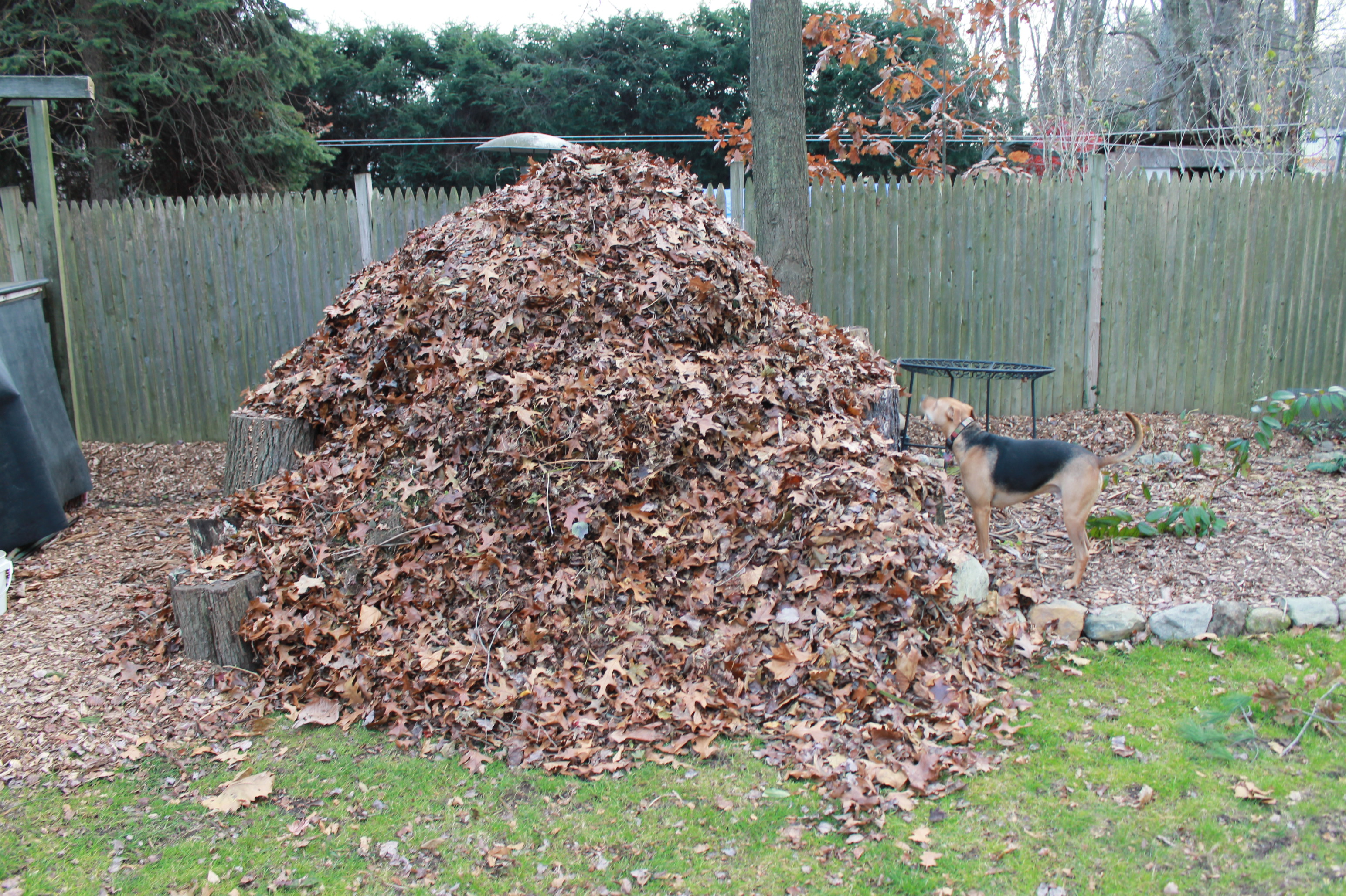
A freshly topped pile after a day of yard cleanup. It will soon breathe out and settle back into itself, soon to be ready to receive more.

A freshly topped pile after a day of yard cleanup. It will soon breathe out and settle back into itself, ready to receive more.


I enjoy the busyness of fall, which for my nascent pile begins in early October when the first leaves begin to drop from the swamp maples and the ever-messy sycamores. I tend to and add to my pile through each season, until it’s ready to harvest in late summer. But the bulk of my pile is amassed over six or so weeks of autumn, with the last big round-up of leaves coming over the Thanksgiving holiday.

As Robert Frost wrote in his poem “Gathering Leaves,” 

Spades take up leaves
No better than spoons,
And bags full of leaves
Are light as balloons.

I make a great noise
Of rustling all day
Like rabbit and deer
Running away.

But the mountains I raise
Elude my embrace,
Flowing over my arms
And into my face.

I may load and unload
Again and again
Till I fill the whole shed,
And what have I then?

Next to nothing for weight,
And since they grew duller
From contact with earth,
Next to nothing for color.

Next to nothing for use.
But a crop is a crop,
And who’s to say where
The harvest shall stop?

I stumbled across the poem while reading an article by Les Line in Audubon Magazine, “In Living Color,” in which the author puts some hard numbers to go along with the poetry in tallying up the season’s leaves, which “fall and fall and fall in uncountable numbers.”

“However, it is possible to calculate their total weight, or mass,” Line writes. “For example, the annual leaf-fall mass in a mature mixed hardwood forest in the Allegheny Mountains of West Virginia ranged from 1.57 to 2.45 tons per acre during the first 19 years of an ongoing study led by U.S. Forest Service soil scientist Mary Beth Adams. ‘It varies a lot from year to year, depending on rainfall, temperature, and insect outbreaks,” she told me, adding that the long-term average was 1.83 tons an acre.”

I read elsewhere that the average mature tree has some 200,000 leaves, which weigh about 60 pounds in sum. Of course, like the trees of Lake Wobegon, I think of my trees as all above average. At least it seems that way, as each bedsheet full of leaves seems to weigh at least 60 pounds, and account for only a portion of the gathered cast-offs.

If the weather and my work schedule cooperates, I can put in an hour or two after work several times a week — at least until daylight savings robs me of that last hour of workable sunlight. It’s enough to rake up a load of leaves from underneath a tree or from along the street gutters that contain my corner lot. Weekends are for fuller clean-ups.

There’s something about using a two-stroke combustion engine to recycle green energy from my yard that strikes me as off-putting. As I’m tooling about in the garden after work or on the weekend, I’d rather listen to the tines of my rake scraping across the ground or pavement than the blast of a leaf blower. I also like the exercise raking affords, the basic movement a combination of a hockey playing taking a slap shot and conductor waving a baton. There is an art to raking, after all. Poets don’t write odes to a leaf blower.

What’s more, the high-revving motor of my old Toro or newer blower spew a worrisome amount of exhaust. On the “Fun Times Guide” website, I read that “In one year’s time, that little leaf blower engine you hear buzzing up the street pumps out as much smog-forming pollution as 80 cars, each driven 12,500 miles, according to a California air quality agency.”

The author adds, “In addition to blowing leaves, there is a considerable amount of trash, dust, dirt and other allergens that are sent airborne as a result of using a leaf blower. This could greatly affect those susceptible to respiratory problems (such as asthma).”

That said, a leaf blower does have its labor-saving moments, and my lawn mower does a good and necessary job mulching volumes of leaves into a fraction of their former selves.

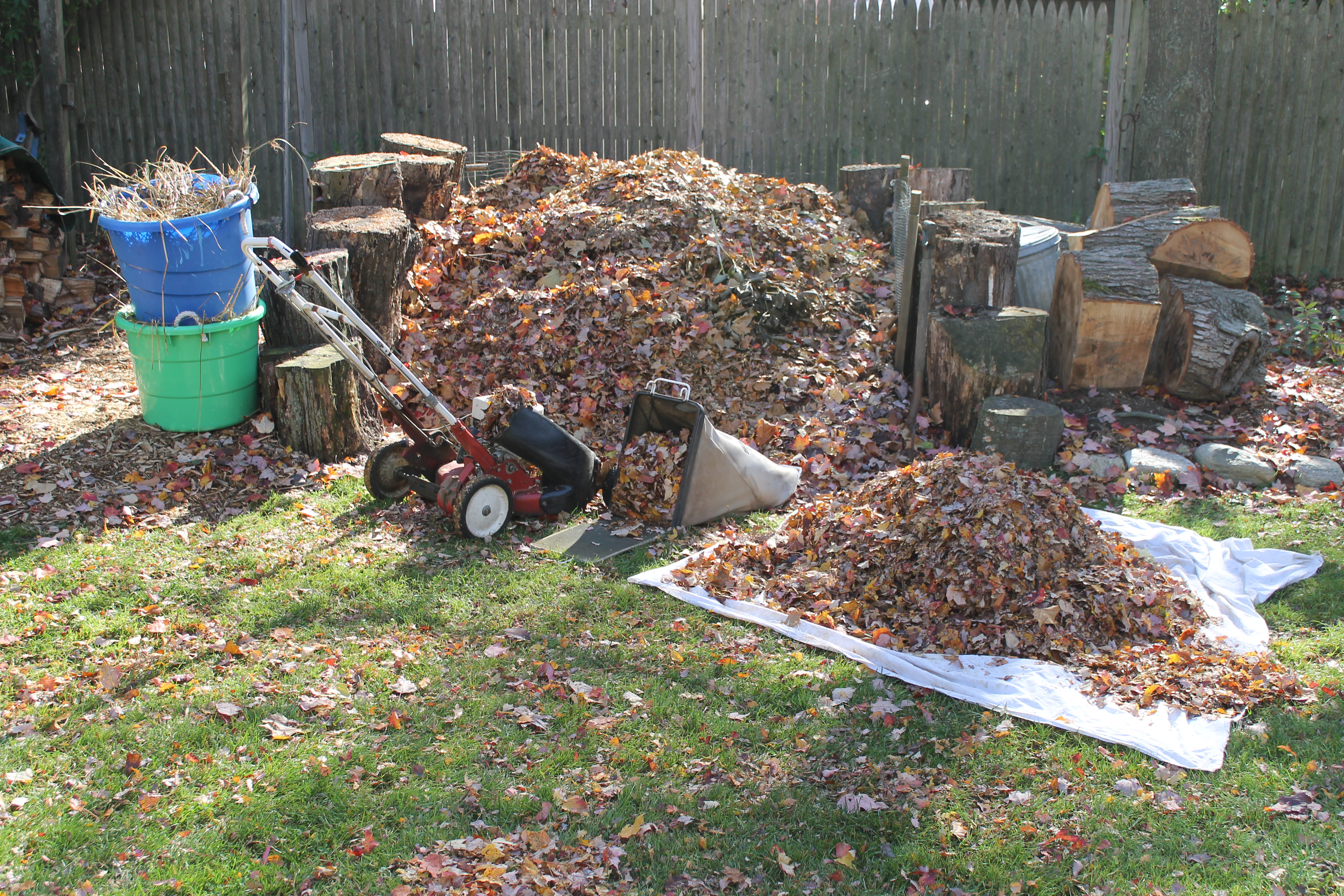
Though I add many leaves wholesale to my pile, mulching with the mower vastly reduces volume.

Though I add many leaves wholesale to my pile, mulching with the mower vastly reduces their volume.

Chopped-up leaves are manna to my pile.

Getting sliced and diced by the whirring blades of a lawnmower turns each leaf into many more bite-sized meals to all the things that want a piece of it. Most anything is more vulnerable to attack if injured, and decay begins at the edges.

My pile is firstly about deconstruction: of a whole leaf, banana peel or or egg shell into ever-smaller increments, mostly by something eating something else, and pooping it. Then you die and become a meal for something else, usually smaller. I couldn’t give you the technical definition of entropy, but have a feeling that my pile is a pretty good example. Things fall apart in my pile, according to laws governing both biology and thermodynamics — along with some more magical dark arts, it often seems.

Even a pile that is already stuffed seems always able to accept a load of leaves, especially when they’r mulched. A load or two of the dry, dusty stuff also makes a good cap for my pile, especially when I’m cleaning up the yard ahead of a coming storm. Mulched leaves don’t scatter in the wind, they soak up any rain that may come, and spread across the top give my pile a manicured, maybe even a little manufactured, look.

It’s also heavy, a blanket to throw over my pile to help it settle, to get it cooking under its own increasing layered mass.

Come late fall, when my pile is stuffed, I mulch the last of the leaves back into the yard. What’s good for the gander, is good for the goose.

The best, most productive way to shrink a pile is to just add water, and all it takes to shrink my pile is to wait for a good soaking rain. (Raking a patch of leaves soaked by fall rains is another matter altogether, one that I try hard to avoid. Each load I spread atop my pile is like a wet blanket.) But water is weight, and in the right proportion, it is also the catalyst for all the energy my pile will consume and create over the next few months.

If it’s dry, as this fall’s been, before I put away the garden hose for the winter, I’ll poke the end of it into the innards of my pile and turn the tap on for a few minutes. By mid-fall, my pile’s about the size and shape of an old VW beetle, and I imagine I’m sticking the hose through the sunroof to soak the inside.

You can see the weight of the water sucking the pile back into itself, and no doubt the wetness helps activate its inner workings. Heck, I’d be thirsty, too, if I’d just ingested a half-dozen trees’ worth of leaves. I leave the hose on for 10 or 20 minutes, and figuring a gallon of water weighs 8 pounds, I’m adding a hundred or more pounds to my pile, say a bathtub’s worth. If I’ve done my layering and mulching right, my pile soaks up all the water like a sponge.

A good compost pile is a mix of green and brown organic matter, air, and water. Here, I give my pile a drink after a fall-leave cleanup in early November.

A good compost pile is a mix of green and brown organic matter, air, and water. Here, I give my pile a drink after a fall-leaf cleanup in early November.

Sometimes I take a bucket of sand from the beach and spread it across the top. Grains of sand may seem like spreading fairy dust across my pile, but there’s heft to it, and I imagine the grains percolating down through the mass of leaves and greens, contributing in their own way to the organic stew that is my pile. Unlike water, sand is immutable, a direct deposit to my pile.

Along with air and all the organic and inorganic material that adds up to my pile, water is the other key catalyst, and I try to find the right balance  by combining them all. (Eventually, especially after my pile has been covered by a heavy blanket of snow, the trick to keeping my pile alive is to breathe air back into it, with pitchfork or other tool. But that’s a story for another day.)

My pile is an accordion that expands with each fresh effort, a squeezebox that in its own sweet time produces its own sweet harmonies.

My Pile: An Endless Source of Fodder

I have long wanted to collect my thoughts, feelings and findings about the compost pile I have tended to, in various backyards around the country, for the past 25 years. My pile is an endless source of fodder, materially and spiritually.

A compost pile is wonderfully useful to a suburban gardener. It’s recycling in its most elemental, home-brewed form; a hand’s-on effort at sustainability that sustains me with plenty of manual exercise the year-round.  Set in the corner of a verdant backyard lot in the wooded suburbs of Fairfield County, Connecticut, my pile is well-situated. What my land and life produces and consumes, stays on the property, by and large. My pile also has the capacity to take in the organic remains and vegetative cast-offs from my neighbors, my work place, the coffee shop I frequent. It also reaps the rewards of the nearby seashore and local farms and stables.

There are four full seasons to this land at its privileged latitude, and my pile continually stimulates me and my backyard as a bio lab of a project in which the profundity of one year’s bounty turns into the next year’s wellspring of continued growth. Each fall I gather the freshly dead ingredients of the growing season. Over the winter and spring the collection melds and molds and is amended into something new. Each summer I spread loads and loads of wheelbarrows full of finished compost across the garden and lawn, which in time returns its bumper crop of harvested life back into my pile.

My pile weathers the seasonal swings in temperature, drawing strength and sustenance from the sun through the spring and summer and feeding off its own inner resources over the long cold months when everything else is dormant. My pile is a power plant, an internal combustion engine that produces enough heat to stoke it through the coldest stretch of winter.

My pile is also blessed by regular dousings of water, as vital as air. Nearly 50 inches of precipitation falls upon this landscape each year, on average. Sometimes it’s in the form of a gully washer of a thunderstorm, other times it’s a foot-thick blanket of snow. Generally, though, this essential ingredient comes in nearly weekly doses of about an inch of water throughout the year.

Making compost is an act of creation through destruction. Part plant, part animal, the domain of the multitude of microorganisms that make up the preponderance of life as we know it, my pile is an endlessly looping live performance that plays out through the seasons, according to my humble inputs and its own internal rhythms and processes.

My pile is more than the sum of its parts, a process that in the end produces something that scientists are still trying to describe, much less exactly define. My pile is not dirt, exactly, nor fertilizer. “Soil amendment” hardly covers what some scientists call Humus, from the Latin word for “earth” or “ground.” Wikipedia says humus is “the fraction of soil organic matter that is amorphous and without the “cellular structure characteristic of plants, micro-organisms or animals.”

How do you define something that by definition is amorphous? Wiki takes another stab: “In agriculture, humus is sometimes also used to describe mature, or natural compost extracted from a forest or other spontaneous source for use to amend soil.”

For my pile, I suppose the “spontaneous source” could refer to the trees that lord over my backyard lawn and garden, the dumpster bin full of coffee grounds, the beach lined by seaweed — or me.

If you can’t exactly define something, the next best thing is to describe it, and in that regard, my compost pile is truly a little bit of everything.

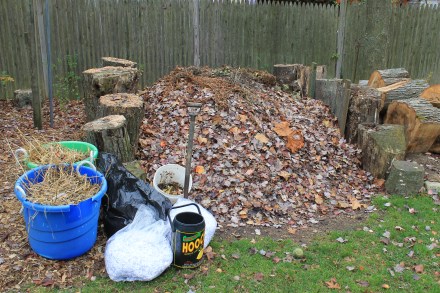
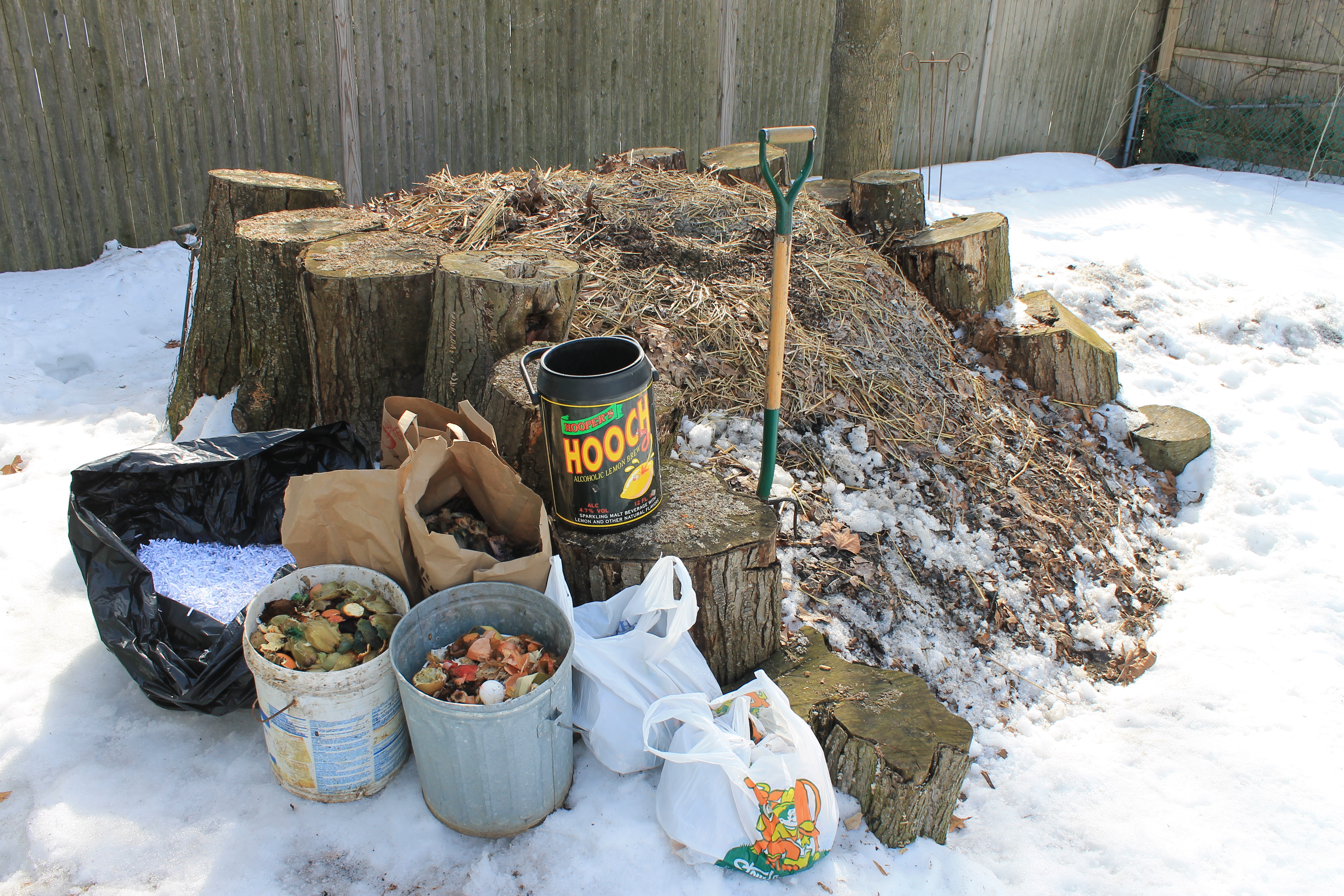
My pile is made of many things, like all these ingredients stockpiled through a winter storm and about to be added to the mix.

My pile is made of many things, like all these ingredients stockpiled through a winter storm and about to be added to the mix.

There’s no exact recipe for making compost, and managing a compost pile is like being a baker who doesn’t have to follow a recipe to turn out finished product that by happenstance is somehow always just right.

What a compost pile is and ends up as depends on where it’s made and what it’s made from. This weekend, I dumpster-dove for coffee grounds because the seaweed I gather from the high-tide line of our local beach is in short supply. It’s been a delightful fall; no early Nor’easters, just a steady decline in temperatures and daylight that have allowed the leaves to flutter to the ground at a steady pace.

Each fall I construct my pile like I’m making lasagna, in layers. The pasta is the fall leaves, and these sort themselves out accordingly to their own schedule. The maples shed their leaves first, followed closely by the sycamores; last are the oaks.

My favored form of leaf cleanup is to rake the leaves into a slouchy heap, lay an old bed sheet beside it, then pile the leaves over it until just the four corners of the sheet are visible. I gather them together and, like Santa Claus, sling the makeshift bag over my shoulder and haul it over to the heap I keep in the back corner of the yard. If the leaves are heavy with dew, then I have to drag the damp sheet across the ground. Either way, it’s quick and easy, and in short order — a load or two or three — you’ve got a clean sweep of a lawn and that much more organic material stashed atop my pile.

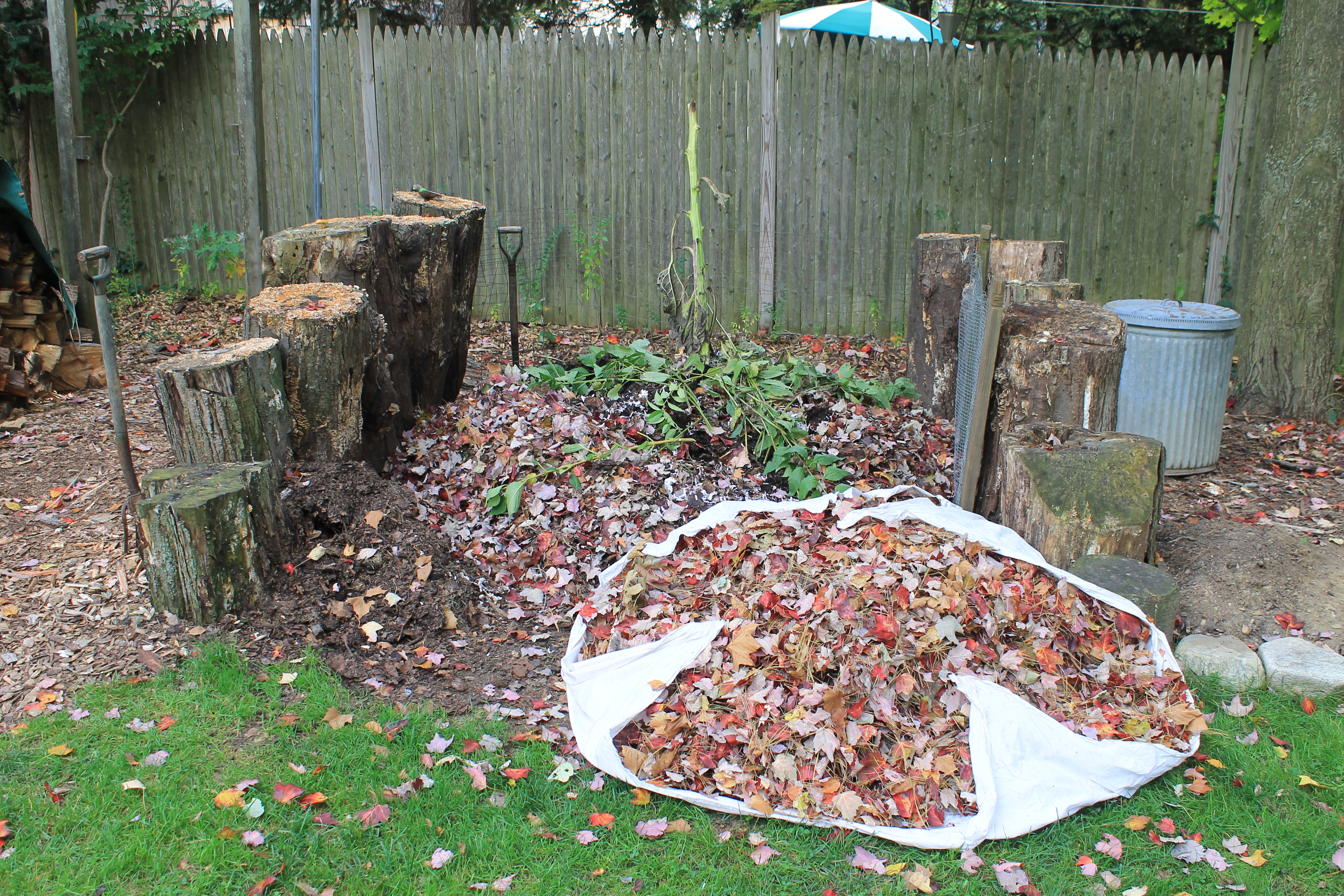
A sheetful of leaves swept up from the yard and ready to be added to the beginning of my pile in mid-October. I've already tossed in the spent vines and stems from the vegetable garden, along with sunflower stalk. As it decomposes, the hollow stem will serve as a passageway for air and microorganisms, from top to bottom.

A sheetful of leaves swept up from the yard and ready to be added to the beginning of my pile in mid-October. I’ve already tossed in the spent vines and stems from the vegetable garden, along with sunflower stalk. As it decomposes, the hollow stem will serve as a passageway for air and microorganisms, from top to bottom.

But compost heaps don’t thrive on leaves alone — at least not mine. True, a pile of leaves alone will in time — a year or two in these parts — turn into leaf mold, a very good and basic kind of compost, to be sure. But where’s the fun, the art, in that?

So along with every fresh deposit of leaves, I try to add a layer of some sweetener, a catalyst of high energy to inspire my pile to be more than humble leaf mold. In early fall, grass clippings are still in good supply, and what I don’t mulch back into the yard, into the pile it goes.

Between mowings, there’s seaweed, hauled in big plastic buckets from the beach, or coffee grounds. Kitchen scraps, from my home or from one of my neighbors. Manure, brought home by the bin from a local nature center, nearby rescue shelter or riding stable out in the country.

My compost pile is not mine alone; over the years my neighbors have gotten in on the act. The family of six next door contributes their kitchen scraps; the neighbors across the street have learned that it’s easier to haul their leaves over to my pile than to stuff them all into big paper bags for the town to pick up.

The neighbors to the other side have a rabbit, and from their hutch I get a steady supply of rabbit litter. Manure is about the most potent source of nitrogen you can add to a compost pile, and the end product of a little bunny is more convenient to work with than, say, what comes out of a cow. It’s also a whole lot easier to find than bat guano, which tops the charts in containing the three main ingredients of commercial made fertilizer, nitrogen, phosphoric acid and potash, according to Stu Campbell in “Let It Rot — The Gardener’s Guide to Composting.”

In my experience, it’s the rabbit bedding — shredded paper, soaked in bunny pee — that is the favorite foodstuff of earthworms. When I turn the pile over I sometimes come across a remnant of recycled rabbit litter being feasted upon by a mass of wriggly red worms. Of all the living things in my pile, worms are my biggest allies. It’s funny to think of a worm as an apex predator, but they exist near the top of the food chain that is my pile. It’s humbling to know that it is their digestive tracts that in large part produce what becomes of my pile.

So, in it all goes, layer upon layer, soldier after soldier. Water, air, sweat and the toil of countless things seen and unseen that eat and fight and live and die in situ. It’s all fodder for my pile.