My Pile: Child’s Play

The transition from winter to summer, while always inevitable, has so far been tentative here in coastal southern Connecticut. I woke this cold Saturday to read online: “The National Weather Service in New York has issued a freeze watch for Westport and area which is in effect from late tonight through Sunday morning. It said temperatures around freezing will occur late tonight into early Sunday morning with the potential for sensitive crops and plants to be killed.”

Among the casualties already are the waxy leaves of the montauk daisy to the side of the back door and, I noticed on my morning run, the pink blossoms of a large tulip magnolia along a neighboring street, shriveled to black. I imagine both will recover from their frostbite.

Still, this week in mid April marks the tipping point when the season begins to shift, delightfully, from cold and dormant to warm and growing. Two days of showers have doused the landscape, and my pile. The forsythia are ablaze in yellow, the fiddleheads and other ferns in the backyard garden beds are unspooling upward, and the most precocious of the perennials are emerging from the deep wood-chip mulch spread late last fall. The purplish stalks of the peonies, slender tiger lily shoots and coiled thrusts of the hostas are all sprouting.

In the vegetable garden, the rhubarb leads the charge, unfurling its elephant-ear leaves from its robust, ruby-red stems thrusting up through the mound of compost I’d heaped upon it last fall. A friend who grew up on a New Hampshire farm once told me that rhubarb grows best on a pile of compost, and I’ve long followed that bit of farm wisdom. Other self-seeding herbs, chiefly the cilantro, are also sprouting like weeds.

The grass lawn, though slowed by the still-cold temperature of the soil, is greening nicely under the strengthening sun of spring, especially the dark, thick patches where the dog does his business. The overarching trees that surround my yard have yet to issue leaves, though the wine-dark flowers of the maple trees dapple the grass like so much confetti. Soon the lawn will be littered with countless winged maple seeds that helicopter down from the branches above.

My pile seems a doughty old relic in the midst of all this nascent green growth, though from the puffs of steam vapor I see rising from its mounded top in the early morning I know that it is churning and burning under its cloak of dank, matted leaves.

I hadn’t planned to spend much time with my pile this weekend, but that changed yesterday evening when my neighbor stopped by with a gift from his wife, who teaches Kindergartners at a local pre-school. She’d guided her students in a special project the past few weeks to make compost in plastic tubs, combining kitchen scraps the kids brought from home with what I expect was the giggly fun of a class trip outdoors to add to the mix some dirt and leaves and any earthworms they could find. The class assignment over, she’d brought the stuffed bins home to pass along to me.

I happily added this bin of Kindergartner compost to my pile.

I happily added this bin of Kindergartner compost to my pile.

I will happily add this bin of grade-A compost to my pile, along with my own half-full bucket of scraps from the kitchen and more from the backyard neighbors. The hausfrau spots me wandering the yard as she’s stringing wet clothes on the line that stretches from her back porch, and calls over the fence. Her youngest daughter has finished a long-overdue chore and thoroughly cleaned the rabbit hutch. Could I take the stinky mess off their hands?

Of course. The Sunday morning work also allows me to further prep my pile for the coming load of grass clippings that will transform the heap, still largely composed of leaf mold, into a finished product of humus.

Since excavating my pile last weekend, and stuffing and fluffing it, two days of rain mid-week have caused it to sag back into itself, especially the front slope. Time to toss it once again.

First I dig around the perimeter of the top of my pile with the pitchfork to rebuild a berm along both log walls. It’s steamy and fragrant in a loamy, good way, and the loose leaf litter is flecked with earthworms. Next, picking a spot high along the saggy front slope, I tease out more forkfuls of mushy leaf mold to fashion a new facade. Behind this ridgeline a void opens, into which I dump the bin of compost from the kindergartners, the buckets of kitchen refuse and the shaggy green hay from the bottom of the rabbit hutch.

The bits of colored shells of easter eggs and wattled husks of avocado skins mix easily and deeply with the warm, musty leaf mold. The tine of the pitchfork snags a tangled mess of seaweed wrapped in the remains of a flounder rig, which I pull out and set aside. Another pitchfork plunge produces an old tennis ball stuck between the tines. I don’t know how long it’s been buried, but when I toss it out onto the lawn, the dog, who waits patiently next to my pile, happily retrieves it. Otherwise, I see little evidence of past insertions of compostibles, even from a week ago.

I add fresh compostibles to the front of my pile and will bury it all by borrowing from the back.

I add fresh compostibles to the front of my pile and will bury it all by borrowing from the back.

I walk around the back side of my pile to mine the strip of leaves along the rear wall. Last weekend, I’d carved down about halfway, creating a bench of sorts. Reaching over the wire fence,  I plunge the pitchfork into the caches of dry brittle leaves in the two corners and toss the crumbly leaves onto the top. Having excavated two rows of leaves already this spring, I’ve reached the inner sanctum of my pile, unearthing the swath of leaves mower-mulched by my across-the-street neighbor and dragged up onto the pile en masse. The crumbly leaves are easy to extract and make good fresh fodder to spread across the top of my pile.

I dig out this back bench of leaf mold all the way to the ground, fashioning a vertical wall that is moist and rich in the center. The two tallest logs along the back, now unbound by the crush of leaves, yet still connected by the length of wire fencing stapled to their decaying skins of bark, teeter in place. I rock one of the log pilings loose from its mooring and examine the impression it has made upon my pile. Where log has faced leaf mold for these past few months is a vein of rich, dark crumbly rot, seething with roly-polys. The log is rotting away faster than the leaves; it’s another sign of how the log walls of my pile help seed my pile with the microbial actors so important to decay. I set the log back in place, and shore up its footing by kicking a wedge of firewood underneath it.

I finish the half-hour’s work on my pile by tidying up the front, trimming a row of loose moldy leaves from the base to stack up onto the top. My pile is now less a heap than a construct. Once wide and sprawling, it’s now tall and compact. My pile is steadily consuming itself, a process of entropy and attrition aided by my fididdling of pulling layers of raw, even untouched leaves from these lower reaches out to upper edges and top. My goal, as always, is to keep my pile chest-high by borrowing from the front and back, in the process basically turning the heap inside out and upside down. Wandering in place.

It is child’s play, this playing in the dirt. I’ll soon add insertions of green grass clippings from the season’s first mow and further kitchen scraps and what else as I go, to thoroughly mix the old brown leaves that have been entombed since the fall with the fresh growth of spring. I’m continually thankful that my pile keeps me connected to such simple pleasures, and with mother earth.

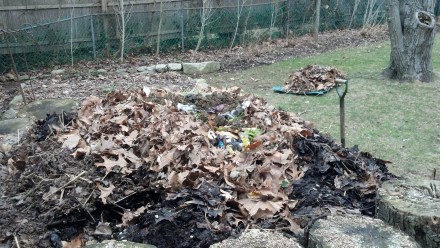
A side view of my much-condensed pile in mid April. Soon, it will be engorged with the green fodder of the growing season.

A side view of my much-condensed pile in mid April. Soon, it will be engorged with the green fodder of the growing season.


My Pile: To Each His Own

Every compost heap, by definition, evolves organically, in its own way.

My pile suits my backyard and reflects the New England climate and the resources I bring to bear on it, including my own energy and ambitions.

My brother lives in the rural high country of New Mexico. He owns a small ranchette and keeps an old mare in a corral out back, rescued from a shelter. His compost pile and its concerns are wholly different from my own. Seeing my pile for the first time, he expressed envy for its copious amounts of leaves and ample supply of rainwater, as well as the seaweed. He has manure, hay and kitchen scraps, but with the arid desert and daytime heat, keeping his backyard heap wet enough is a constant problem, as is keeping the coyotes at bay. Instead of decomposing, his pile dessicates, becoming more a mound of mummified remains than a compost heap. I advised him to consider pit composting, and to locate it near the water trough for the horse, for easy access to both water and manure.

Closer to home, a nearby friend has house atop a small rocky outcrop, with towering oaks that shade all but a patch of her backyard, on which she tends a small garden of herbs and vegetables. Without the time or inclination to amass a heap of leaves, she instead tucks her garden trimmings into a tumbler set up on the side of her house. It looks like a 55-gallon oil drum on a rotisserie, and churns out buckets of compost in short order that she spreads across her tidy garden.

On a larger property just down the road, one of the original farmsteads in town, is a barn and open field behind the main house. The owners keep a small menagerie of a few sheep, a couple goats and a llama in an enclosure near the road. When my son was younger, he’d delight in stopping by to pet the animals through the fence along the road. The acreage behind the barn lies fallow, and a real estate sign indicates that the owners are just waiting for the right price to develop the parcel into new homes.

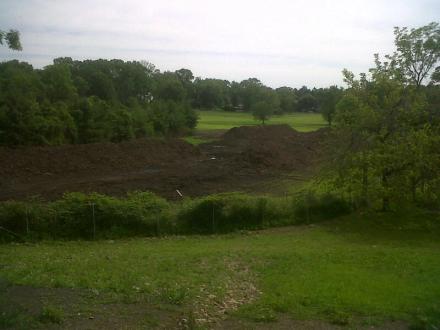
A view of one of the last tracts of open land left in Westport, on which the owners have spread leaf mulch to compost.

A view of one of the last tracts of open land left in Westport, on which the owners have spread leaf mulch to compost.

But some agriculture still takes place, if only for tax purposes, and a couple years ago I was delighted to see the owner spreading truckfuls of leaves collected from the town’s fall cleanup across an acre of so of freshly plowed land, depositing them in long windrows about six feet tall.

Over the course of a few months, he turned the windrows with a small front-end loader, then spread the cooked-down lot across the field. Sheet composting, it’s called, and by the next year the ground had absorbed it all, and it’s now a rich meadow of field grass.

The scale of the operation puts my puny pile to shame. But then again, I would imagine that the urban composter with a vermiculture setup under the kitchen sink would say the same thing about my backyard compost heap.

On my shelf of compost books is a title from England, “How to Make and Use Compost – the Ultimate Guide,” by Nicky Scott. Published by Green Books, it’s a useful compendium of composting tips, if a little foreign.

Particularly intriguing is the chapter, “Choosing the Right Composting System,” which leads with a description of the Dalek bin.

“The compost bin that most people are familiar with is the plastic ‘dalek’-type bin, promoted by local authorities. Sizes vary from just over 200 litres to 350 litres, some have access/inspection hatches, and they come in a variety of colours. Millions of these are now in use in the UK.

“Daleks are lightweight, so you can move them around the garden easily and plonk them down where you want either on earth or hard ground. They contain your materials, so you just need to mix or layer the material as they go in.

“When they get pretty full, lift the whole bin up – as if making a sand castle – and if you have enough space put the bin down next to your compost castle and fork the top, uncomposted layers back into the bin. The bottom section should be nicely composted and ready to use…

Some councils have given bins away free; other councils pass on the benefits of being able to bulk buy, so that the bins are offered at wholesale cost price, around 12-15 pounds…”

A collection of Dalek bins at a garden center. "Danger, Will Robinson!"

A collection of Dalek bins at a garden center. “Danger, Will Robinson!”

The English love their gardens, and long ago raised gardening to an art form. So it should come as no surprise that in the land where every man’s home is his castle, millions of council houses and flats have one of these stubby little bins in the backyard, castles of compost.

It saddens me to realize just how backward our own country remains when it comes to backyard composting – but in a glass-half-full way I’m optimistic when I think just how much potential there exists for Americans to take to composting in the individual way that best suits their own needs. As they say, people who wonder whether the glass is half empty or full are missing the point: The glass is refillable…


My Pile: Wandering in Place

I am sure there’s a systematic way to add to, aerate and otherwise mix my pile in the most efficient and productive way possible, a process whose inputs and variables could be modeled by a computer program, spit out and followed. Commercial composters take such a scientific and mechanized approach to their operations.

My backyard pile is much more artisanal, handmade in small batches, sampled throughout the year but mostly harvested en masse by late summer. The recipe for this homemade humus varies from year to year, as does its specific cooking time. Some parts mature early, and most springs I can usually harvest a wheelbarrow or two of fresh-hot compost to tuck along the rows of sprouting vegetables in the garden or new transplants in the perennial beds, or to fill the holes left by rocks I pluck from the lawn through mud season.

Creating each new vintage of compost is part art, part science. Mostly it’s about mixing air, water and sundry organic ingredients by turning my pile inside-out, in place, with a minimum of fuss and to the maximum effect. It’s a sport-like hobby, a pastime that engages me both mentally and physically.

The guidebooks and online sources describe a bewildering array of compost setups and contraptions, from the homemade to the high-tech. Google a few search terms and you’ll see that there is a composting solution for every need. It would be easier if I had room for a two-bin type compost heap; I’m envious of the setups using two or three side-by-side bins made of removable wood-slat bins that turns composting into more of an assembly-line process. As is, working my pile in place is a constrained, somewhat convoluted act, like changing your clothes in the backseat of a small car.

Structurally, the best description I can find for my pile is that it’s known as a “log cabin” compost heap. I rather like that. There is a Lincoln Log aspect to my pile, harking back to a baby-boomer childhood spent playing around suburban construction sites and building forts in the woodlots yet to be filled in by new housing. There is a bit of the rail-splitter in every American.

Despite adding volumes of compostibles to my "log cabin" pile throughout the winter, as the spring season begins, it is a condensed, compressed stack of organics in need of a good "airing out."

Despite adding volumes of compostibles to my “log cabin” pile throughout the winter, as the spring season begins, it is a condensed, compressed stack of organics in need of a good airing out.

The literature defines my backyard composting as following the Indore process, first developed a century ago in India by Sir Albert Howard, with a prototypical American twist, which Rodale describes as the University of California method. It’s fitting, as my composting has its roots in California, and I happen to be a UC Berkeley alum.

“The composting method developed at the University of California in the early 1950s is probably the best known and the most clearly articulated of the rapid-return or quick methods,” I read in “The Rodale Book of Composting.” “It is similar to earlier methods recommended by modifiers of the Indore method, to those practices in mechanical digester units in Europe and America, and to those described and advocated by Harold B. Gotaas of the World Health Organization in his 1935 book ‘Composting.’ Whereas the Indore method may be described as falling on the cool end of the compost spectrum, the California method aims for more heat and faster decomposition.”

“Turning is essential to the California method, for it provides aeration and prevents the development of anaerobic conditions. The more frequent the turning, the more rapidly the method works. If you have a single bin, turning the pile requires you to remove the front of the bin and fork out the contents, beginning with the top layer and keeping track of the original location of the material. When you return the contents, make sure that the material from the outer layers (top and sides) of the pile ends up in the interior of the new pile. The material should be fluffed as it is forked, and it should be so thoroughly mixed that the original layers are indistinguishable. In the course of the composting process, every particle of the pile should at one time or another have been exposed to the interior heat of the pile.”

Even more apropos is Rodale’s evocative, if tautological, description of the “wandering compost pile,” which seems to describe my pile well:

“For continuously composting household, yard and garden waste while maintaining optimum pile size, a ‘wandering compost pile’ is effective. Starting with minimum dimensions of 3 feet high by 3 feet wide by 3 feet deep, this type of heap ‘wanders’ as fresh ingredients, such as kitchen refuse (minus meat or animal fat), are tossed onto the sloping front face and finished compost is sliced from the back. By screening the finished compost as it is removed and using the larger particles to cover additions to the front of the pile, newly added materials are seeded with the necessary microrganisms.”

There’s a good bit of manual labor involved in working a compost heap the size of my pile and its particular composition. Actually, the “how-to” reminds me of the old-fashioned flywheels that you see pulling taffy in a candy shop on a seaside boardwalk. First I spread my pile open and out, adding air and space, then fold back in fresh heapings of green and brown from the edges. I think this taffy-pulling bioturbation of my pile is the best way to go about it, as is the log cabin I keep it in.

Last time I turned my pile, to add the unplanned load of horse manure, I excavated twin channels across the top of my pile, scooping the rotting remains of the heap up and outward. I added in the manure and kitchen scraps, then back-filled with dried leaves shaved from the sloping sides.

Weighed down by a few inches of heavy spring snow that fell that night and melted the next day, the dome of my pile from a week ago has now settled in on itself, sagging beneath the tops of the bracing log walls. It’s a good sign of the foment within, and a pattern I’ve followed on pretty much a weekly basis since amassing this heap of fallen leaves and gathered seaweed and hay and other compostibles from the last days of summer on through the end of autumn.

At its peak last last year, my pile swelled to a height higher than my head and sprawled over the log walls that sought to contain it, spilling over the wire fence along the back and down a cascading slope onto the lawn at its front. Each time I watered it, or rain or snow fell upon it, my pile shrunk within itself, subsiding under its sheer weight and succumbing to the forces of gravity and similarly unseen forces of natural decay and entropy. And each time I tucked a fresh batch of kitchen scraps and other organic recyclables into the midst of my pile, I heaped more leaves upon it, gathered from its flanks or the yard, building it up again, as high as my eye. My pile would now be 20 feet tall, if it didn’t always, and inexorably, settle into less.

Over this time, I’ve narrowed my pile’s footprint by nearly half, pulling a wide swath of leaves that once bulged against the back wire fence up onto the top and cleaving three feet or more of compressed leaf litter from the once-sloping front. My pile is now a squat, vertical stack. True, I’ve prodded and poked and probed my pile through and through with the steel rebar rod, perforating it to allow air and water to penetrate its inner recesses. But up to this moment, I have only stirred the top portion of my pile, infusing it with fresh compostibles on through the winter. I have yet to get to the bottom of it, where fresh air and water are needed most to spur on the decomposition process.

Today, the first Sunday of April, it’s time for my pile to get a move on.

After setting out the day’s additions — a week’s worth of kitchen scraps, a fresh bucket of rotting seaweed and salt marsh hay and the last scraps of sycamore fluff hoovered from the winter lawn — I pry into the bottom front of my pile with the straight-tined pitchfork. I tease out clumps of matted leaves, some dry, some wet, from the grip of gravity, heaping shovelfuls up onto the back of the heap.

My pile, in the process of taking a big step forward at the start of spring.

My pile, in the process of taking a big step forward at the start of spring.

Before long I have created an overhang of pressed leaves and tattered seagrass, which I pluck off with the curved tines of the hay pitchfork and add to the top of my pile as high as it will repose. After shaving this scraggly brow, I have a new, near vertical face of old leaves, which I undermine once more, using the hay pitchfork to pull more leaf litter from the bottom toward my feet to form a berm, about shin-high along the front. Within this gathering are just glimpses of anything more than old leaves — stray bits of white shredded paper, a few egg shells and flecks of seashells.

The newly created overhang of leaves along the front of my pile quivers. I step back to take a quick cell-phone video of the gentle avalanche that results:

I’m pleased to see, newly exposed, a rich, dark, moist mass of leaf mold. It’s like I’ve bitten into a creme-filled chocolate. I tease out the mix with the pitchfork. I’d considered trying to harvest a few shovelfuls to spread across my vegetable garden, having read recently that tomato plants thrive under such unfinished compost. But after some digging, the batch still seemed too raw, and besides, I’m still at least a month away from the last frost and planting time.

So I spread the steamy leaf mold atop the berm of drier material along the new front of my pile, and heap shovelfuls across the top. It will infuse these rawer parts of my pile with a rich riot of decomposers.

Such busywork creates a trench along the front portion of my pile, all the way down to bare dirt. I scrape into the crevasse some dried leaves from the corners and creases of my pile, then add the sycamore seed fluff, the kitchen scraps and mix thoroughly, topping it off with a layer of seaweed flecked with salt marsh hay.

I backfill the trench I've made in my pile with a fresh batch of seaweed and bury it deeply with leaf mold scraped from the top.

I backfill the trench I’ve made in my pile with a fresh batch of seaweed and bury it deeply with leaf mold scraped from the top.

I fill in the hole by causing another avalanche from the midst of my pile, and scrape more leaves from the top. The log walls make good markers, and a reckon I’ve tossed and turned nearly the front half of my pile, from top to bottom.

Backfilling in this way shrinks the top of my pile enough to prompt me to walk around the back side to cleave a half row of compost from behind to restore the heap to shoulder high. I now have a shelf of rotting leaf litter along the rear, and I see that just behind the wall of leaves is a rich vein of humus-like compost. Facing south and exposed to the warming sun, it is thick with earthworms and within easy reach.

The next time I mess with my pile, I reckon it will be to add these raw leaves along the back with grass clippings from the season’s first mow. I also make note to mine the newly revealed backside for a pre-season top dressing of raw compost for the tomatoes, not to mention the rhubarb. It’s a comfort to have an itinerary for my wandering pile.

I borrow from the backside of my pile to build up the top.

I borrow from the backside of my pile to build up the top.

I finished my hour’s work by tidying up the front of my pile with a rake, restoring it, at least in look, to the heap of leaves it always appears to be. A good portion of the hard-pressed bottom of my pile has now become the fluffed-up top. With April showers on the way, my pile will soak up all the rain it receives and settle back into itself. But by taking two steps forward and once step back, my pile is newly suffused with air and freshly mixed organic material. It’s primed for productive decay, a healthy rot, thoroughly dead but rife with life, and all the other remarkable paradoxes that constitute and define my pile.

And so my log cabin of a pile wanders in place through the seasons. “Wandering in place” is also an apt description of me in my backyard, as it is for most gardeners.


My Pile: April Fool

Every bloomin’ April First, the joke’s on me, as I’m reminded of the foolishness that remains my absolute low point as a compost-minded backyard gardener.

The chief reason I bought my small home on a corner lot in Westport a decade ago this spring was the tulip magnolia tree in the front yard. After noticing the real estate listing in the local paper, I arranged to meet a real estate agent at the house the first Sunday in April. I made up my mind to buy the place as soon as I pulled into the rutted driveway and saw the magnificent tulip magnolia in full bloom. Talk about curb appeal!

The house and rest of the property was a mess. But this specimen of a tree stood out, even though it besieged by tangly vines and surrounded by spiky barberry bushes and sucker saplings from its own spreading roots. About 30 feet tall and with a canopy almost as wide, it was covered by fist-sized cups of white flowers tinged with magenta.

Peering through the scrub bushes and stringy saplings that rose from its roots, I could see that the tree’s bones were very good. The tree’s lowest branches started about waist-high and spread in handy increments nearly horizontally; a perfect tree for my five-year-old son to climb. Underneath its canopy was a smattering of crocuses, poking up through the weeds that spread across what I could tell was once an oval island of tended garden surrounded by grass.

Placed as it was in the front corner of my yard, and that part of the property being on a slight bend in the road, it was the prettiest tree in the whole neighborhood. Approaching my house from either direction, rounding a slight bend, it was though you were driving straight toward the tree and its blossoming beauty. It was a head-turner, that magnificent magnolia, if only for that week or two each spring.

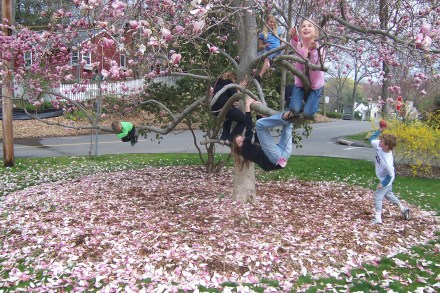
After moving in I pruned the tree of its sucker branches and cleared the ground around it of the wild wisteria and Chinese bitterroot vines that sought to overtake it. My son and the neighborhood kids he soon befriended loved to climb the tree’s smooth-bark trunk and perch on its low-spreading main branches.

For that spring and the next, the tulip magnolia made for great fun and wonderful photo ops, especially in the brief blooming moment, often just at Easter.

A playdate in the tulip magnolia, in its final years.

A playdate in the tulip magnolia, in its final years.

For a backyard composter, a tulip magnolia is no great shakes. I raked up the fallen petals each spring; the silky pieces melted into my pile like breath strips on your tongue. The seed pods that all those flowers produced were less welcome, as were the waxy coated leaves that rained down each fall. Some compost books consider them more of a nuisance, as they take too long to decompose, but into the mix they went as well.

To restore the garden island the tree grew on and also to give the kids a softer landing in case they were ever to fall from its limbs, I added a layer of wood-chip mulch around its base, spreading it out to the tree’s drip line. I proudly counted how many wheelbarrow loads the ground beneath the tree could absorb, mentally tallying both Safe Daddy points and the kudos for sustainable gardening methods.

The tree thrived, as did the kids.

An autumn or two on, a neighbor took down a towering spruce tree that posed a threat to his house. I drove by just as the tree crew was chipping up the last of the branches and blowing them into a plywood-sided box in the back of the two-ton dump truck. I told them they could deposit the load of chips in my driveway up the street.

It was like getting a hundred Christmas trees, all ground into a poultice of mulched needles, bark and sappy chips. The mound was already steaming when I spread load after load of minced spruce across the garden island on which my tulip magnolia ruled. My greatest fear was that I would bury the crocuses and daffodils too deeply and they wouldn’t be able to find their way up to the sun come the spring.

The following April the magnolia bloomed magnificently. The spring bulbs did well, too.

The third spring surprised me – less blooms crowned the tulip magnolia. I chalked it up to the vagaries of a tough winter.

By the fourth spring, the tree bloomed only sparsely, and produced small, wilted leaves. Neighbors walking by would stop to chat, commenting and offering advice. I watered deeply. That summer, I hammered a score of tree fertilizer spikes into the ground all around the tree.

Then one afternoon the fellow who had done all the tree work for me when first I moved in happened by. I’d been impressed by how he handled the massive hulk of the dead old willow tree in the backyard, saved my roof from the overhanging mulberry trees, showed no mercy for the swamp maples and other “junk” trees. Men who climb tall trees with ropes and snarling chain saws for a living command a certain level of respect from earthbound gardeners like me.

He stopped his truck in the street, rolled down his window and in the kindest way possible gave me the news that he clearly thought I should have known all along: Magnolias didn’t like their surface roots to be covered by mulch. The heat from the decomposition cooks them and could kill the tree.

I thought back to the previous fall, sticking my hand in the deep layer of mulch under the tree to feel its warmth. After so many years of neglect, however benign, I thought I was giving the tulip magnolia a warm blanket of freshly made compostible wood chips from which to draw nutrients.

As soon as he drove off, I grabbed my wheelbarrow and shovel and removed dozens of barrows fulls of old mulch from around the tree, spreading it elsewhere in the yard as best I could. I drove more fertilizer spikes into the ground, as penitence. But by then it was too late.

In its final spring, the tulip magnolia mustered just a few, misshapen blooms and a smattering of leaves, most of which shimmered to the ground during a hot spell in July.

I took the tree down that August, climbing up the bare branches myself with a borrowed chain saw. Its demise, played out over the better part of four years, was slow-motion, every-day proof of my foolishness and ignorance as a gardener. Simply put, I’d loved the tree to death, killing it with what I thought was the kindness of layer upon layer of a steaming hot wood chips.

All gardeners live with failure and most hope to learn from their mistakes, self-inflicted or otherwise. These days, I spread wood chips much more sparingly across my perennial beds, and steer clear of mulch from fir or pine trees.

I replaced the tulip tree with a weeping willow. A curiously old-fashioned choice, I admit, in a modern garden. But I didn’t have the heart to plant a new flowering tree in place of the tulip magnolia. And I knew from the towering willow that had died of old age in the backyard long before I bought the place that it would thrive despite me. Native to China, it’s considered an invasive, but I’ve read that it was first brought to American by a Connecticut trader in the 18th century. It’s a local import that has thrived.

I found the willow in the remnant section of the local nursery. Its roots had grown through the drainage holes of its black plastic container and spread deep into the gravel patch the bucket rested on. I needed help from a nursery laborer to wrest it from its spot and took it home at a bargain price of $20 or so, its wispy branches fluttering out of the back hatch of my SUV.

Five years on, the rescued willow is now already nearly as tall as the tulip magnolia it succeeded. I’ve loped off the upper branches to widen its canopy and to keep if from getting too close to the utility wires strung along the street. Its setting in the corner of my yard leaves it far from any drain pipes. Anyway, I’m pretty sure its thirsty roots have tapped into a long-buried spring that flows from the granite ledge across the street and under the road nearest the tree.

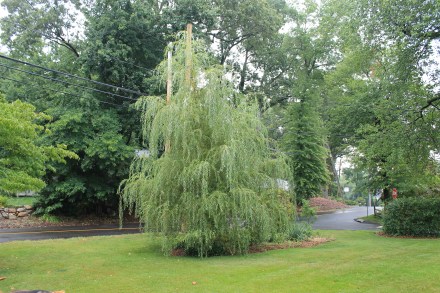
The willow, from two summers ago, fast-growing and just now starting to "weep."

The willow, from two summers ago, just then starting to “weep.” It’s now twice as big and full. Two years before that, I’d brought it home in the back of my SUV.

The willow may lack the tulip magnolia’s magnificent presence each spring, but its loping, dangling yellow branches are striking in their own way, early to bud in the spring and late to let go of its slender, oblong leaves in the fall. And like the massive old willow that once graced the backyard where my pile now sits, it is a hardy living thing that I know will survive whatever foolishness I will inflict upon it.

Rather like my pile.

My Pile: Holy Ground

You don’t have to dig too deeply into the canon of writings about compost to find a spiritual, even mystical appreciation of the process. For some, composting is nearly a religious act.

Biblical, even: “In the beginning, there was manure,” Stu Campbell sets forth in “Let It Rot! The Gardener’s Guide to Composting.”

“Soil is where geology and biology overlap,” Steve Jones writes in “The Darwin Archipelago.” “Adam’s name comes from adama – the Hebrew word for soil – and Eve from hava – living – an early statement of the tie between our existence and that of the ground we stand on (Homo and humus also share a root).”

“The most exemplary nature is that of the topsoil,” I read further in “The Art of the Common Place: The Agrarian Essays of Wendell Berry.” “It is very Christ-like in its passivity and beneficence, and in the penetrating energy that issues out of its peaceableness. It increases by experience, by the passage of seasons over it, growth rising out of it and returning to it, not by ambition or aggressiveness. It is enriched by all things that die and enter into it.”

It’s Easter Sunday. Today I will worship not at a church but at the altar that is my backyard compost pile. And I will place within it a tithing of fresh green horse manure. Rich in nitrogen and ripe with voracious microscopic decomposers, it will kick-start the near dormant heap of dead brown leaves amassed last fall. Manure also provides plenty of phosphorous and potassium, both vital elements to the renewed growth of spring.

Yesterday, partly to free myself up for a blessed spring Sunday devoted to gardening chores, I drove my son’s grandmother from her senior-living facility nearby to a horse-rescue farm in the northwest corner of the state. A lifelong animal-rights supporter, she sponsors a broken-down race horse now in pastoral retirement. She wanted to see the old filly, hand deliver a further donation, and I was happy to drive her there. In part, because in the back of my car was a large plastic tub to fill with horse poop to haul back home to my compost pile.

If she had religion, Gigi’s patron saint would surely be St. Francis of Assisi. The Vatican is a bit more equivocal on the point person for me and my pile.

Saint Phocas, the patron saint of composting.

Saint Fiacre is said to be the patron saint of gardening, but it seems he had an aversion to women, which is why he’s also considered the patron saint of those afflicted by venereal disease. Hard to cast yourself with that lot.

I’ve heard Saint Phocas described as the heavenly protector of compost, as he was martyred by Roman soldiers after digging his own grave in his garden, so that his remains would be subsumed by the soil. Props to him, but I’ll pass…at least for the time being.

Instead I make this pilgrimage to the nonprofit manger in upstate Connecticut, a complex of stables and paddocks devoted to giving comfort and shelter to rescued thoroughbreds from the race track, retired carriage horses from Manhattan and the odd, abandoned Shetland pony. The shelter also gives young girls a chance to groom and ride the horses, which is nice. Other than that, its chief product is horse poop.

“It’s the one thing we have plenty of,” said the friendly blue-jeaned blonde who runs the place, directing me to a 10-foot tall mound of manure in a muddy enclose behind the barn.

It’s a sight for any backyard gardener to behold. Karol Capek captured the feeling well in The Gardener’s Year. The slim, almost psalmic volume, is worth quoting nearly chapter and verse: “There are times when the gardener wishes to cultivate, turn over, and compound all the noble soils, ingredients, and dungs. Alas! there would be no space left in his garden for flowers. At least, then, he improves the soil as well as he can; he hunts about at home for eggshells, burns bones after lunch, collects his nail-cuttings, sweeps soot from the chimney, takes sand from the sink, scrapes up in the street beautiful horse-droppings, and all these he carefully digs into the soil; for all these are lightening, warm, and nutritious substances.

“Everything that exists is either suitable for the soil or it is not. Only cowardly shame prevents the gardener from going into the street to collect what horses have left behind; but whenever he sees on the roadway a nice heap of dung, he sighs at the waste of God’s gifts.

When one pictures a mountain of manure in the farmyard – I know, there are various powders in tin boxes; you can buy whatever you like, all sorts of salts, extracts, slags, and powders; you can inoculate the soil with bacteria; you can till it in a white coat like an assistant at the university or in a chemist’s shop. A town gardener can do all that; but when you picture a brown and fat mountain of dung in a farmyard –.”

Alas! Grabbing a thin-tined rake set against the fence, I fill my beer-keg tub with a rank mixture of horse droppings, rotting straw and sawdust shavings. Good thing I’d remembered to bring along a heavy-duty plastic bag to cover the tub or it would have been that much longer a ride home with my former mother-in-law. As is, I could only fill the bucket about halfway to the brim before it got too heavy for me to lift.

Whoa, Nelly! A mother lode of rotting manure and muck from horse stalls at a horse rescue farm in upstate Connecticut.

Alms for my pile, direct from the source. Back home at dusk, I finish up my winter reading:

“The compost heap in your garden is an intentional replication of the natural process of birth and death which occurs almost everywhere in nature. Compost is more than a fertilizer, more than a soil conditioner. It is a symbol of continuing life,” I read in “The Rodale Guide to Composting.” As thick as a King James Bible, the guide was first printed in 1979, as the title page states, “on recycled paper, containing a high percentage of de-inked paper.” For organic gardeners, this seminal work is as close to the gospel truth as it gets. Even so, its authors remain admirably humbled by the unknowable essence of their subject:

“The entire composting process, awesome in its contributions to all plant and animal life, is probably impossible to contemplate in its full dimensions.”

The Guide draws on the research and inspiration of the American prophet of compost, J.I. Rodale, who was building on the pioneering research done in the 1840s by German scientist Justus von Liebig, and the work of British agronomist Sir Albert Howard in the early 1900s, who spent nearly 30 years in colonial India experimenting with organic gardening and farming.

In 1943, Sir Howard published “An Agriculture Testament,” based on his findings that the best compost consisted of three times as much plant matter as manure, with materials initially layered in sandwich fashion, and then turned during decomposition (known as the Indore method). The book renewed interest in organic methods of agriculture and earned him recognition as the modern-day father of organic farming and gardening, report the helpful researchers at the University of Illinois Extension.

I read further on the UI site that “the ancient Akkadian Empire in the Mesopotamian Valley referred to the use of manure in agriculture on clay tablets 1,000 years before Moses was born. There is evidence that Romans, Greeks and the Tribes of Israel knew about compost. The Bible and Talmud both contain numerous references to the use of rotted manure straw, and organic references to compost are contained in tenth and twelfth century Arab writings, in medieval Church texts, and in Renaissance literature.”

If passing along these writings qualify me as a modern-day evangelist for the art and science and, yes, religion of composting, then so be it. I confess. And then I get to work on replenishing the sagging, sodden mound of gathered leaves that is my pile. First I carve a shallow trench along the top front, uncovering among the rotting leaves the moldy remains of my last insertion of food waste from the kitchen, releasing a plume of steaming vapors in the cold morning air. I add a few shovelfuls of the manure into the mix. Next I dig a deeper, wider hole along the back, pitching the excavated leaf litter to the front to mix in and aerate with the freshly deposited manure.

A trench along the front of my pile filled with leaves, manure and kitchen scraps. I’ll dig out a trench along the back, heaping old leaves on top of this new supply and bury the rest of the leaves and manure.

Into this new void goes a modest roundup of dry, crinkly leaves that have blown up through the winter against the chain-link fence that lines one side of my backyard. I follow with more manure, then add some wet, matted leaf mold scraped from the bottom backside of my pile. A week’s worth of fresh kitchen scraps follows, along the rest of the manure. I top it off by strip-mining the back side of my pile with the hay pitchfork. Pressed into a shawarma-like stack by a long winter, the leaves cleave off the ragged edge of my pile in tidy forkfuls.

In short order, I have buried twin chambers of hot manure and fermenting kitchen scraps deep within the dank, musty leaf mold and piled the heap high again with borrowings from its crumbly flanks, returning my pile to the pyramid-shape I favor for composting efficiency — and to have a backyard privy tall enough to pee behind.

If my pile and I had a religion, it would stem from the civilization that prospered long ago on the banks of the river Nile. “The ancient Egyptians saw the shape of the pyramids as a method of providing new life to the dead, because the pyramid represented the form of the physical body emerging from the earth and ascending towards the light of the sun,” I read on the About Religion website.

My pile is now fully primed for its resurrection by the warming powers of the spring sun. By mid-summer, the heap of dead leaves and organic detritus will be transformed into newly minted soil to be cast about the garden and lawn. Come the fall, it will begin again.

Until then, allow the last words on this virtuous cycle to Wendell Berry:

“A person who undertakes to grow a garden at home, by practices that will preserve rather than exploit the economy of the soil, has set his mind decisively against what is wrong with us. He is helping himself in a way that dignifies him and that is rich in meaning and pleasure.

“Even in its functions that may seem, to mechanists, to be mechanical, the topsoil behaves complexly and wonderfully. A healthy topsoil, for instance, has at once the ability to hold water and to drain well. When we speak of the health of a watershed, these abilities are what we are talking about, and the word “health,” which we do use in speaking of watersheds, warns us that we are not speaking merely of mechanics. A healthy soil is made by the life dying into it and by the life living in it, and to its double ability to drain and retain water we are complexly indebted, for it not only gives us good crops but also erosion control as well as both flood control and a constant water supply.

“It is apparently impossible to make an adequate description of topsoil in the sort of language that we have come to call ‘scientific.’ For, although any soil sample can be reduced to its inert quantities, a handful of the real thing has life in it; it is full of living creatures. And if we try to describe the behavior of that life we will see that it is doing something that, if we are not careful, we will call ‘unearthly’: it is making life out of death. Not so very long ago, had we known about it what we know now, we would probably have called it ‘miraculous.’”