My Pile: Wandering in Place

I am sure there’s a systematic way to add to, aerate and otherwise mix my pile in the most efficient and productive way possible, a process whose inputs and variables could be modeled by a computer program, spit out and followed. Commercial composters take such a scientific and mechanized approach to their operations.

My backyard pile is much more artisanal, handmade in small batches, sampled throughout the year but mostly harvested en masse by late summer. The recipe for this homemade humus varies from year to year, as does its specific cooking time. Some parts mature early, and most springs I can usually harvest a wheelbarrow or two of fresh-hot compost to tuck along the rows of sprouting vegetables in the garden or new transplants in the perennial beds, or to fill the holes left by rocks I pluck from the lawn through mud season.

Creating each new vintage of compost is part art, part science. Mostly it’s about mixing air, water and sundry organic ingredients by turning my pile inside-out, in place, with a minimum of fuss and to the maximum effect. It’s a sport-like hobby, a pastime that engages me both mentally and physically.

The guidebooks and online sources describe a bewildering array of compost setups and contraptions, from the homemade to the high-tech. Google a few search terms and you’ll see that there is a composting solution for every need. It would be easier if I had room for a two-bin type compost heap; I’m envious of the setups using two or three side-by-side bins made of removable wood-slat bins that turns composting into more of an assembly-line process. As is, working my pile in place is a constrained, somewhat convoluted act, like changing your clothes in the backseat of a small car.

Structurally, the best description I can find for my pile is that it’s known as a “log cabin” compost heap. I rather like that. There is a Lincoln Log aspect to my pile, harking back to a baby-boomer childhood spent playing around suburban construction sites and building forts in the woodlots yet to be filled in by new housing. There is a bit of the rail-splitter in every American.

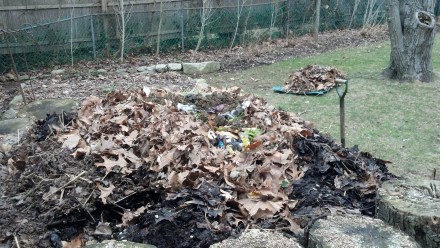
Despite adding volumes of compostibles to my "log cabin" pile throughout the winter, as the spring season begins, it is a condensed, compressed stack of organics in need of a good "airing out."

Despite adding volumes of compostibles to my “log cabin” pile throughout the winter, as the spring season begins, it is a condensed, compressed stack of organics in need of a good airing out.

The literature defines my backyard composting as following the Indore process, first developed a century ago in India by Sir Albert Howard, with a prototypical American twist, which Rodale describes as the University of California method. It’s fitting, as my composting has its roots in California, and I happen to be a UC Berkeley alum.

“The composting method developed at the University of California in the early 1950s is probably the best known and the most clearly articulated of the rapid-return or quick methods,” I read in “The Rodale Book of Composting.” “It is similar to earlier methods recommended by modifiers of the Indore method, to those practices in mechanical digester units in Europe and America, and to those described and advocated by Harold B. Gotaas of the World Health Organization in his 1935 book ‘Composting.’ Whereas the Indore method may be described as falling on the cool end of the compost spectrum, the California method aims for more heat and faster decomposition.”

“Turning is essential to the California method, for it provides aeration and prevents the development of anaerobic conditions. The more frequent the turning, the more rapidly the method works. If you have a single bin, turning the pile requires you to remove the front of the bin and fork out the contents, beginning with the top layer and keeping track of the original location of the material. When you return the contents, make sure that the material from the outer layers (top and sides) of the pile ends up in the interior of the new pile. The material should be fluffed as it is forked, and it should be so thoroughly mixed that the original layers are indistinguishable. In the course of the composting process, every particle of the pile should at one time or another have been exposed to the interior heat of the pile.”

Even more apropos is Rodale’s evocative, if tautological, description of the “wandering compost pile,” which seems to describe my pile well:

“For continuously composting household, yard and garden waste while maintaining optimum pile size, a ‘wandering compost pile’ is effective. Starting with minimum dimensions of 3 feet high by 3 feet wide by 3 feet deep, this type of heap ‘wanders’ as fresh ingredients, such as kitchen refuse (minus meat or animal fat), are tossed onto the sloping front face and finished compost is sliced from the back. By screening the finished compost as it is removed and using the larger particles to cover additions to the front of the pile, newly added materials are seeded with the necessary microrganisms.”

There’s a good bit of manual labor involved in working a compost heap the size of my pile and its particular composition. Actually, the “how-to” reminds me of the old-fashioned flywheels that you see pulling taffy in a candy shop on a seaside boardwalk. First I spread my pile open and out, adding air and space, then fold back in fresh heapings of green and brown from the edges. I think this taffy-pulling bioturbation of my pile is the best way to go about it, as is the log cabin I keep it in.

Last time I turned my pile, to add the unplanned load of horse manure, I excavated twin channels across the top of my pile, scooping the rotting remains of the heap up and outward. I added in the manure and kitchen scraps, then back-filled with dried leaves shaved from the sloping sides.

Weighed down by a few inches of heavy spring snow that fell that night and melted the next day, the dome of my pile from a week ago has now settled in on itself, sagging beneath the tops of the bracing log walls. It’s a good sign of the foment within, and a pattern I’ve followed on pretty much a weekly basis since amassing this heap of fallen leaves and gathered seaweed and hay and other compostibles from the last days of summer on through the end of autumn.

At its peak last last year, my pile swelled to a height higher than my head and sprawled over the log walls that sought to contain it, spilling over the wire fence along the back and down a cascading slope onto the lawn at its front. Each time I watered it, or rain or snow fell upon it, my pile shrunk within itself, subsiding under its sheer weight and succumbing to the forces of gravity and similarly unseen forces of natural decay and entropy. And each time I tucked a fresh batch of kitchen scraps and other organic recyclables into the midst of my pile, I heaped more leaves upon it, gathered from its flanks or the yard, building it up again, as high as my eye. My pile would now be 20 feet tall, if it didn’t always, and inexorably, settle into less.

Over this time, I’ve narrowed my pile’s footprint by nearly half, pulling a wide swath of leaves that once bulged against the back wire fence up onto the top and cleaving three feet or more of compressed leaf litter from the once-sloping front. My pile is now a squat, vertical stack. True, I’ve prodded and poked and probed my pile through and through with the steel rebar rod, perforating it to allow air and water to penetrate its inner recesses. But up to this moment, I have only stirred the top portion of my pile, infusing it with fresh compostibles on through the winter. I have yet to get to the bottom of it, where fresh air and water are needed most to spur on the decomposition process.

Today, the first Sunday of April, it’s time for my pile to get a move on.

After setting out the day’s additions — a week’s worth of kitchen scraps, a fresh bucket of rotting seaweed and salt marsh hay and the last scraps of sycamore fluff hoovered from the winter lawn — I pry into the bottom front of my pile with the straight-tined pitchfork. I tease out clumps of matted leaves, some dry, some wet, from the grip of gravity, heaping shovelfuls up onto the back of the heap.

My pile, in the process of taking a big step forward at the start of spring.

My pile, in the process of taking a big step forward at the start of spring.

Before long I have created an overhang of pressed leaves and tattered seagrass, which I pluck off with the curved tines of the hay pitchfork and add to the top of my pile as high as it will repose. After shaving this scraggly brow, I have a new, near vertical face of old leaves, which I undermine once more, using the hay pitchfork to pull more leaf litter from the bottom toward my feet to form a berm, about shin-high along the front. Within this gathering are just glimpses of anything more than old leaves — stray bits of white shredded paper, a few egg shells and flecks of seashells.

The newly created overhang of leaves along the front of my pile quivers. I step back to take a quick cell-phone video of the gentle avalanche that results:

I’m pleased to see, newly exposed, a rich, dark, moist mass of leaf mold. It’s like I’ve bitten into a creme-filled chocolate. I tease out the mix with the pitchfork. I’d considered trying to harvest a few shovelfuls to spread across my vegetable garden, having read recently that tomato plants thrive under such unfinished compost. But after some digging, the batch still seemed too raw, and besides, I’m still at least a month away from the last frost and planting time.

So I spread the steamy leaf mold atop the berm of drier material along the new front of my pile, and heap shovelfuls across the top. It will infuse these rawer parts of my pile with a rich riot of decomposers.

Such busywork creates a trench along the front portion of my pile, all the way down to bare dirt. I scrape into the crevasse some dried leaves from the corners and creases of my pile, then add the sycamore seed fluff, the kitchen scraps and mix thoroughly, topping it off with a layer of seaweed flecked with salt marsh hay.

I backfill the trench I've made in my pile with a fresh batch of seaweed and bury it deeply with leaf mold scraped from the top.

I backfill the trench I’ve made in my pile with a fresh batch of seaweed and bury it deeply with leaf mold scraped from the top.

I fill in the hole by causing another avalanche from the midst of my pile, and scrape more leaves from the top. The log walls make good markers, and a reckon I’ve tossed and turned nearly the front half of my pile, from top to bottom.

Backfilling in this way shrinks the top of my pile enough to prompt me to walk around the back side to cleave a half row of compost from behind to restore the heap to shoulder high. I now have a shelf of rotting leaf litter along the rear, and I see that just behind the wall of leaves is a rich vein of humus-like compost. Facing south and exposed to the warming sun, it is thick with earthworms and within easy reach.

The next time I mess with my pile, I reckon it will be to add these raw leaves along the back with grass clippings from the season’s first mow. I also make note to mine the newly revealed backside for a pre-season top dressing of raw compost for the tomatoes, not to mention the rhubarb. It’s a comfort to have an itinerary for my wandering pile.

I borrow from the backside of my pile to build up the top.

I borrow from the backside of my pile to build up the top.

I finished my hour’s work by tidying up the front of my pile with a rake, restoring it, at least in look, to the heap of leaves it always appears to be. A good portion of the hard-pressed bottom of my pile has now become the fluffed-up top. With April showers on the way, my pile will soak up all the rain it receives and settle back into itself. But by taking two steps forward and once step back, my pile is newly suffused with air and freshly mixed organic material. It’s primed for productive decay, a healthy rot, thoroughly dead but rife with life, and all the other remarkable paradoxes that constitute and define my pile.

And so my log cabin of a pile wanders in place through the seasons. “Wandering in place” is also an apt description of me in my backyard, as it is for most gardeners.
 

My Pile: April Fool

Every bloomin’ April First, the joke’s on me, as I’m reminded of the foolishness that remains my absolute low point as a compost-minded backyard gardener.

The chief reason I bought my small home on a corner lot in Westport a decade ago this spring was the tulip magnolia tree in the front yard. After noticing the real estate listing in the local paper, I arranged to meet a real estate agent at the house the first Sunday in April. I made up my mind to buy the place as soon as I pulled into the rutted driveway and saw the magnificent tulip magnolia in full bloom. Talk about curb appeal!

The house and rest of the property was a mess. But this specimen of a tree stood out, even though it besieged by tangly vines and surrounded by spiky barberry bushes and sucker saplings from its own spreading roots. About 30 feet tall and with a canopy almost as wide, it was covered by fist-sized cups of white flowers tinged with magenta.

Peering through the scrub bushes and stringy saplings that rose from its roots, I could see that the tree’s bones were very good. The tree’s lowest branches started about waist-high and spread in handy increments nearly horizontally; a perfect tree for my five-year-old son to climb. Underneath its canopy was a smattering of crocuses, poking up through the weeds that spread across what I could tell was once an oval island of tended garden surrounded by grass.

Placed as it was in the front corner of my yard, and that part of the property being on a slight bend in the road, it was the prettiest tree in the whole neighborhood. Approaching my house from either direction, rounding a slight bend, it was though you were driving straight toward the tree and its blossoming beauty. It was a head-turner, that magnificent magnolia, if only for that week or two each spring.

After moving in I pruned the tree of its sucker branches and cleared the ground around it of the wild wisteria and Chinese bitterroot vines that sought to overtake it. My son and the neighborhood kids he soon befriended loved to climb the tree’s smooth-bark trunk and perch on its low-spreading main branches.

For that spring and the next, the tulip magnolia made for great fun and wonderful photo ops, especially in the brief blooming moment, often just at Easter.

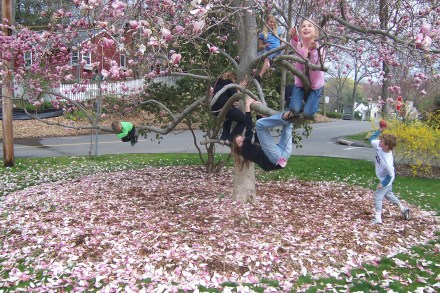
A playdate in the tulip magnolia, in its final years.

A playdate in the tulip magnolia, in its final years.

For a backyard composter, a tulip magnolia is no great shakes. I raked up the fallen petals each spring; the silky pieces melted into my pile like breath strips on your tongue. The seed pods that all those flowers produced were less welcome, as were the waxy coated leaves that rained down each fall. Some compost books consider them more of a nuisance, as they take too long to decompose, but into the mix they went as well.

To restore the garden island the tree grew on and also to give the kids a softer landing in case they were ever to fall from its limbs, I added a layer of wood-chip mulch around its base, spreading it out to the tree’s drip line. I proudly counted how many wheelbarrow loads the ground beneath the tree could absorb, mentally tallying both Safe Daddy points and the kudos for sustainable gardening methods.

The tree thrived, as did the kids.

An autumn or two on, a neighbor took down a towering spruce tree that posed a threat to his house. I drove by just as the tree crew was chipping up the last of the branches and blowing them into a plywood-sided box in the back of the two-ton dump truck. I told them they could deposit the load of chips in my driveway up the street.

It was like getting a hundred Christmas trees, all ground into a poultice of mulched needles, bark and sappy chips. The mound was already steaming when I spread load after load of minced spruce across the garden island on which my tulip magnolia ruled. My greatest fear was that I would bury the crocuses and daffodils too deeply and they wouldn’t be able to find their way up to the sun come the spring.

The following April the magnolia bloomed magnificently. The spring bulbs did well, too.

The third spring surprised me – less blooms crowned the tulip magnolia. I chalked it up to the vagaries of a tough winter.

By the fourth spring, the tree bloomed only sparsely, and produced small, wilted leaves. Neighbors walking by would stop to chat, commenting and offering advice. I watered deeply. That summer, I hammered a score of tree fertilizer spikes into the ground all around the tree.

Then one afternoon the fellow who had done all the tree work for me when first I moved in happened by. I’d been impressed by how he handled the massive hulk of the dead old willow tree in the backyard, saved my roof from the overhanging mulberry trees, showed no mercy for the swamp maples and other “junk” trees. Men who climb tall trees with ropes and snarling chain saws for a living command a certain level of respect from earthbound gardeners like me.

He stopped his truck in the street, rolled down his window and in the kindest way possible gave me the news that he clearly thought I should have known all along: Magnolias didn’t like their surface roots to be covered by mulch. The heat from the decomposition cooks them and could kill the tree.

I thought back to the previous fall, sticking my hand in the deep layer of mulch under the tree to feel its warmth. After so many years of neglect, however benign, I thought I was giving the tulip magnolia a warm blanket of freshly made compostible wood chips from which to draw nutrients.

As soon as he drove off, I grabbed my wheelbarrow and shovel and removed dozens of barrows fulls of old mulch from around the tree, spreading it elsewhere in the yard as best I could. I drove more fertilizer spikes into the ground, as penitence. But by then it was too late.

In its final spring, the tulip magnolia mustered just a few, misshapen blooms and a smattering of leaves, most of which shimmered to the ground during a hot spell in July.

I took the tree down that August, climbing up the bare branches myself with a borrowed chain saw. Its demise, played out over the better part of four years, was slow-motion, every-day proof of my foolishness and ignorance as a gardener. Simply put, I’d loved the tree to death, killing it with what I thought was the kindness of layer upon layer of a steaming hot wood chips.

All gardeners live with failure and most hope to learn from their mistakes, self-inflicted or otherwise. These days, I spread wood chips much more sparingly across my perennial beds, and steer clear of mulch from fir or pine trees.

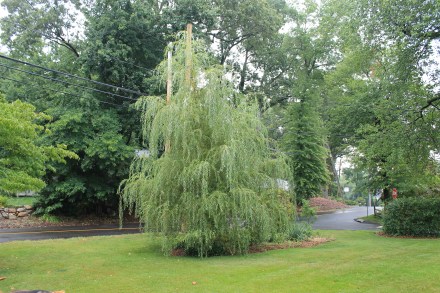
I replaced the tulip tree with a weeping willow. A curiously old-fashioned choice, I admit, in a modern garden. But I didn’t have the heart to plant a new flowering tree in place of the tulip magnolia. And I knew from the towering willow that had died of old age in the backyard long before I bought the place that it would thrive despite me. Native to China, it’s considered an invasive, but I’ve read that it was first brought to American by a Connecticut trader in the 18th century. It’s a local import that has thrived.

I found the willow in the remnant section of the local nursery. Its roots had grown through the drainage holes of its black plastic container and spread deep into the gravel patch the bucket rested on. I needed help from a nursery laborer to wrest it from its spot and took it home at a bargain price of $20 or so, its wispy branches fluttering out of the back hatch of my SUV.

Five years on, the rescued willow is now already nearly as tall as the tulip magnolia it succeeded. I’ve loped off the upper branches to widen its canopy and to keep if from getting too close to the utility wires strung along the street. Its setting in the corner of my yard leaves it far from any drain pipes. Anyway, I’m pretty sure its thirsty roots have tapped into a long-buried spring that flows from the granite ledge across the street and under the road nearest the tree.

The willow, from two summers ago, fast-growing and just now starting to "weep."

The willow, from two summers ago, just then starting to “weep.” It’s now twice as big and full. Two years before that, I’d brought it home in the back of my SUV.

The willow may lack the tulip magnolia’s magnificent presence each spring, but its loping, dangling yellow branches are striking in their own way, early to bud in the spring and late to let go of its slender, oblong leaves in the fall. And like the massive old willow that once graced the backyard where my pile now sits, it is a hardy living thing that I know will survive whatever foolishness I will inflict upon it.

Rather like my pile.

My Pile: Holy Ground

You don’t have to dig too deeply into the canon of writings about compost to find a spiritual, even mystical appreciation of the process. For some, composting is nearly a religious act.

Biblical, even: “In the beginning, there was manure,” Stu Campbell sets forth in “Let It Rot! The Gardener’s Guide to Composting.”

“Soil is where geology and biology overlap,” Steve Jones writes in “The Darwin Archipelago.” “Adam’s name comes from adama – the Hebrew word for soil – and Eve from hava – living – an early statement of the tie between our existence and that of the ground we stand on (Homo and humus also share a root).”

“The most exemplary nature is that of the topsoil,” I read further in “The Art of the Common Place: The Agrarian Essays of Wendell Berry.” “It is very Christ-like in its passivity and beneficence, and in the penetrating energy that issues out of its peaceableness. It increases by experience, by the passage of seasons over it, growth rising out of it and returning to it, not by ambition or aggressiveness. It is enriched by all things that die and enter into it.”

It’s Easter Sunday. Today I will worship not at a church but at the altar that is my backyard compost pile. And I will place within it a tithing of fresh green horse manure. Rich in nitrogen and ripe with voracious microscopic decomposers, it will kick-start the near dormant heap of dead brown leaves amassed last fall. Manure also provides plenty of phosphorous and potassium, both vital elements to the renewed growth of spring.

Yesterday, partly to free myself up for a blessed spring Sunday devoted to gardening chores, I drove my son’s grandmother from her senior-living facility nearby to a horse-rescue farm in the northwest corner of the state. A lifelong animal-rights supporter, she sponsors a broken-down race horse now in pastoral retirement. She wanted to see the old filly, hand deliver a further donation, and I was happy to drive her there. In part, because in the back of my car was a large plastic tub to fill with horse poop to haul back home to my compost pile.

If she had religion, Gigi’s patron saint would surely be St. Francis of Assisi. The Vatican is a bit more equivocal on the point person for me and my pile.

Saint Phocas, the patron saint of composting.

Saint Fiacre is said to be the patron saint of gardening, but it seems he had an aversion to women, which is why he’s also considered the patron saint of those afflicted by venereal disease. Hard to cast yourself with that lot.

I’ve heard Saint Phocas described as the heavenly protector of compost, as he was martyred by Roman soldiers after digging his own grave in his garden, so that his remains would be subsumed by the soil. Props to him, but I’ll pass…at least for the time being.

Instead I make this pilgrimage to the nonprofit manger in upstate Connecticut, a complex of stables and paddocks devoted to giving comfort and shelter to rescued thoroughbreds from the race track, retired carriage horses from Manhattan and the odd, abandoned Shetland pony. The shelter also gives young girls a chance to groom and ride the horses, which is nice. Other than that, its chief product is horse poop.

“It’s the one thing we have plenty of,” said the friendly blue-jeaned blonde who runs the place, directing me to a 10-foot tall mound of manure in a muddy enclose behind the barn.

It’s a sight for any backyard gardener to behold. Karol Capek captured the feeling well in The Gardener’s Year. The slim, almost psalmic volume, is worth quoting nearly chapter and verse: “There are times when the gardener wishes to cultivate, turn over, and compound all the noble soils, ingredients, and dungs. Alas! there would be no space left in his garden for flowers. At least, then, he improves the soil as well as he can; he hunts about at home for eggshells, burns bones after lunch, collects his nail-cuttings, sweeps soot from the chimney, takes sand from the sink, scrapes up in the street beautiful horse-droppings, and all these he carefully digs into the soil; for all these are lightening, warm, and nutritious substances.

“Everything that exists is either suitable for the soil or it is not. Only cowardly shame prevents the gardener from going into the street to collect what horses have left behind; but whenever he sees on the roadway a nice heap of dung, he sighs at the waste of God’s gifts.

When one pictures a mountain of manure in the farmyard – I know, there are various powders in tin boxes; you can buy whatever you like, all sorts of salts, extracts, slags, and powders; you can inoculate the soil with bacteria; you can till it in a white coat like an assistant at the university or in a chemist’s shop. A town gardener can do all that; but when you picture a brown and fat mountain of dung in a farmyard –.”

Alas! Grabbing a thin-tined rake set against the fence, I fill my beer-keg tub with a rank mixture of horse droppings, rotting straw and sawdust shavings. Good thing I’d remembered to bring along a heavy-duty plastic bag to cover the tub or it would have been that much longer a ride home with my former mother-in-law. As is, I could only fill the bucket about halfway to the brim before it got too heavy for me to lift.

Whoa, Nelly! A mother lode of rotting manure and muck from horse stalls at a horse rescue farm in upstate Connecticut.

Alms for my pile, direct from the source. Back home at dusk, I finish up my winter reading:

“The compost heap in your garden is an intentional replication of the natural process of birth and death which occurs almost everywhere in nature. Compost is more than a fertilizer, more than a soil conditioner. It is a symbol of continuing life,” I read in “The Rodale Guide to Composting.” As thick as a King James Bible, the guide was first printed in 1979, as the title page states, “on recycled paper, containing a high percentage of de-inked paper.” For organic gardeners, this seminal work is as close to the gospel truth as it gets. Even so, its authors remain admirably humbled by the unknowable essence of their subject:

“The entire composting process, awesome in its contributions to all plant and animal life, is probably impossible to contemplate in its full dimensions.”

The Guide draws on the research and inspiration of the American prophet of compost, J.I. Rodale, who was building on the pioneering research done in the 1840s by German scientist Justus von Liebig, and the work of British agronomist Sir Albert Howard in the early 1900s, who spent nearly 30 years in colonial India experimenting with organic gardening and farming.

In 1943, Sir Howard published “An Agriculture Testament,” based on his findings that the best compost consisted of three times as much plant matter as manure, with materials initially layered in sandwich fashion, and then turned during decomposition (known as the Indore method). The book renewed interest in organic methods of agriculture and earned him recognition as the modern-day father of organic farming and gardening, report the helpful researchers at the University of Illinois Extension.

I read further on the UI site that “the ancient Akkadian Empire in the Mesopotamian Valley referred to the use of manure in agriculture on clay tablets 1,000 years before Moses was born. There is evidence that Romans, Greeks and the Tribes of Israel knew about compost. The Bible and Talmud both contain numerous references to the use of rotted manure straw, and organic references to compost are contained in tenth and twelfth century Arab writings, in medieval Church texts, and in Renaissance literature.”

If passing along these writings qualify me as a modern-day evangelist for the art and science and, yes, religion of composting, then so be it. I confess. And then I get to work on replenishing the sagging, sodden mound of gathered leaves that is my pile. First I carve a shallow trench along the top front, uncovering among the rotting leaves the moldy remains of my last insertion of food waste from the kitchen, releasing a plume of steaming vapors in the cold morning air. I add a few shovelfuls of the manure into the mix. Next I dig a deeper, wider hole along the back, pitching the excavated leaf litter to the front to mix in and aerate with the freshly deposited manure.

A trench along the front of my pile filled with leaves, manure and kitchen scraps. I’ll dig out a trench along the back, heaping old leaves on top of this new supply and bury the rest of the leaves and manure.

Into this new void goes a modest roundup of dry, crinkly leaves that have blown up through the winter against the chain-link fence that lines one side of my backyard. I follow with more manure, then add some wet, matted leaf mold scraped from the bottom backside of my pile. A week’s worth of fresh kitchen scraps follows, along the rest of the manure. I top it off by strip-mining the back side of my pile with the hay pitchfork. Pressed into a shawarma-like stack by a long winter, the leaves cleave off the ragged edge of my pile in tidy forkfuls.

In short order, I have buried twin chambers of hot manure and fermenting kitchen scraps deep within the dank, musty leaf mold and piled the heap high again with borrowings from its crumbly flanks, returning my pile to the pyramid-shape I favor for composting efficiency — and to have a backyard privy tall enough to pee behind.

If my pile and I had a religion, it would stem from the civilization that prospered long ago on the banks of the river Nile. “The ancient Egyptians saw the shape of the pyramids as a method of providing new life to the dead, because the pyramid represented the form of the physical body emerging from the earth and ascending towards the light of the sun,” I read on the About Religion website.

My pile is now fully primed for its resurrection by the warming powers of the spring sun. By mid-summer, the heap of dead leaves and organic detritus will be transformed into newly minted soil to be cast about the garden and lawn. Come the fall, it will begin again.

Until then, allow the last words on this virtuous cycle to Wendell Berry:

“A person who undertakes to grow a garden at home, by practices that will preserve rather than exploit the economy of the soil, has set his mind decisively against what is wrong with us. He is helping himself in a way that dignifies him and that is rich in meaning and pleasure.

“Even in its functions that may seem, to mechanists, to be mechanical, the topsoil behaves complexly and wonderfully. A healthy topsoil, for instance, has at once the ability to hold water and to drain well. When we speak of the health of a watershed, these abilities are what we are talking about, and the word “health,” which we do use in speaking of watersheds, warns us that we are not speaking merely of mechanics. A healthy soil is made by the life dying into it and by the life living in it, and to its double ability to drain and retain water we are complexly indebted, for it not only gives us good crops but also erosion control as well as both flood control and a constant water supply.

“It is apparently impossible to make an adequate description of topsoil in the sort of language that we have come to call ‘scientific.’ For, although any soil sample can be reduced to its inert quantities, a handful of the real thing has life in it; it is full of living creatures. And if we try to describe the behavior of that life we will see that it is doing something that, if we are not careful, we will call ‘unearthly’: it is making life out of death. Not so very long ago, had we known about it what we know now, we would probably have called it ‘miraculous.’”


My Pile: Ticked Off About Deer

The best thing about my pile? The deer don’t touch it.

I share all else in my backyard with white-tail deer. Lots of them. Resilient, highly adaptable and just darn Bambi-cute, Odocoileus virginianus now makes itself at home in many a suburb, including my own.

My neighborhood street and its flanking swaths of lushly landscaped yards connect an access road that parallels the marshy drainage ditch along a major highway (I-95) to an upland ridge of granite ledge and hardwood trees that is too hard to build on and, thus, largely undeveloped.

Midway between those two refuges of privacy and protection is my property, a convenient way station for deer on their daily commute.

Being a corner lot, it’s not practical to fence it all off, so nightly, as sure as sin, I am visited by a stealthy band of hungry deer.

I don’t know exactly how many and how they are related, but I figure it’s a family group of a doe and yearlings traveling along with their mother. Because the furtive prey animals forage mostly at night, I hardly ever see deer in my backyard, but I know them for the damage the cause – the evidence they leave behind.

Not my garden, but you get the picture. (Actually, the deer in my yard are much fatter!)

Not my garden, but you get the picture. (Actually, the deer in my yard are much fatter!)

Sets of two-pronged cloven hoof-prints are familiar tracks across my yard, especially during mud season. The deer scat provides more clues to just how popular my salad bar of a garden is with these rangy ruminants, and how long and where they linger. Patches of green-brown pellets are scattered like buckshot next the yew shrubs and evergreens planted alongside the house, in the perennial beds along the side of the yard, or just plopped in the middle of the lawn.

I can’t be bothered with deterrents such as wrapping bushes in netting or installing strobe lights or sonic devices. Nor do I have a mind to spraying my yard, either by contracting a commercial service or by buying a batch of coyote urine or some such extract off the internet.

Sometimes the dog and I adjust our schedules and catch a deer or two or three loitering in the pre-dawn gloaming; he’ll give chase, their white tails high in retreat. Usually, the dog stops when he gets to the edge of our property, and the deer pause in the yard across the street to wag their own high tails at him.

Mostly, the dog just sniffs and snorts at the deer droppings he comes across in the lawn, which I let disintegrate where they fall. I also let stand the cow-patty-sized dung I see on occasion. I figure they are from a buck relieving himself, marking my yard as his territory.

I saw him last, I think, on Halloween night. My across-the-street neighbor, Claire, stopped by to say hello after the kids had finished their trick-or-treating. We were chatting on the porch when behind her an 8-point buck strolled up the middle of the street between our houses. We figured his nightly routine had been interrupted by the costumed kids and their parents parading up the street. He took the festivities in stride and ambled up the street on his way to the woods like he was auditioning for a TV commercial.

The other evidence of deer in my yard is everywhere. Everywhere except my pile.

I admit to some feeling of satisfaction that my pile is the one thing in my yard that I don’t have to share with deer. All else seems fair game.

The deer keep the perennial azaleas trimmed to the nub, and munch on the scraggly rhododendrons I was foolish enough to buy when first planting my garden some years ago. I’ve never seen a blossom, as the deer always get to them first.

Same with the tiger lilys and tulip bulbs I received as housewarming gifts. The deer pinch off the delicate flowers and leave behind the beheaded stems to remind me who is the top of the food chain in my yard. (Fortunately, the deer seem to have no taste for daffodils and crocuses, which now provide me with the first and most welcome blooms of the growing season.)

The row of hostas I planted along the back fence suffer the same fate. Each season the deer wait for them to grow dense, then chomp the verdant green leaves to stubs, seemingly at the same time each year, just as the hostas are about to bloom.

This litany of woe is familiar to most gardeners who share their habitat with deer, and like most, I’ve adapted, planting mostly ornamentals that the deer don’t have a taste for – at least until they get desperate from drought or extended snowfall. Sometimes I think the deer act a fox in a henhouse, and just mow down whatever they can, because they can. I see lots of chewed-off branches strewn across my yard.

Some summers the deer let me enjoy my black-eyed susans, phlox and hydrangeas; sometimes they don’t. Over the years I’ve buried hundreds of acorns, gathered during walks at parks or golf courses, and am pleased that a few have snuck their way past the deer and squirrels to grow tall enough to have a chance at a long life. I now have 10 or 12 saplings along the perimeter of my yard, from nearly as many kinds of oaks. They will make fine replacements for the swamp maples that I inherited and am trying to rid my yard of.

The deer pass by the bright yellow shocks of forsythia, the cleome that blossom the summer long and the cone flowers, joe pye and butterfly bushes that mark the peak of summer and attract so many hummingbirds and bees. Deer don’t have a taste for pachysandra, pampas grass or yucca, either, and all those are staples in my perennial beds.

The shade garden in the back corner of the yard, next to my pile. In a few weeks, the hostas will be deer dinner.

The shade garden in the back corner of the yard, next to my pile. The hostas make a fine salad for the deer.

Over the years I’ve added more and more ferns as well, and I now have six or seven types. Most I gather on walks in a tract of open space nearby that borders a municipal golf course. I hike it with a buddy and our two dogs. He scours the woods for wayward golf balls, while I collect a fiddlehead or two. I know it’s not exactly kosher to collect plant specimens from public land, but the ferns grow in colonies, and I see no lasting harm in separating a clump from brethren and transplanting it in my garden.

Our deer “problem” is pervasive and near epidemic proportions. The other morning while driving my son to school, we passed a large yard a couple neighborhoods down the road and counted a herd of 14 deer grazing on the grass. “Look at that, a new personal best,” I told him after slowing to make a quick count. “Add to it,” he replied, pointing out 5 more in the yard on his side of the car.” They were all does and yearlings, near as I could tell.

It wasn’t always this way. I’ll quote a local deer expert, Peter Knight, in an editorial to our local newspaper before a town meeting about what to do with Bambi.

Says Knight: “With no natural predators, the deer population has grown from an estimated 12 — yes, 12 — in all of New England in 1896 (following the years of land clearance for farming) to approximately 150,000 today. The latest survey conducted by the Wildlife Division of the Department of Environmental Protection in January 2009 estimated an average 62 deer per square mile in Fairfield County that covers 625 square miles. (Okay, we’ll do the math — 38,750 deer.)

Sixty-two deer a square mile is a lot of mouths to feed. As I live in the only one of Connecticut’s 169 municipalities that has banned all hunting, the upshot of this perennial debate about what to do with the deer “problem” is, invariably, “live and let live.”

Aside from having to counter-program my garden according to the whims and wills of all these passive-aggressive creatures, deer bring with them an even greater concern: Lyme disease.

When I purchased my house a decade ago, the yard was seriously overgrown and unkempt – a chief reason why I could afford to buy the rundown property in the first place.

From neighbors after the fact, I heard that the elderly widow who had lived in the house for 30 years had tried to keep up the garden her late husband had tended. But, the story goes, she contracted Lyme disease while gardening, which forced her to withdraw indoors.

The pernicious disease perhaps caused ailments that led to her being a shut-in for the last decade of her life. I don’t know, but one upshot was that her untended backyard became a haven for deer. When first grubbing out the back corner of my lot, near where my pile is today, I found a nesting place for deer tucked into the briar patch of tangly scrub and poison ivy vines. Not only did they feed in the yard, but they slept here.

Nowadays, the deer might not linger so long, but they still bring with them the ticks that serve as vectors for a game-changer of a disease for gardeners and outdoor enthusiasts.

The symptoms of Lyme disease were identified among a cluster of young patients in Lyme, Old Lyme and East Haddam in 1975 – Connecticut towns just 40 miles or so up the shoreline. A year later a biologist in the DEP identified the deer tick that carried the disease and a few years later the popular name for it was coined.

Dr. Mark Friedman, a professor at the University of Connecticut’s School of Medicine, calls Lyme disease “the great imitator, an insidious infectious disease that is very difficult to diagnose.”

In addition to the variety of common symptoms – fevers, aches and rheumatoid arthritis among them – Friedman blames Lyme ticks for current incidents of disfiguring Bell’s Palsy, and Lyme dementia, which can often be misdiagnosed as Alzheimer’s disease. He also reports it has recently been discovered that the ticks can carry a disease called Babesiosis, which is similar to malaria.

While deer are not the only carriers of infected ticks, they are essential to the successful reproduction and completion of the life cycle of over 95 percent of ticks, Knight reports. They are also by far the largest distributors of ticks — just compare the acreage through which they roam with that of a mouse.

The ticks have a two-year life cycle. The adult ticks feeds on deer blood and as a result the female becomes fertile and finds a mate on the same deer. The tick drops off and lays 2-3,000 eggs that develop into larvae and then nymphs that feed on the blood of small animals such as mice or birds. These small animals are frequently infected with the Lyme disease bacteria and transmit it, through their blood, to the tick. Later in the second year, the nymphs molt to become adult ticks and the cycle repeats on the deer.

“It’s costing taxpayers in Connecticut $1 billion a year in health and landscaping costs,” he said about the uncontrolled deer population, in an article in our town’s local online news site.

I always try to take tick precautions when outdoors, whether tromping through the woods or in the backyard. Gathering up a pile of leaves and hauling a bagful slung over my shoulder is downright risky behavior, in terms of exposing yourself to ticks.

It’s a pain, but I make it a habit of stripping off my work clothes after a session in the garden or working the pile and toss them straight into the washing machine. A long-sleeved shirt, pants and gloves are de rigueur, though for me the garb is more to protect against poison ivy.

Still, I find ticks on me from time to time and have, on occasion, made a trip to the doctor or local clinic for a dose of antibiotics. Last summer, the dog pulled up lame; the vet confirmed that he’d contracted Lyme Disease too.

The point is, you can’t write about a compost pile without taking into account the impact deer have on the garden — and gardener. The best thing I can say about them is that they were here first, they are handsome, graceful animals, and they have the good sense to leave my pile alone.

My Pile: True Grit

It’s Palm Sunday, and the first day of spring. On through the week, the news media have been predicting a Nor’easter to arrive by tonight.

The forecasts, as they usually do, started with dire predictions of a foot or more of heavy, wet spring snow, prompting a run on milk, bottled water and batteries at the local stores. The latest computer models show the weather system staying offshore as it tracks northward up the gulf stream, with only a chance of an inch or two of snow starting later today. I told my son to finish his homework; he hasn’t a prayer of a snow day on Monday.

But with the prospect of snow and the distant storm already producing high surf on the nearby Sound, I have already laid in provisions for my pile, combed from the beach yesterday: A plastic half barrel of seaweed, mashed by the waves and heavy with wet sand.

It now sits beside my pile, along with two half-filled buckets of food scraps and a leftover black plastic bag of the sycamore fluff mulched up from the lawn a week ago. And hanging from a hook in the tool shed is a gift from a neighbor who walks his dog past my house: A double-wrapped plastic bag of cabbage peels and potato skins and other leftover makings from his St. Patrick’s Day celebration. Perhaps this stew will help get my pile’s Irish up.

I have more in store for my pile: While doing some spring-cleaning to start the morning, the vacuum cleaner clogged with a winter’s worth of domestic detritus – dog and cat fur, dirt and sand tracked in from outside, dander and dustballs flecked with the down feathers from a pillow fight.

I’ve read that most any vacuum-cleaner bag contains a cringe-worthy amount of detritus of our own making – sloughed-off skin and hair along with the remains of all the mites and motes that share the interior spaces of our lives. I rather like recycling all that stuff. Dust to dust, as the good book says, with a stop in between to be recycled by my pile. Instead of stuffing the dust bag in my kitchen garbage can, I take it outside to my pile.

Snow or no snow on the horizon, the first day of spring is a fine time to stir my pile with an infusion of fresh green organic energy and other recyclables.

Having turned the top of my pile last weekend and added a sizable amount of kitchen waste and the bulk of the sycamore fluff to its midst, this morning the craggly brown layer of leaves that cover the surface is damp; smoky wisps of water vapor tell me that my pile is cooking underneath. But still, I worry that adding so much sycamore seed fluff will hold back its decay.

Sure enough, as I turn out the top edges of my pile with the pitchfork, I unearth patches of matted orange-brown sycamore fluff, unchanged from the week before, seemingly immutable as Donald Trump’s hair.

After a winter’s worth of messing with my pile, I am now practiced at borrowing from the sagging center of the heap to build up the edges. I’m relieved to see the jangled stalks of salt marsh hay, buried just a week ago, are rotting nicely. And once more, the foodstuffs previously tucked into its midst have done their disappearing act, save an eggshell or two, and the curled skin of an avocado.

Before long, I’ve carved out a bathtub-sized crater from the center of my pile, and into the excavated space I tumble most of the plastic bag of sycamore seeds, heaping it with all of the assembled food scraps, and the remains of the vacuum bag. I stir it together with the pitchfork, and add a layer of seaweed, matted together in clumps and already pungent from sitting in the plastic tub overnight.

Adding a fulsome amount of food scraps and gleanings from the yard to my pile, on the first day of spring.

Adding a fulsome amount of food scraps and gleanings from the yard to my pile, on the first day of spring.

The front of my pile is a now raggedy stack of pressed leaves, like so much shawarma on a spit. I shave off slices of the compressed leaf litter and turn them up and onto the top of my pile, once again building it up higher than before.

Over the past few weeks I’ve borrowed about three feet from the front scree of my pile, and it, like the backside, now forms a nearly vertical wall. It’s about the shape of an old toaster, with some of the same function. I know, just behind that crumbly brown wall of dried pressed leaves is the very center of my pile, into which I’ve been mixing food wastes and other compostibles on through the winter. It’s now within easy reach, and will soon be exposed to the warming sun of spring as I begin to turn my pile upside-down and inside out.

After raking up some scattered leaves, I now stand on the hard-packed dirt that was once part of its original footprint from the fall and dump the rest of the plastic bucket of seaweed across the top, which finishes as a flourish of sand collected on the bottom.


I borrow leaves from the front slope of my pile to build up the top and create a nearly vertical wall made of dried, compressed leaves.

I borrow leaves from the front slope of my pile to build up the top and create a nearly vertical wall made of dried, compressed leaves.

A measure of sand is always welcome at my house, whether it’s clinging to skin or sandal or towel or brought back by the bucket full. Beachcombing is much like my perambulations around the garden and lawn and all the messing I do with my pile. It’s an outdoor pursuit that’s rewarding in a free-range sort of way.

Regular additions of such freeloaded sand benefits my pile and in turn my lawn and garden. Made up largely of inert particles of rock and other minerals like silica, beach sand helps keep the soil in my yard — which leans toward silty clay once you get past the root zone — airy and stable. Sand adds heft and no doubt plenty of trace elements and minerals to my pile, and I imagine the granular crystals help grind up the leaves, like so much microbot sandpaper. Sowing a shovel-full across the top of a freshly fluffed gathering of leaves in the fall weighs it down just enough to keep the winds from scattering the leaves back across the yard.

I don’t worry too much about overloading my pile and yard with the salt that I’m sure infuses the sand that I scoop from the beach, but several years ago I was pleased to make use of a local surplus of construction-grade sand, also free for the taking.

In the aftermath of Superstorm Sandy, the town’s garbage drop-off and recycling center became the final dumping ground for many of the sandbags used by residents to keep floodwaters from their garages and basements.

With my pile such a capacious repository for kitchen waste, I visit the dump mostly to drop stuff off for recycling – newspapers, especially the colored slick ad inserts – milk jugs, plastic sport-drink bottles, beer cans and the odd bottle of wine. By weight, I would guess that dog poop collected from the yard is probably my biggest contribution (or his) to the local garbage stream, which is hauled to a nearby power plant for incineration.

By the following spring after Sandy, which destroyed a number of houses along the Connecticut coast and flooded by own crawlspace of a basement, the mound of burlap bags was still rotting away off to the side. So I loaded a half-dozen of the most intact sandbags into my car and added them, one at a time, to my pile over the course of the growing season. I also draped the empty sacks in front of my pile to sop up standing water, the rough burlap weave soon melding with the muck of mud season to disappear under my feet.

My pile and how I keep it is all about recycling. Seaweed and sand and another gleanings from the beach and elsewhere take a spin through the heap of leaves and kitchen scraps and then are flung back into circulation as compost across my yard. True grit, my pile.

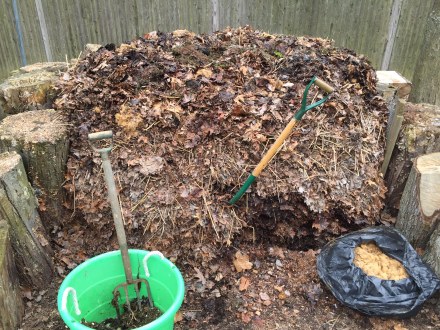
My pile, poised to begin spring as a stout stack of decaying leaves from the fall, spiked in the middle by a winter's worth of fixin's.

My pile, poised to begin spring as a stout stack of decaying leaves from the fall, spiked in the middle by a winter’s worth of fixin’s.