My Pile: Off the Charts

Arriving home from work this evening, I check the mailbox and find a business envelope, with a return address of University of Connecticut, College of Agriculture and Natural Resources. Inside is a sheaf of single pages, results of each of my three soil samples. At the bottom of the first page, in pencil, is a handwritten note.

“Hi,
We did run your 3 samples as requested. Our standard nutrient test is not meant for compost, as the nutrients are all above our mineral soil limits on the analytical equipment….”

I check the tabular results for the compost sample. On the left of the page are four rows labeled Calcium, Magnesium, Phosphorus and Potassium. Stretching across the page are three columns, titled “Below Optimum,” “Optimum” and “Above Optimum.” The colored bars for all four key minerals extend into the last column, with Phosphorus stretching the farthest.

My pile is off the charts!

Another page is labeled “Modified Morgan Extractable,” and on it I see that my pile has 38.2% organic matter — which makes me wonder what the other 62% consists of.

I compare the results for my pile with those for the vegetable garden and perennial bed, which I keep covered with annual spreadings of wood chips. One number stands out: The Nitrate-Nitrogen level for my compost pile is 150.1 PPM, vs. the mulched bed’s 19.1.

I scan the back of the page, where the handwritten note continues:

“As to your mulch question – I wouldn’t worry about it. The benefits of mulch far outweigh any problems with nitrogen deficiencies. Wood mulches, in particular, decompose so slowly that nitrogen deficiencies would not typically be seen here. If you added a finer, more rapidly decomposing source of high carbon organic matter, like sawdust, you could see nitrogen deficiency around quick growing annual plants, like peppers and zinnias. I use shredded bark mulches in all my perennial beds and usually fertilize once in May. I have no seen any nitrogen deficiencies. Hope these tests answer some of your questions.”
Dawn P

The pH readings are 7.0 for the compost sample, 6.6 for the mulched perennial bed, 5.5 for the vegetable garden.

Another page is a handout titled, “Interpretation of Soil Test Results.” It informs me that “soil pH is a measurement of a soil’s acidity. The pH scale ranges from 1 to 14, with a pH of 7 being neutral. Values below 7 are considered acidic while those above indicate alkaline conditions. The pH of a soil not only affects the availability of necessary plant nutrients but also the solubility of potentially toxic elements such as aluminum and lead.

Most garden plants prefer a pH between 6.0 and 6.8. Notable exceptions include acid-loving blueberries and ericaceous plants like rhododendrons, azaleas and mountain laurel. These plants prefer a pH of 4.5 to 5.3. The majority of Connecticut soils tend to be acidic with pH values ranging from 4.8 to 5.5 due to the geology and climate of the region.”

I’m pleased, if not downright proud, of the results across the board. My pile turns out to be extraordinary rich in nutrients, and I imagine as it continues to mature will increase its percentage of organic material. The vegetable garden, with its base of native soil, remains true to its slightly acidic nature, which I will address soon by adding a thick top dressing of compost. And I’m relieved that years of covering my perennial beds with wood chips and chopped leaves haven’t turned it acidic. I have a science-based answer to why my flowers thrive so well — and perhaps why the rhododendrons haven’t.

And I’m happy to have received such personalized attention from a government bureaucracy. Thanks, Dawn!

I celebrate with a quick mow of the yard. I’m rushing daylight and laboring under a steamy August night, so mow only the stretch of lawn where the grass and clover are most lush — which happens to be the precise area I spread a season’s worth of compost two summers ago. I mow around the perimeter of the front lawn, along the street where the windblown weeds take root quickest, but leave the interior to grow whole under the hot summer sun.

Still, I gather two hopper fulls of fresh-cut grass clippings, which I heap along the front of my pile. I have a stuffed container of kitchen scraps to dispense with, as well as my neighbor’s ash can. They left town for their annual summer trip to the mother’s home country of Hungary early in the week, and I find the heavy can half full of food scraps, rotting in a pool of rank liquid. It’s been that hot of late, and the food waste has simmered into a ratatouille of rot — compost tea, some call it.

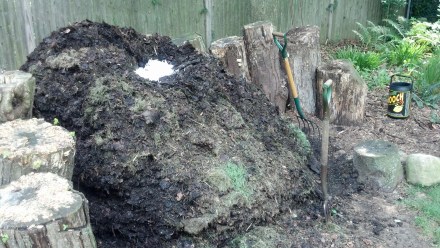
I’m nearing the point of dispersing my pile through the garden, around the perennials and across the patch of straggly lawn that didn’t receive the last batch of compost, so I start my digging and turning in the left-rear corner of my square-cut heap of nearly finished compost. The heap has shrunk over time, and it now rests a foot or so away from the log wall that once contained it. I stab the pitchfork into the edge of my pile, the tines piercing into the dirt floor, to draw the piecemeal leaf mold along the bottom outward, back up against the two and tallest logs at the back of my pile.

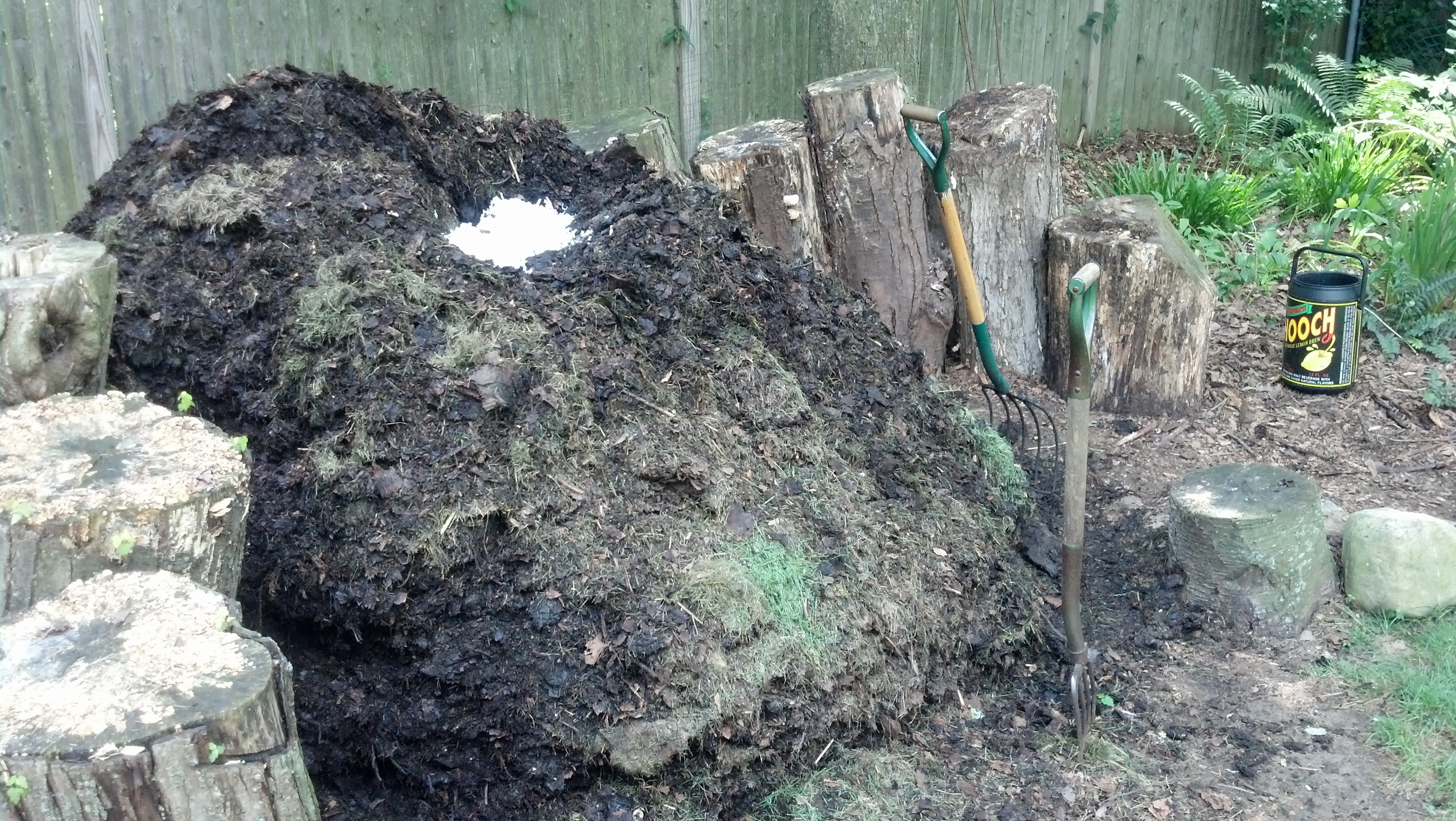
I scrape away, building up a back berm of freshly unearthed compost. It is moist and smells richly of forest floor. I sprinkle a thin layer of grass clippings across the top, and dig away to excavate a trench in which to bury my soggy week’s worth of kitchen trimmings. I bury the mess with scalpings of sun-baked leaf mold from the top and sides of my pile, and burrow further back and down until I reach a vein of leaves cocooned since last fall. If this isn’t the very bottom part of my pile, it’s very close. I turned out the old virgin leaves and cover them with a thin layer of fresh grass clippings, a May-December marriage if ever there was one.
Burrowing into the bottom of my pile to turn out the old and bury the new.

Burrowing into the bottom of my pile to turn out the old and bury the new.

As I burrow my way back and down and up and in to this corner of my pile it collapses onto itself. It knows when it’s goose is cooked, and I fold another layer of grass clippings across the top, finishing the near-done humus with a basting of fresh, wet grass trimmings.

This back corner of my pile rises high, bolstered by pitchforks of sodlike leaf mold that have tumble down along the flanks. I’m choosing this  redoubt as my last stand — with my pile it’s LILO, last in, last out. I’ll harvest my pile from the opposite corner first, and give this blend of the latest kitchen scraps, grass clippings and the rawest of leaf mold as much time as it needs to ripen as compost. It’s this section that will likely form the base of next year’s pile.

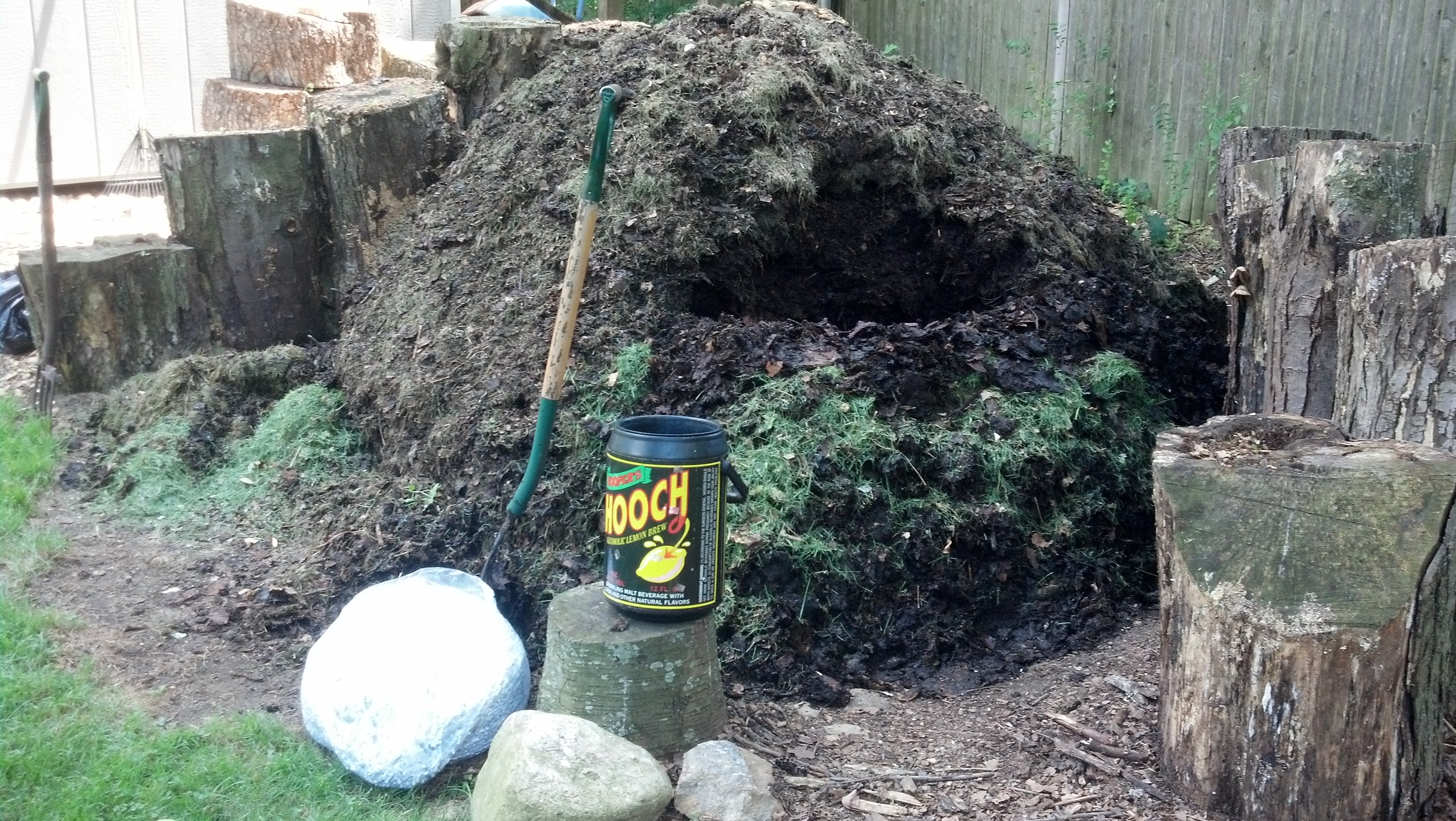
With more grass clippings and the neighbors’ soggy tin can of food waste to dispense, I work my way along the backside of my pile, digging a knee-high trench to turn out the old and bury the new. I tidy up along the edges to return my pile to the rounded heap of nearly finished compost that it is, only shape-sifted a few cubic feet into a fresh semblance of its former self.

I finish in the gloaming of evening and step back to consider my pile, now at its most fulsome and accomplished state of being.
My Pile: Shredded

I spend an anxious week eagerly awaiting the results of my soil test samples sent off to the UConn lab. It’s like waiting on a pregnancy test. Am I fertile? What if something’s wrong with my pile?

Not that there’s anything I can do about it. I know all that’s gone into my pile, and know of its seemingly infinite capacity to absorb, transmute and transform the riot of raw materials into a finished product that is at itself not fully understood by scientists but invariably useful and productive to gardeners and farmers of every kind.

As the quote of the day on the UConn Soil Nutrient Analysis Laboratory website cites from Franklin D. Roosevelt: “The nation that destroys its soil destroys itself.”

Today, a Saturday and the first day of August, dawns bright and clear after a week of hot, muggy weather that was finally broken by a gully washer of a thunderstorm.

The rains gave the yard and gardens and my pile a soaking down through the root zone and then back up until the low parts of the lawn were squishy under my shoes. I threw a tennis ball for the dog this morning, and his paws unleashed sprays of water; the tennis ball itself spun out its own galaxy of droplets.

The heat wave stifled the grass, and for the first weekend in a month or so I don’t have to mow. Still my soggy pile of nearly finished compost could use a good turning. I have a clutch of mildewing grass clippings dropped off by a neighbor a few days ago. And I have a bucket full of summer kitchen scraps to dispense with more urgency than normal. While making coffee few mornings ago I was buzzed by a small squadron of fruit flies, hovering above the kitchen sink.

Fruit flies are more an annoyance than a danger, but still a presence that no kitchen composter wants to tolerate. After clapping as many as I could mid-air, and squashing a few more with my thumb against the east-facing window above the sink, I check the Hooch bucket that sits on a glass-topped table to the side of the kitchen counter. No sign of an infestation, which after further inspection I realize comes from some spilled beer in the paper-lined bin I keep under the sink to stash my recyclable cans, jars and bottles.

The bucket of kitchen scraps this week includes a handful of long-expired vitamins and capsules of fish-oil supplements.

Before I take the Hooch bucket outside, I open the fridge to make one last sweep through the vegetable bin. I find nothing past its due date, but spot the collection of vitamin and supplement bottles that have long resided in the tray on the inside of the door. There’s a bottle of multi vitamins and two of fish oil supplements, dating from a long-ago new year’s resolution. Each one is more than half-full. I check the expiration dates and and am shocked to see that they are years out of date. I debate whether they should go in the Hooch bucket or the trash can, then check online for advice. While I know certain prescription drugs are now creating all kinds of hazards, up and down the food chain when flushed down the toilet or sent to a landfill, I can find no authoritative counsel on whether vitamins pose the same risk.

I find some concern about the risk, especially to small children, of coming into contact with excessive amounts of iron, but after reading on one garden forum the comment, “hey, the pills contain minerals that are naturally occurring anyway,” I decide to chuck them into the Hooch bucket. The fish oil capsules will surely wash safely away, and I figure a handful of multivitamins ingested by a compost pile of my size, which will soon be spread across a third-acre of grass and garden, is an acceptable way of recycling such nutrients.

I take the Hooch bucket outside and place it next to a plastic bag of shredded paper from the office. What began several months ago around tax time as an impromptu gesture has now been added to my job description: Whenever the small bin of the finance department’s paper shredder fills up, “the compost guy” gets the call to empty it.

It’s a task that I am happy to have taken on. For one, the shredded strips of crinkled white paper have mixed well with the copious amounts of green grass clippings I’ve added to my pile’s crumbly brown heap of leaves and other rotting mixings. The dry, crinkly white shreds soak up the watery slop of kitchen waste — watermelon rinds and other fruit trimmings that are quick to putrify in the summer heat. For another, I see my recycling at the office as a fairly easy way to practice what I preach in my own backyard at the place where I spend most of my waking hours.

And there’s this: I spent more than 25 years as a practicing journalist and until recently was always an avid consumer of printed magazines and newspapers. Over my career, I am at least partially responsible for the destruction of a large forest’s worth of paper. To recycle even a tiny portion of that highly processed product in my backyard is a way to atone for being an ink-stained wretch for so long.

Here’s what the Cornell School of Horticulture has to say about it, on their Home Gardening website:

“Several paper products – especially newspaper and cardboard – are useful in the garden and landscape. While it provides no nutrients, paper is organic material, made primarily of wood fibers. It decomposes slowly but provides structure when used in a compost pile.

“Shredded newspapers or telephone books are good paper choices for composting or digging into soil directly. They decompose well when mixed with high nitrogen products such as manure. Shredded newspaper may also be used under other mulches in the landscape, where it is broken down by earthworms.

“Shredded computer or other office paper and glossy magazine-style paper decomposes slowly and may contain dioxins. There are enough concerns about the dioxin in bleached and glossy paper that it would be wise not to use them in the garden.”

Of course, I take the glossy ad inserts, junk mail and the like to the local recycling center, as well as the newspaper I don’t use as kindling to start my fireplace in the winters. Years and years ago, while living in New York City, I helped a buddy fill up his parents’ Volvo with a half-year’s supply of New York Times. Our orders, in exchange for spending a long weekend at his parents summer cottage on the North Fork of Long Island, was to spread the newspapers wholesale across a section of their garden. We carpeted the weedy ground with sections laid tight together, circling close around any perennials.

This was a practice they’d done for years, and worked well. In another part of the garden, “all the news that’s fit to print” had smothered the growth as it slowly degraded from newsprint to papier mache.

I grant the Cornell Horticultural experts their concerns about adding shredded office paper to a compost pile, given the potential risk of dioxins. But the consensus among avid composters is that adding shredded paper is on balance a good thing for the environment and backyard heaps, provided you have a good supply of greens to keep the carbon to nitrogen ratio in balance. Plus, I have to trust the earthworms and their microbial allies that inhabit my pile to digest trace amounts of toxins and render them more harmless. It’s a good feeling, mine and the worms’, and I’m going with it.

At this point in the summer, my pile is easy to work with, and through. I dig a trench along the back side that becomes a hole that allows me for the first time since last November to reach the core of my pile, the very bottom of the center.

Using the straight-tined pitchfork, I tease out some surprisingly whole leaves and turn them out onto the top of my pile. I cover with a few scraps of rotting grass leaves. Into the hole at the center of my pile go the kitchen scraps and the shredded paper, mixed with crusty leaves scraped from the sides and along the bottom edges of my pile.

My pile will have no trouble digesting this shredded office paper, mixed with grass clippings and kitchen scraps tucked deep inside its core.

My pile will have no trouble digesting this shredded office paper, mixed with grass clippings and kitchen scraps tucked deep inside its core.

My goal is to mix and bury the new material with as much of the undigested parts of my pile. With the calendar now turned to August and 10 months into this season’s batch of compost, I figure my pile is only about four or six weeks from being dispensed with. The shredded paper, evidently much loved by earthworms, has until now always disappeared without a trace.

By now my pile is mostly a uniform mix of almost finished compost, crumbly enough to begin parceling out piecemeal, first as a late-season covering in the vegetable garden, then across the lawn and garden beds.

My Pile: Acid Test

Here’s what continually amazes me about my pile: Over the past eight months I’ve added to the original, virgin mass of autumn leaves a dozen or more tubs of seaweed and salt marsh hay, hundreds of pounds of soggy kitchen scraps, a dozen carton’s worth of egg shells, a bathtub full of coffee grounds, more pee than I’m willing to fess up to, reams of shredded paper, a steady supply of droppings from the back end of both horse and rabbit, and, lately, enough grass clippings and pulled weeds to fill the bed of a pickup truck.

My pile has taken all that and more. And after everything I’ve thrown at it and into it, my pile still looks just like a heap of old rotting leaves.

Exactly what has been going on deep inside my dark, dank heap of compost remains a mystery to me.

So before I mow the lawn and give my pile its weekly toss and turn I take three ziplocs bags and label each with a Sharpie: #1 is “compost pile”; #2 is “wood chip mulched perennial bed” and #3 is “vegetable garden.”

The precise nature of my pile will soon be put to the test by the Soil Nutrient Analysis Laboratory of the University of Connecticut’s College of Agriculture & Natural Resources Cooperative Extension System’s Department of Plant Science.

And if that’s not enough of a mouthful, wait til they get a load of my pile…

Actually, the sample, as specified in the pdf I downloaded from the UConn website, calls for 1 Cup, “taken from 10 or more random, evenly distributed spots in your sample area.”

Though by now I figure my pile is the very definition of “random,” still I try my best to follow the instructions and extract representative tablespoons with the tip of a trowel from 10 or so spots. I take care to flick away any identifiable bits of leaves, and toss back a sea shell or two.

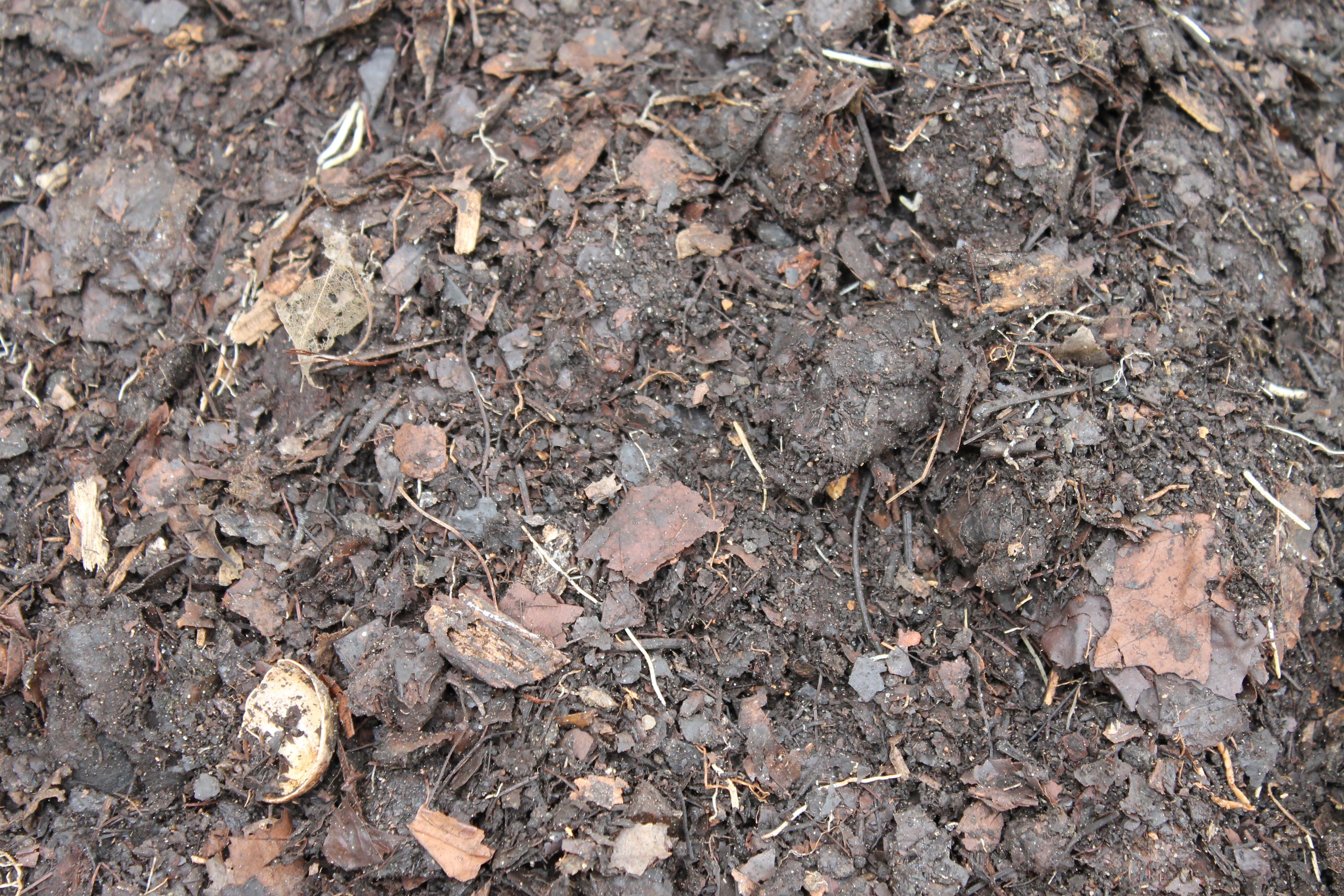
A close-up of my nearly finished pile. I know what it's made of, but wonder what it's become of itself...

A close-up of my nearly finished pile. I know what it’s made of, but wonder what it’s become of itself…

The other two bags, my idea of control samples, are easier to get. One is filled with trowel bits gathered from a few spots along my perennial beds covered by mostly decomposed wood chips, the other with small scoops from a few spots in my raised, fenced-in vegetable garden.

Why put my pile – and yard – to the test?

“Soil testing is an inexpensive yet valuable tool for assessing the fertility of lawn and garden areas,” advise the ag experts from UConn. “Test results indicate the soil’s pH level, the amounts of available plant nutrients and the existence of nutrient imbalances, excesses or deficiencies.

“Soil testing eliminates the guesswork many gardeners face when deciding the kinds and amounts of fertilizers or soil amendments they should purchase and apply…

“The standard nutrient analysis will provide the soil sample’s pH, the available amounts of phosphorus, potassium, calcium and magnesium, extractable micronutrient levels and a lead scan…Separate analyses offered by the lab include percent organic matter, particle size analysis (the relative amounts of sand, silt and clay), micronutrients, soilless media and soluble salts.”

I seal the ziplocs and stuff into a small box the three samples with a check and a form, checking off the option that requests the sample to be tested for organic matter. In all, the soil test costs $7 a sample, and results are said to be prepared in 7 to 10 days.

After a quick run to the post office to mail the box, I mow the lawn, depositing two hoppers worth of freshly cut grass to the side. I worry now that I am overloading my pile with these surplus grass clippings, and only after I finish mowing do I recall a trick I’ve used in years’ past: I seal off the mower’s grass catcher with duct tape so that all the grass clippings are recycled straight back into the yard. I’ll do that with the next mow, as I figure to be aerating my lawn this fall. The grass thatch and finished compost that I spread will be easily absorbed when the aerator plugs the turf with thousands upon thousands of thumb-sized holes.

I haul out from the kitchen the Hooch bucket half-filled with a week’s worth of coffee grinds and vegetable peelings and a box filled with a dozen or so Dunkin Donut holes, leftovers from a local fundraiser the weekend before that I’d agreed to take home and promptly forgot about in the fridge.

The donut holes are now rock hard, so I add them to my pile, figuring that if it’s worth any endorsement dollars, I’d be happy to say my pile runs on Dunkin’ donuts…

The kitchen scraps, including the stale donut holes, go into a trench in the middle of my pile.

The kitchen scraps, including the stale donut holes, go into a trench in the middle of my pile.

I carve out trenches on three sides of my pile, stuffing the voids with tossed clumps of grass clippings. I go where the pile leads me, as it’s ever-more likely to collapse into itself if I dig too steeply. My pile this year is more massive than in season’s past. I have yet to reach the very core of my pile, middle earth. But still, I am able to turn and aerate a large swath of the outer edges of it, garnishing the leaf mold with as much fresh-cut grass as I can.

My pile is nearly done. From years past I know that if I wait much longer to begin adding its harvest of humus across my garden and the lawn, the surface roots of the adjacent two maple trees will infiltrate the foundation of my pile, sucking nutrients away and leaving behind a web of tangly fibrous matter I have no use for.

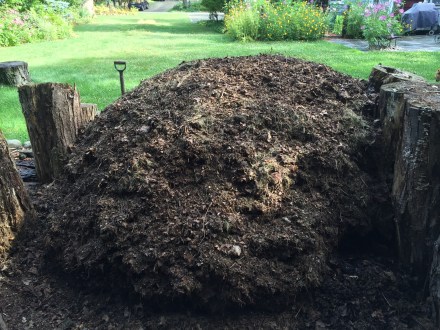
A close-up of the surface roots of the maple tree my pile sits beneath.

A close-up of the surface roots of the maple tree my pile sits beneath.

I plug as much of the surplus grass clippings into my already stuffed pile as I can and finish by spreading more grass across the top, then covering with the scrapings of crusty leaves from the bottom edges.

More than ever my pile is a tossed salad of fresh greens and old browns. With enough air and moisture it will  ferment into something that is more than the sum of its parts, a small batch of new soil born of the old.

My Pile: The Grass Is Always Greener…

Happy to be back home after a week-long trip to Memphis. I’ll take coastal southern New England in mid-July any day over the sweltering summers of the Deep South…

After a few long work days catching up at the office, I start the weekend with a Friday evening mow of the lawn.

It’s been just over a week since I last mowed, but the grass is as thick as I’ve ever seen it. It’s been a good turf-growing season so far, with well-spaced rains and no long heat waves. I have yet to hook up the rainbow sprinkler to the hose, and have put no fertilizer on the lawn other than the spreading of last season’s finished compost last fall. Even so, the grass is ankle deep and a lush dark green.

And best of all, the crabgrass this year is sparse, and what sprigs I spot on my wanderings about the yard are easy to pinch out of the ground. There’s no space left for the weeds to sprout in the bare ground, so they grow suspended above the mat of grass.

My experiment with creating micro meadows of clover in my lawn has paid off with an ankle-high swarm of bees. They alight on the white flower balls and sway on their slender stems while supping the sweet clover nectar.

A few years ago, when the bee blight became a national story, the waxing and waning of local populations played out in my own backyard. One summer the honey bees were gone, save for a few lumbering bumble bees that nest in the rotting wood of the small lean-to shed in my vegetable garden and hover above the garden.

Maybe the native bees had someplace better to go. Maybe they’ve were hijacked and trucked across country to serve as migrant labor in the almond groves of California. Maybe they were dead in their whiteboard hives and tree trunk colonies, brought down what seems like a variety of human-induced causes.

I’m happy to see the bees back in force, for lately I have another backyard delight to worry about: fireflies.

“Blink and you’ll miss them this summer. Around the world, people are reporting that local firefly populations are shrinking or even disappearing,” reports John R. Platt in a recent article on TakePart.com.

“You can wipe fireflies out really easily,” says firefly researcher Ben Pfeiffer, founder of Firefly.org, a website about the decline of the insects, also called lightning bugs. “It’s not hard. You’ve got a one-acre plot, and you put a house there. Good-bye, fireflies. They’ll never be there again.

“The loss of fireflies, which are beetles, can have multiple effects on their ecosystems. For one thing, some firefly species—there are at least 170 in the U.S.—play a role in pollination. They’re not as essential as bees, but they help pollinate milkweed, goldenrod, wild sunflowers, and other species.

“More important, however, firefly larvae are voracious predators that live in the ground and eat slugs, snails, worms, aphids, and other problem critters that would otherwise grow out of control. “I call them nature’s pest control,” Pfeiffer said. (On the other side of the dinner table, fireflies are important food sources for species such as bats and spiders.)

“The insects play a role in human health as well. Two of the enzymes fireflies use to create their bioluminescent flashes—luciferin and luciferase—are used to track the growth of cancer tumors, among other things. Fireflies have also been used to help detect bacteria in food products.

“The exact extent of the decline is unknown, but early indications suggest that lightning bug populations have shrunk in many places and disappeared from others. “Everyone is reporting declines,” said Eric Lee-Mäder, codirector of the pollinator program for the Xerces Society for Invertebrate Conservation.

“The causes, however, appear to be clearer: a combination of habitat degradation and loss, light pollution, destruction of water tables, and pesticides, Pfeiffer said.”

Bees and fireflies are the winged hands that help feed us, making possible the propagation of species through what’s now seeming like a worldwide neural network that’s beginning to misfire.

Like my Toro. I decide to plow through one of the tangly islands of clover to deadhead the blossom balls, now turned a dingy brown. The nitrogen rich clover will make good fodder for both my pile and when it’s grass-cycled back into the lawn. Choking on the thick wet clover, the mower seizes up, sending out blasts of white oily smoke.

As I let the engine cool, I dump the groaning grass catcher at the front of my pile atop my neighbor’s regular contribution. From the looks of his gleanings and a glance across the street, I notice that his lawn has thinned out and turned a paler shade of green, having burned through its springtime fertilization.

To my relief, the two-stroke engine fires back up, and I resume my snail’s pace of a walk behind the mower. I go slowly enough to flush all but the most myopic bees before my path, with the blade set high enough, I hope, to spare the fire flies preparing to take flight with the night. I skirt a micro meadow and am pleased to see it crowded with refugees bees, and leave unmowed a long stripe in the center of the lawn to create a new landing strip for the bees to alight on.

Still, the grass catcher quickly fills back up, and the whirring blades spit out tufts of finely chopped clippings from underneath the chassis. Hotter weather is forecast in the days ahead, so I’ll let the sun shrivel the clippings into slivers that melt back into the turf.

My backyard after a mid-summer mow. I've kept one patch of clover in the middle of the lawn.

My backyard after a mid-summer mow. I’ve kept scattered patches of clover in the middle of the lawn.

As Mike McGrath writes in The Book of Compost, “If you use a mulching mower … you’re already providing about half the food your lawn needs. Those grass clippings are powerful sources of nitrogen — the primary food for turf. If they were bagged and sold as fertilizer, those mulched clippings would rate an impressive 10-1-1 nutrient count on the label. That’s right — they’re 10 percent nitrogen! And that’s about as good as a natural fertilizer gets.”

Taking pity on my Toro, I stop twice more to empty the grass catcher, in the process creating a dauntingly large heap of fresh hot greens beside my pile.

Mowing at such a laborious pace gives me time to plot out the coming overhaul of my pile, a chore I relish. My pile needs a good tossing, and I could use the exercise. Plus, I have a yard’s worth of grass clippings, as well as a half-full plastic bag of shredded paper from the office, plus some past-due produce from the fridge to dispense with.

I plunge into my pile by turning the wide-tined pitchfork over and using the curved tines to pierce through the back bottom wall of pressed leaves to draw and disperse the clumps a couple feet backward into a new berm. As I build this backstop of moist, dark gleanings from the bottom of my pile, I spread a thin layer of grass clippings atop the berm and along the newly exposed earthen floor.

I dig further into the midst of my pile, creating a trough into which I pour the shredded paper, more grass and the Hooch bucket of kitchen slop. I cover these additions with scrapings of the dried-out leaves from across the top of the heap, then step back to watch the backside of my pile topple down upon itself. Steam rises from the newly exposed inner reaches of my pile through slanted shafts of the morning sun. It’s a rewarding sight, proof that my pile has enough oxygen for the aerobic bacteria and other micro denizens deep within it to continue to munch away.

I dig deeper still, building a new backside to my pile as steep as the crumbly matrix of leaf mold and whatnot will allow, layering it as I go with the fresh-cut grass. Before long, I’ve cored out a hole that reaches nearly to the center of my pile. I step back to take a break and give me and my pile breather.

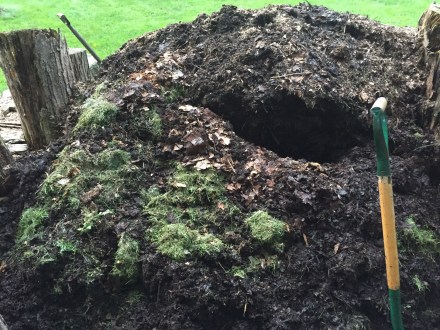
Steam vapor rises from the void. In this hole goes the maple seedlings that bedevil my gardening.

Steam vapor rises from the void. In this hole goes the maple seedlings that bedevil my gardening.

Nature abhors a vacuum and so do I. It’s then I get what I consider a bright idea: I’ll gather up the heap of maple seeds rotting away in the other back corner of my yard near the street and bury them in the middle of my pile.

Since sweeping them off the driveway and along the street, the mass of maple whirligigs has been left to mold away next to the base of a large maple. Lately, I’ve been kicking myself for not having blown more of the winged seeds off the chipped wood mulch that rings the perimeter of my yard. Over the past month or so, hundreds of the seeds have sprouted across the mulch beds, creating a chia bed of maple seedlings that I’ll either have to pluck by hand or smother with a new supply of chips this fall. Left unchecked, they would soon throw lethal shade over the variety of young oaks that I’ve have grown from acorns tucked underneath the wood chips over the past decade.

The maple seedlings go untouched by the fauna on my suburban plot because most fall from an alien species, the Norway maple. “It throws such deep shade that it outcompetes native vegetation and is moving toward monoculture in many woodlots,” writes Douglas W. Tallamy in his seminal “Bringing Nature Home — How Native Plants Sustain Wildlife in Our Gardens.”

Writes Tallamy: “The message in this book is a simple one. By favoring native plants over aliens in the suburban landscape, gardeners can do much to sustain the biodiversity hat has been one of this country’s richest assets. I have argued that native plants support and produce more insects than alien plants and therefore more numbers of species of other animals. People who accept this logic from the perspective of creating functioning ecosystems in our growing suburbs may also be alarmed by the apparent disconnect between the typical goal of the gardener, to grow beautiful undamaged plants, and my suggesiton to use gardens to produce lots of insects. Yikes! Am I crazy? Maybe just a little, but not because I want suburbia to do a better job supporting the natural world.”

Tallamy would, quite naturally, take exception to the square footage that I devote to growing grass, though I’d like to think he’d give me a pass on the the micro-meadows I tend on behalf of the bees and fireflies.

Dispatching the moldy mound of maple seeds en masse into my pile gives me a small measure of payback as well. I fill a plastic tub of the featherweight seeds and dump them into the hole in the back of my pile, then mix in a supply of grass clippings. What seeds might still be viable will soon be cooked and broken down; No doubt the seeds are packed with nutrients to be returned to my yard. I cover them by dragging the top of the pile over them and tidying up the ground along the rear edge of my pile.

In a half-hour’s time, I’ve worked up a good sweat – and worked my way through nearly half my pile – and about half of the grass clippings piled along the front. So after scraping them aside, I plunge into the front, to mix and turn to the front half of my pile. Using the tip of the pitchfork tine, I tease apart what clumps of whole leaves I come across, and cover with the rest of the grass clippings.

I short order I’ve reassembled my pile. It looks the same as before, only it’s reconstituted as a freshly mixed tossed salad of old browns and new greens, well on its way to becoming black gold.

I step inside as the evening gives way to twilight, leaving the backyard to the fireflies that rise from the lawn to twinkle in the gloaming. My work is done for the day, and for the week. My pile has all it needs to continue doing what it does best on its own: Composting.


My Pile: Fecund to None

A free Saturday afternoon gives me time to mow the lawn and plunge back into my pile.

The patches of clover around the yard are now lush and quirky enough to catch the attention of my 15-year-old son, who volunteers to spot me on the mower. He carves his way through the grass, unbound by the usual boring back-and-forth striping, and proceeds to create a few new clover islands of his own. The bees have at long last shown up in some profusion among the clover flowers, and I am happy to see the summer’s first hummingbird flitting about the magenta blooms sprouting in the garden beds.

With the now customary two hoppers worth of grass clippings waiting off to the side, I use a rake to skim sun-dried leaf litter from my pile’s top and flanks, scraping the dry scraps of brown to the side. I’ll use it as backfill, to mix with the week’s kitchen scraps and grass clippings. In two days I leave town for the week, and today I intend to give my pile a good airing out and mixing of old brown and new green so that it can continue to digest and foment.

This is a wholesale excavation and turning of my pile, focused on the right flank, the final quadrant to be exhumed as virgin territory. Up to this point I’ve been circling around my pile, working the front and back and lately the left side, as well as the top center. My pile has become a rich mix of nearly mature compost, though the bottom right side of it remains more or less undisturbed. Not for long.

First I tease out the front side of my pile, creating a berm of nearly finished compost and an open maw into which to mix the raw material laid down last fall that I will soon unearth. At this point in the life cycle of my pile, it’s as much about re-arranging the existing materials as it is incorporating new compostibles.

I tear into the right side with the flat-tined pitchfork to excavate forkfuls of rich compost in the making, turning them out onto the top and flanks. I mix pockets of dry leaves with helpings of grass clippings, combining the steaming hot sections of my pile with the cool dark pockets.

Before long I’ve opened up a cavity along the right side, into which I dump a bucket of kitchen scraps from the neighbor’s, full of corn husks and other summer vegetables. I top with gleanings of dry material as I go. It’s a three-step process, adding in equal measures fresh grass clippings and food scraps to mix with clutches of raw brown leaves first laid down last fall, and the in-process compost from here and there.

I bury a week's supply of food scraps deep within my pile, and mix the fresh green compostibles with old dried leaves excavated from the bottom.

I bury a week’s supply of food scraps deep within my pile, and mix the fresh green compostibles with old dried leaves excavated from the bottom.

My neighbor wanders by to retrieve his remote thermometer sensor, but not before aiming the gun into the depths of my half-rent pile. A week after the last insertion of fermenting seaweed and grass clippings, my pile is full steam ahead. We make sport of aiming the probe into the maw. The LED display tops out at 131 degrees, and I imagine we could have easily found hotter spots within.

The heat itself is not what is cooking my pile; it’s just the exhaust of the countless microorganisms thriving inside it. As they say, it’s not the heat, it’s the fecundity. At this point in its death spiral, my pile must surely rank among the most lively places on earth.

“Every compost pile is a complex eco-system of decomposition experts,” writes Julia Rymut, creator of the compostheaven.com blog.

“The main groups of microorganisms in soil are bacteria, fungi, protozoa and actinomycetes.  These tiny little creatures are major players in decomposition.  In a teaspoon of compost, you may find up to a 1,000,000,000 bacteria, 440-900 feet of fungal hyphae, and 10,000 to 50,000 protozoa.”

I don’t know how many teaspoons of compost are in my pile, but I imagine enough to add many zeroes to those numbers.

Bacteria are not only the most abundant microorganism in soil, accounting for up to 90% of all microorganisms in compost, they also produce enzymes that further break down the complex carbohydrates – the cellulose and lignin of woody plant matter – that are slowest to rot. These enzymes continue to work even after the bacteria die off, decomposing and helping the fungi and actinomycetes finish up the hardest materials.

My pile is a riot of tiny creatures, each taking advantage in its own turn of changing food, temperature, moisture and air.  It’s Hunger Games, writ small.

The worms may have fled to the cooler, outer fringes while my pile cooks off; as I was rolling the logs from the right-side wall a strip of bark peeled off, exposing a teeming mass of red worms. But worms are are far from the only slithering and creepy-crawly habitues of my pile. The proverbial teaspoon of compost can contain 30 to 300 nematodes, I discover in Compost Heaven, which “are the second most dominant form of life, with maybe as many as 1 million species worldwide.”

A slithering predatory nematode.

A slithering predatory nematode.

A type of tiny worm usually much smaller than a whisker, nematodes get a bad rap, in part because of their onomatopoeic name, but also because some forms are considered garden pests that attack plant roots. But many other species live nobler nematode lives eating decaying organic matter or preying on other microscopic critters, and some even as large as the dreaded turf-killing grub.

My pile: It’s a jungle in there, a backyard ecosystem that is alive with truly countless living creatures, all living, loving, laboring and dying to turn a heap of leaves and organic matter into a useful (and still living) product called humus.

To further sample Walt Whitman:

Behold this compost! behold it well!
Perhaps every mite has once form’d part of a sick person–yet behold!
The grass of spring covers the prairies,
The bean bursts noiselessly through the mould in the garden,
The delicate spear of the onion pierces upward,
The apple-buds cluster together on the apple-branches,

What chemistry!

Now I am terrified at the Earth, it is that calm and patient,
It grows such sweet things out of such corruptions,
It turns harmless and stainless on its axis, with such endless
successions of diseas’d corpses,
It distills such exquisite winds out of such infused fetor,
It renews with such unwitting looks its prodigal, annual, sumptuous crops,
It gives such divine materials to men, and accepts such leavings
from them at last.