My Pile: Inner Workings (Part II)

The first Sunday of the new year. I let the dog out and follow him into the backyard. Each step makes a crunchy imprint across the frozen grass.

I take stock of my pile with a morning pee of my own over the wire mesh that girdles the backside. A tendril of steam rises through the damp stalks of seagrass cross-hatched across the top. A tea kettle on slow boil, my pile.

On the outside, my pile begins the new year complete, composed. A heap in full. It almost seems a shame to meddle with it.

But mess with it I will, for I have a holiday’s worth of gleanings from my kitchen and from the neighbors to contribute. I have more fresh supplies in store for my pile, from the yard and beyond. A bucket of seaweed, churned to mulch by the gathering high tides of winter, awaits, as does a white plastic bag of coffee grounds procured from behind the counter of the local java shop.

Plus, it’s a mild winter day with a mix of rain and sleet on the way. I could use some exercise and an outdoor diversion, a break between the football games on TV. My pile is my own private hot-stove league.

I do indoor chores while the sun slowly warms. I scoop the cold ash and charcoal bits from the fireplace into a brown shopping bag and set it aside.

I’m also long overdue to clean the half-filled 20-gallon glass aquarium in the den that’s home to Bubbles, the pet red-eared slider turtle. Soon the turtle is paddling about in his tank of fresh clean water, and I have a bucket full of murky green turtle effluent to add to my pile. Better that end purpose than flushing the slop down the kitchen sink.  Laced with nitrogen, urea and who knows what other nutrients that make up a Chinatown turtle’s night soil will be like adding jet fuel to my pile.

I assemble the rest of my stocks and implements alongside the left log wall, then scrape the frazzled toupee of seagrass hay to the side with a heavy gravel rake. Next I plunge the wide-tined hay pitch fork into the spongy wet leaves. I drag forkfuls back toward me to create a trench, releasing a faint whiff of the beach at low tide.

Excavating a space in my pile for an insertion of fresh green material.

I dig deeper into the time warp that is my pile, down through the stratified layers of past heapings, releasing whaffs of steam along the way. Two feet down, the tines of my pitchfork jab into a mat of flattened leaves like a fork sticking a phone book.

I stick my hand into the hole. The wall of leaves is cool to the touch. It seems my pile is combustible only in spots. The cold of winter is winning out over the hot flush of organic fusion.

But to each his own, say the smart folks at the University of Illinois Extension, on their Science of Composting website. My pile’s inner workings are sorting themselves out in their own time and way:

There are different types of aerobic bacteria that work in composting piles. Their populations will vary according to the pile temperature. Psychrophilic bacteria work in the lowest temperature range. They are most active at 55° F and will work in the pile if the initial pile temperature is less than 70º F. They give off a small amount of heat in comparison to other types of bacteria. The heat they produce is enough however, to help build the pile temperature to the point where another set of bacteria, mesophilic bacteria, start to take over.

Mesophilic bacteria rapidly decompose organic matter, producing acids, carbon dioxide and heat. Their working temperature range is generally between 70º to 100º F. When the pile temperature rises above 100º F, the mesophilic bacteria begin to die off or move to the outer part of the heap. They are replaced by heat-loving thermophilic bacteria.

Thermophilic bacteria thrive at temperatures ranging from 113º to 160º F. Thermophilic bacteria continue the decomposition process, raising the pile temperature 130º to 160º F, where it usually stabilizes. Unless a pile is constantly fed new materials and turned at strategic times, the high range temperatures typically last no more than three to five days. Thermophilic bacteria use up too much of the degradable materials to sustain their population for any length of time. As the thermophilic bacteria decline and the temperature of the pile gradually cools off, the mesophilic bacteria again become dominant. The mesophilic bacteria consume remaining organic material with the help of other organisms.

Into the maw of my pile goes the neighbors' bucket of kitchen scraps.

Into the maw of my pile goes the neighbors’ bucket of kitchen scraps.

Over the next two months, I’ll gouge out similar holes in a half a dozen places, hoping to spike my pile with enough hot spots to keep the biological processes churning through the cold months. Some hot, some cold.

What my pile does through the winter mystifies me, the obvious efforts of all these aerobic bacteria notwithstanding. Keith Reid, in “Improving Your Soil” supplies the most helpful explanation I’ve come across. As he writes:

“The usual textbook method of classifying the critters in the soil by species is not useful to most readers. It is more relevant to understand what these organisms do, so here, we have categorized the huge diversity of life in the soil by their functions.” Here’s the skinny from his book:

The Shredders
When fresh organic material is added to the soil, the shredders begin breaking it down into smaller pieces. As the shredders chew, they expose surface area that smallerorganisms can then access and also start to break down the tougher materials. The best-known shredders are earthworms. As they burrow through the soil, they eat organic materials that are broken down in their gut, mixed with mucus and excreted. The finely ground material left behind creates a rich buffet for smaller creatures.

The Decomposers
In addition to the shredders, fungi play a key role in breaking down big pieces of organic debris. Unlike shredders, however, fungi work from the inside out. Fungal hyphae can grow into decaying leaves, stems and even wood, excreting enzymes that destroy the bonds between cell walls, then digesting and converting lignin and cellulose into simple sugars the fungi can use.

The Digesters
Once the organic matter has been broken down into smaller pieces, bacteria and actinomycetes go to work. Through their sheer numbers, these organisms are able to access most of the easily digested materials in the soil and incorporate them into their bodies, with the sole purpose of making more bacteria. In the process, they release nitrogen, phosphorus, sulfur and other nutrients that have been bound up in the organic matter.

The Grazers
Bacterial and fungal growth attracts a whole population of tiny animals that feed on them in much the same way that cattle or sheep graze a pasture. These include protozoa, such as the amoeba and paramecium. Large numbers of mites and nematodes also fill this role. Not all of the nutrients consumed by the grazers are used for their own growth, and the waste they release hastens the cycling of nutrients into a form that plants can use.

The Hunters
Just as in aboveground ecosystems, there are specialized predators in the soil. This group includes many species of nematodes, mites and small insects. Aside from keeping the population of grazing animals in check, these predators continue the cycling of nutrients through the soil ecosystem.

The Fixers
One group of microbes plays a crucial role in the soil environment by taking nitrogen out of the air and “fixing” it in a form plants can use. Most nitrogen fixation is carried out by bacteria that live symbiotically with legumes, but a few species of bacteria and blue-green algae fix nitrogen without being associated with higher plants.”

Sums up Reid: “The reality is that an active soil life unlocks nutrients in the soil, making them more available to plants, but it does so only if those nutrients are present in the first place.”

Which is where I come into play.

I dump the bucket of kitchen slop into the bottom of the hole, twisting it into the bottom of the hole to fluff things up. In goes the neighbors’ bucket and bag of coffee grounds, like soup into a hollowed-out loaf of bread. Stir again. The fresh additions disappear into the matrix of brown leaves.

I spread dollops of seaweed across the excavated hole, then cover it with a loose collection of leaves gathered from my neighbor’s yard –my way of a thank-you for them hosting me for Christmas dinner. I drain the turtle stew into the mix; who knows what bacteria will sup up that nourishment.

I finish by drawing the blanket of rotting seagrass stems back across the top with the rake, and sprinkle with a dusting of wood ash and charcoal bits from the fireplace. Once again, my pile is whole, its inner workings cloaked.


My Pile: Marking Territory

My pile has many mutually beneficial purposes. It serves me well. I heap it with produce and praise, shower it with attention … and pee.

As Charlton Heston once explained to Dear Abby, in response to the lady who feared her husband’s habit of urinating on their lawn was inappropriate: “So it may be, but the fact remains that all men pee outdoors,” said Moses himself.

It’s the gospel truth. One of the reasons I keep my pile as tall as I do is to take a leak behind it without fear of pissing off any passing neighbors. Most mornings I let the dog out; he pees on the front of my pile, and I take the backside. After a cup of coffee and his morning bowl of chow, we may hit it again.

The backside of my pile, set in the corner of the yard. Keeping it chest high makes it big enough to continue to cook through the winter — and for me to step behind it for a private pit stop.

I’d probably piss outside even if I didn’t keep a compost pile. I’ve spent enough years in rain-deprived Southern California to value each toilet flush; I’ve paid enough utility bills to know to conserve my supply of water for more important uses, like watering the tomatoes in July.

I also drink a lot of coffee and beer, and when home try to spend as much time outdoors as indoors, often tromping around in muddy work shoes. Go back inside to take a leak? No, I piss on my pile. It’s a convenient and somewhat furtive release, in a Huck Finnish, behind-the-woodshed kind of way.

To excuse myself further, let’s hear more from Dear Abby & Co. on the subject:

DEAR ABBY: After reading the letter about the woman (“The Whiz-zard’s Wife”) whose husband urinates in the yard, I had to write. It’s what I went through with my ex-husband for 13 years! I pleaded with him to stop, but his answer was that no one could see him because it was dark.

My present husband (now of eight years) did the same thing. He’d be closer to the bathroom in our house and still go out back to urinate in our yard after dark two or three times a week. When I gave him my opinion about it, he’d ignore it.

When we moved to our new home, we had a wooden fence built. I decided to teach him a lesson. When he continued to urinate in the back yard, I decided to do the same. He was shocked! He told me I had better not do it again. I told him that as long as he continued his behavior, I would do the same.

Abby, he has not urinated in our back yard since. Sometimes when they won’t listen, you have to SHOW ’em.
-HAPPY WIFE IN FORNEY, TEXAS

DEAR HAPPY WIFE: Congratulations for having curbed your husband’s spraying. I was intrigued to discover that some men consider it a form of conservation! Read on:

DEAR ABBY: Marking our territory is only one reason for this age-old tradition.

Boys have long enjoyed distance, accuracy and creative urinary competitions: knocking leaves off the trees in the fall, drawing pictures in the winter snow, protecting young fir trees from hungry deer in the spring, and dousing campfires in the summer months are just a few highlights.

Some may deride this as small-minded male nonsense, but on a global scale, this ritual has significant benefits to our environment. The flush water we save is substantial. At 2.5 gallons per flush, a man urinating outside just once a day will conserve almost 1,000 gallons of water a year. If one-fourth of the men in the United States saved one flush per day, we’d save more than 4.5 billion cubic feet of water per year.

If you consider all the rainfall that’s channeled into storm sewers from our streets and parking lots, we’re returning valuable moisture to the soil by urinating on our lawns.
NATIVE OREGON STREAMER, TILLAMOOK, ORE.

Giving the backside of my pile a dousing, I do some calculating: A couple-two-three leaks a day, a pint each, maybe…It adds up to more gallons of golden showers a year than I’d like to admit to. But all that urine is good for my pile: It turns out that this body waste that’s (usually) flushed down the toilet can actually be recycled into a number of useful products, says one online resource, todayifoundout.com.

“Comprised of water, calcium, chloride, potassium, sodium, magnesium, urea, creatinine, nitrogen, uric acid, ammonium, sulphates and phosphates, urine’s beneficial ingredients can be separated from its waste, and used to make fertilizer, medicine, brain cells and, yes, gunpowder.”

The key ingredient is phosphorous, which was discovered in the 1660s by German alchemist Hennig Brand, who was trying to turn urine into gold. Instead, he turned 1,500 gallons of urine, likely collected from beer-drinking German soldiers, into what became a new kind of liquid gold. Under high heat, the phosphate in urine loses its oxygen and becomes phosphorus.

An essential element for life, phosphorous is the sixth most abundant element in any living organism. It not only glows in the dark, but can also be highly poisonous and combustible (white phosphorus is used in many destructive weapons, such as napalm), I read on Gizmodo, an account which adds: “Some environmentalists believe that we will have a severe phosphorus shortage in twenty to forty years. That said, human urine could hold the key to solving the crisis. According to Mother Jones magazine, ‘There’s enough phosphorus in your annual output of urine to provide P for more than half of all the grain you consume in a year.'”

Early each spring, my lawn is pockmarked with bright green patches as the grass begins to grow again, from both the dog and passing deer. I know from the splotches that there are frequent doses of energy, in the form of nitrogen, urea and other organic (and sterile) materials to be directed in a more targeted way. Why not my pile?

According to Nicky Scott, author of “How to Make and Use Compost — The Ultimate Guide,” urine is “the cheapest and best activator to speed up the composting process. It adds nitrogen and water to woody, dry, carbon-rich material.”

Rodale’s Organic Life agrees: “If you aren’t using your urine in your garden and on your compost pile, you are, pardon my French, pissing away a free, valuable resource and missing out an easy way to help close the gaping hole in your household nutrient cycle,” Jean Nick writes in “How to Use Your Pee for the Planet.” Using urine in the garden can help you cut your water use (less flushing) while also cleaning up the environment downstream (no water-polluting fertilizer runoff).”

Nick adds: “Recent scientific studies have shown urine is a safe and very effective fertilizer for cabbage, beets, cucumbers, and tomatoes, and pretty much anything else you want to grow. Urine boasts a nitrogen-phosphorus-potassium (N-P-K) ratio of 10:1:4, plus more modest amounts of the trace elements plants need to thrive. The nutrients in pee are highly available to plants, too—an extra plus.”

So I like having a good excuse to pee outdoors and the privacy that my pile offers in taking that relief. I also take comfort in the fact that my own end product turns out to be so vital to the new beginnings that my pile is all about. A comfort station, indeed, the compost heap I keep…

My Pile: Act of Nature

My pile is much more than a messy construct taking up space in my backyard. It is a garden unto itself.

Truth be told, I get more pleasure and payoff from my pile than I do from the vegetables and flowers that it helps grow come summer.

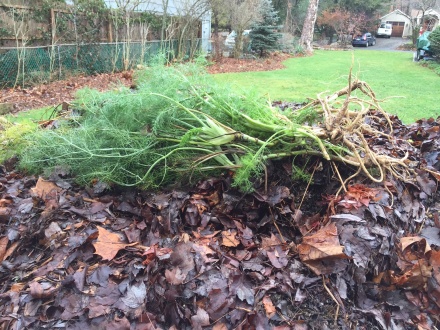
Today, the last day of the year, I dug up the fennel in the corner of my vegetable garden that my neighbor had given me as sprouts last spring. The fragrant green stems have grown wild and tangly, but neither of us knew if the bulbs had developed enough to shave into a fennel salad for brunch on New Year’s day.

Sadly, when I plunged the pitchfork deep under the roots, the fennel below ground was as sprawling as it was above. No fat bulbs that you see in the farmer’s market, just scraggly roots like misshapen white carrots. No matter. Once peeled, the shavings will make a fine, licorisey accent to the salad, and the lush green stems will make fine fodder for my pile.

It’s been unseasonably warm as winter dawns. No white Christmas this year, and the December storms have brought rain that has soaked my pile. The seeds from the pumpkins smashed a week or so ago have sprouted through the sodden leaves that cover my pile; their tender white stalks strive to gain purchase. Already I can see most are under attack from unseen creatures, and perhaps some nibbles from creatures higher up the food chain, a squirrel or one of the small rodents that I’m sure frequent or inhabit my pile, be they chipmunk, mouse, vole or mole.

I look closer at a slender rod of pale white; it’s not a pumpkin sprout but the quill from the wing feather of some sort of waterfowl. The hollow nub of the quill is a-swarm with roving creatures just large enough to detect their movement. They look like roly-polys writ small. I wonder whether these tiny scroungers came to my pile already aboard the molted feather or if they were resident scavengers with a taste for holiday goose. And what feeds upon these tiny mites when they are finished with the feather?

“Details, details, you might protest,” writes Richard Fortey in “The Wood for the Trees,” a biography of his own small patch of land in the shires of England. “I reply that the delight, as well as the devil, is in the details. To an animal of small size, particularly an insect in which the larva hides away discreetly to feed and grow, our wood is a potpourri of opportunities, quite a wonderland of niches. ‘Biodiversity’ as a word sounds rather dull and a bit abstract. Played out on the ground it is something else: the difference between the numbered title of a symphony and its glorious complexity unwrapped in a concert hall. Every rotting log is a small world. The underside of a leaf is a realm to a greenfly; a crack in the bark of a beech tree is a capacious and secret hideout. They all fit together in a jigsaw that remakes its own pieces month by month…

“Each little life is not much more than a pinhead of brilliance,” writes of the the bug that has captured his own attention, a crane fly, and wonders how his woods could support so many species of just this one type of fly. “Some bob up and down together; a mating dance, I suppose. Others move purposefully and then vanish from the light, seeking something, smelling something, following a precise instinct to a precise niche. Even if I had the scientific names of them all, it would only be like having the notes on a page, not the symphony. A species inventory is only the beginning. Every species will have its own biography, its special requirements and its curious secrets.”

Fortey trains his hand lens on the underside of a rotting log to reveal a hidden world very much like what is going on in my pile:

“A list of animals and fungi could become tiresome, but is necessary to grasp the true richness of nature. Think of it as not so much an inventory as a catalogue leading to compelling and interlocking stories. The world beneath a rotting log is a small one, but it is marvelously complete. The cascade of life there comes ultimately from the sun. The photosynthetic work of a tree eats up the energy from sunshine for many years; as soon as the tree falls to the ground, the construction begins to unwind. Fungi play a vital role. Beneath the log in the damp, dark places, the recyclers and degraders get to work. Wood-eaters, and grazers of fungal patches, and then their predators, set up a food chain that is a lightless version, a dark parody, of the grass-herbivore-carnivore system that thrives in light and rain. Rot is creation in the underworld. That list, that catalogue, is the dramatis personae of a kind of soap opera of slow decomposition, where sex and death, voracity and subterfuge, play out their measured parts in the life habits of dozens of species ‘hidden away privily.'”

My pile is part hobby, part pet. It is a living curio cabinet, a menagerie composed of countless wild creatures I keep in untamed captivity. In return for helping create, develop, nurture and mature this creative act of deconstruction, I am rewarded in compound ways, not only in wheelbarrows full of compost at the end of its short year of life, but every day.

My pile keeps me grounded. In a very basic way, it’s even helped make me who I am.

Fragrant shocks of fennel from the garden help my pile ring out the old year. I'll cover the fresh green with a layer of soggy leaves.

Fragrant shocks of fennel from the garden help my pile ring out the old year. I’ll cover the fresh green with a layer of soggy leaves.

Writer Michael Pollan takes a deep dive into the metaphysics of compost in “Second Nature.” This “gardener’s education” reads as true today as when it was first published in 1993, especially the chapter “Compost and Its Moral Imperatives.” It’s worth reading whole, but allow me to share a composted version:

“There isn’t an American gardening book published in the last twenty years that doesn’t become lyrical on the subject of compost … In American gardening, the successful compost pile seems almost to have supplanted the perfect hybrid tea rose or the gigantic beefsteak tomato as the outward sign of horticultural grace.”

“The apotheosis of compost is really just the latest act in a long-running morality play about the American people and the American land. In the garden writer’s paeans to compost you can still hear echoes of Jefferson’s agrarian ideal, paraphrased here by Henry Nash Smith, ’Cultivating the earth confers a valid title to it; the ownership of the land, by making the farmer independent, gives him social status and dignity, while constant contact with nature makes him virtuous…’

“At least in a metaphorical way, compost restores the gardener’s independence – if only from the garden center and the petrochemical industry … and because it makes the soil more fertile, composting flatters the old American belief that improving the land strengthens one’s claim to it…

“No less than the nineteenth-century transcendentalists and reformers, we look to the garden today as a source of moral instruction. They sought a way to preserve the Jeffersonian virtues even in the city; we seek a way to use nature without damaging it. In much the same way that the antebellum garden became a proof of the agrarian ideal, we regard our own plots, hard by the compost pile, as models of ecological responsibility. Under both dispensations, gardening becomes, at least symbolically, an act of redemption.”

Pollan’s ruminations on the nature of compost and what it means leads him to conclude one fall day that “if I wanted to perfect my gardening faith I would have to begin my own compost pile. Which I promptly did … and forgot about it.”

To Pollan, composting is a byproduct of manifest destiny, a “quasi-religious movement” in which the compost pile has “emerged as the status symbol among American gardeners.” But he can resist signing on to the “moral crusade” of this particular branch of American horticulture for only so long:

… By the time I returned to the compost pile in April, I had read enough about American gardening to know that composting was a pretty silly fetish. It would never produce a beautiful perennial border, just a morally correct one, and wasn’t that a little absurd? Well, I guess it is, but when I lifted off the undecayed layer of leaves on top and ran my hand through the crumbly, black, unexpectedly warm and sweet-smelling compost below, I felt like I’d accomplished something great. If fertility has a perfume, this surely was it …. this heap of rotting vegetable matter looked more lovely to me than the tallest spike of the bluest delphinium. Right then I realized that, like it or not, I was an American gardener, likely to cultivate in the garden more virtue than beauty.”

Gardening, and more specifically, tending my backyard compost pile, defines me. It is an act of nature, and I am an actor upon this chosen piece of ground, cultivating the space, both physical and mental, between chaos and order, both natural and man-made.

“Gardening is an obsession that cannot be conquered or abandoned, only indulged,” writes Thomas C. Cooper in the “The Roots of My Obsession,” an anthology in which “Thirty Great Gardeners Reveal Why They Garden” (Timber Press, 2012).

“Marketers have tried for decades to identify what makes a gardener in hopes of brewing up a large batch of it and sowing it, through advertising, across the land. It has never worked … Gardeners are a blend of family and geography, of childhood wonder and even sometimes the independence born of the parental “neglect” that allows a child to get lost in the woods, tracing the source of a springtime rivulet. They rise from trauma and travel. People come to gardening for the refuge of a personal Eden, endlessly complex in its makeup, gloriously simple in its demands.”

That about sums it up for me, though there is much to recognize of myself in the reflections of the 29 other gardeners essayed.

As the page prepares to turn on another calendar year, I have no new resolutions to make other than to continue tending my backyard compost pile as best I can. It’s my nature.

Portrait of an American backyard composter.

Portrait of an American backyard composter.

My Pile: A Natural High

Gardening is my therapy, my pile a retreat and relief from the preoccupations of work and the whatnot of modern life.

The modest dose of natural refuge and respite that my backyard affords is like “a kind of cleaning of the mental windshield that occurs when we’ve been immersed in nature long enough,” in the words of David Strayer, a cognitive psychologist at the University of Utah quoted in a recent National Geographic article, “This is Your Brain on Nature.”

Writer Florence Williams makes the case that “When we get closer to nature — be it untouched wilderness or a backyard tree — we do our overstressed brains a favor.”

It’s an argument that goes back “at least to Cyrus the Great, who some 2,500 years ago built gardens for relaxation in the busy capital of Persia. Paracelsus, the 16th-century German-Swiss physician, gave voice to that same intuition when he wrote, ‘The art of healing comes from nature, not from the physician.’

“In 1798, sitting on the banks of the River Wye, William Wordsworth marveled at how ‘an eye made quite by the power / Of harmony’ offered relief from ‘the fever of the world.’

“American writers such as Ralph Waldo Emerson and John Muir inherited that outlook. Along with Frederick Law Olmstead, they built the spiritual and emotional case for creating the world’s first national parks by claiming that nature had healing powers.”

The latest neuroscience research support the long-held feeling that nature inspires and soothes the modern mind. “Motivated by large-scale public health problems such as obesity, depression, and pervasive nearsightedness, all clearly associated with time spent indoors, Strayer and other scientists are looking with renewed interest at how nature affects our brains and bodies. Building on advances in neuroscience and psychology, they’ve begun to quantify what once seemed divine and mysterious. These measurements–of everything from stress hormones to heart rate to brain waves to protein markers–indicate that when we spend time in green space, ‘there is something profound going on,’ as Strayer puts it.”

My backyard pile is a small piece of that profundity, and tending to it through the seasons is a pleasurable chore.

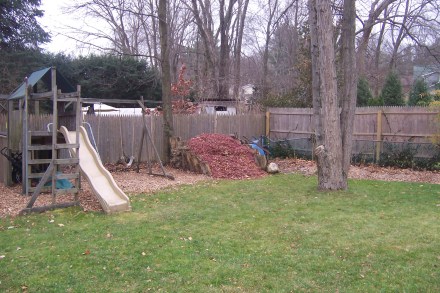
Two outdoor playgrounds, one for my boy and one for me.

Two outdoor playgrounds, one for my boy and one for me.

National Geographic gives me a clearer picture of what happens when my brain is on compost. “Korean researchers used functional MRI to watch brain activity in people viewing different images. When the volunteers were looking at urban scenes, their brains showed more blood flow in the amygdala, which processes fear and anxiety. In contrast, the natural scenes lit up the anterior cingulate and the insula–areas associated with empathy and altruism. Maybe nature makes us nicer as well as calmer.”

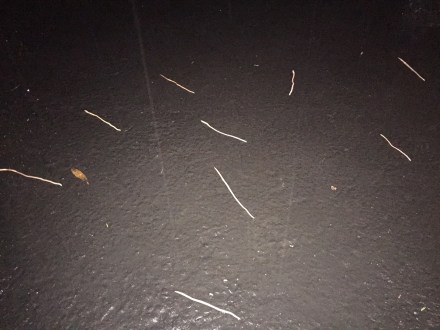
Those findings may help explain a random act of composting kindness I found myself performing this evening. Between breaks in a drenching rainstorm, I wandered out to the driveway to find it swarming with earthworms, flushed out of the saturated lawn onto the pavement.

It seemed a waste that most of these slithering critters would be crushed by the tires of my car or drown in the puddled streams along the curb, so I took a butter knife and tupperware bowl out to the driveway and scooped up dozens of sodden, stretched-out worms.

I was happy to be working under the cloak of darkness and a porch light, as it would be difficult to explain a rescue of invertebrates to all but the most committed of gardeners. But depositing the squirming worms en masse onto my pile pleased me with the thought that these refugees and their progeny would repay me many times over as they populate my pile over the coming months.

A herd of earthworms make tracks across the driveway on a rainy night. Who knows where they were headed to, but they will end up in my pile.

A herd of earthworms make tracks across the driveway on a rainy night. Who knows where they were headed to, but they will end up in my pile.

Such is the modest virtue of my pile and the benefits it returns to me. And I now have earned the eternal gratitude of a herd of homeless earthworms.

So I got that goin’ for me, which is nice.

“To forget how to dig the earth and to tend the soil is to forget ourselves.”
— Mahatma Gandhi


My Pile: Size Matters

The parameters of my pile are shaped partly by my ambition but mostly by the sheer number of leaf-producing trees in my yard. Since moving to my small suburban property 10 years ago, I’ve lost a handful of mature deciduous trees, mostly swamp maples and mostly due to storms.

The grass lawn and garden beds have greatly benefited from the decrease in shade and roots. My house and those of the two adjoining neighbors are that much safer from the threat of their heavy, overarching limbs and rotted trunks riddled by fat black carpenter ants. But my pile is that much less for all the leaves that once dropped from those profligate trees each fall.

To compensate, I’ve expanded my pile’s reach, and more and more of its autumn crop of leaves comes from my neighbors’ yards or from along the street. I also now forage farther afield for bonus materials to add to the mix, chiefly seaweed and seagrass from a nearby beach. It all adds up.

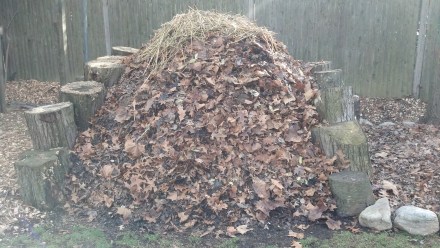
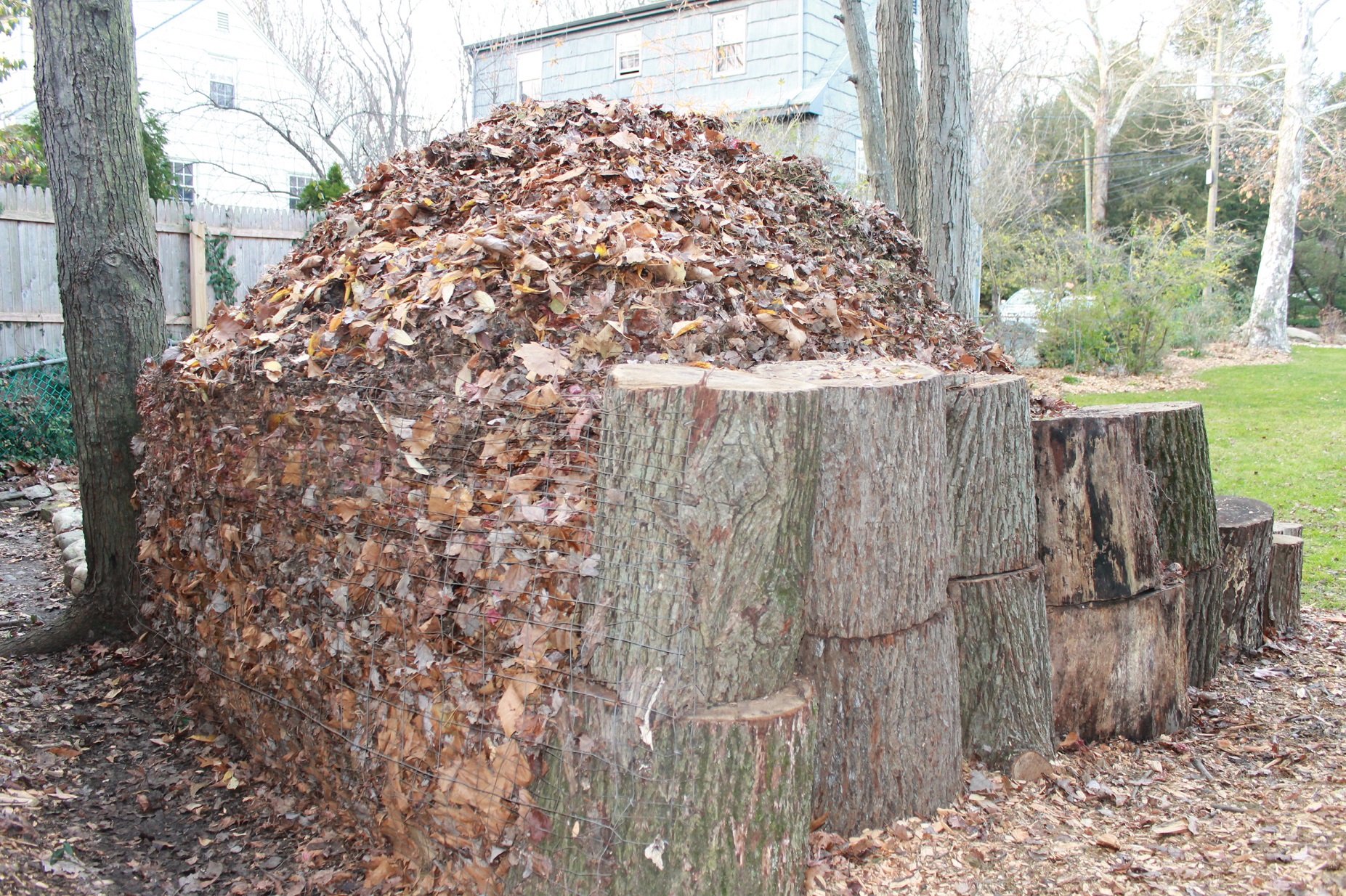
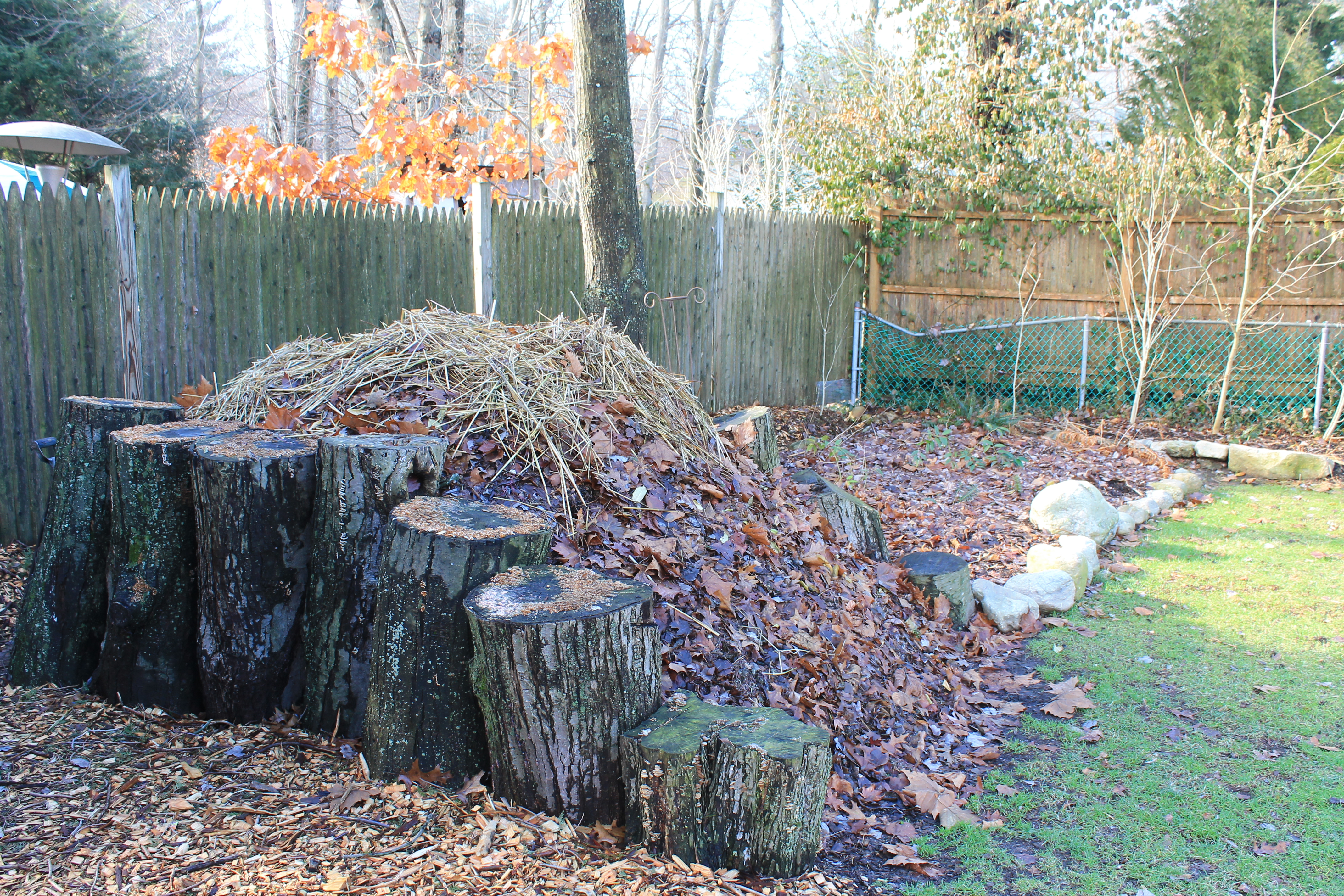
My pile’s mass is bolstered by two parallel rows of seven whole logs (from those maple trees) set about seven feet apart. The smallest pair of logs at the front are a foot or so tall – they make nice flat perches for a hand tool, beer can or butt. I like to ponder my next garden project sitting at the foot of my pile.

The rest of the stacked logs rise in rough matching increments to close to four feet high at the back. A stretch of 36-inch-high wire garden fence, its cut ends stapled to the tallest logs, makes a useful backstop. So at best, my pile is seven feet wide, eight feet deep and five, maybe six feet high at the center.

As such, my pile is pretty sizable for a third-acre piece of suburban property, a sturdy set piece of barnyard nature in the back corner of my yard, on par with the garden shed, trampoline and picnic table. It’s a feature of both my landscape and lifestyle.


The backside of my pile, late fall.

The backside of my pile, as fall turns to winter.

My pile’s structure and dimensions are modest enough to allow me waist-high access to most any part, whether it’s with a pitchfork, rod of rebar, garden hose or shovel. The logs are sturdy enough to clamber up to dump material over the top.

The wire fence along back side bows backward with the weight of the gathered leaves. That and the sidewalls limit the height of the pile to five or six feet tall at best; leaves and such piled higher tend to tumble over the sides and make a mess. I like a tidy pile, so I fuss over its general appearance.

In these climes, a compost pile needs to be of sufficient size to sustain its own internal combustion. Today is Christmas Eve, and with temperatures in the 50s there will be no white Christmas this year. And even though the coming days will grow ever longer, the deep freeze that is a typical New England winter has yet to take hold.

Old hands and the research suggest that 4 ft. by 4 ft. by 4 ft. is the bare minimum for an outdoor, uncovered heap to keep the “hot” bacteria going. Anything smaller isn’t really a compost pile but just a prospect of one, a mound on cold hard ground.

“In most areas of the continental United States, a compost pile needs quite a bit of mass to be self-insulating and maintain ideal temperatures,” advises Stu Campbell in “Let It Rot!”

A pile that is too small may lose its heat so quickly each night that it will cool off, or even freeze, quite readily. Pathogenic organisms, weed seeds, and larvae will not be killed, slowing the whole process. If you want hot, fast compost, your pile should measure at lest 1 cubic yard.

“On the other hand, a pile that’s too large can have different problems. The length doesn’t matter, but if you make it much wider or higher than 5 or 6 feet, the center of the pile may not get enough air and you could wind up with an anaerobic area there. Air naturally penetrates anywhere form 18 to 24 inches into a pile from all directions, but not much beyond that. The center of the pile may heat up too much, killing off the microorganisms. You’re apt to overheat yourself if you try turning a huge heap.

Piles bigger than average – like my own – require more physical effort to sustain the proper mix of air and water needed to fuel the decomposition process. It’s a chore I relish. My pile provides me much more than an ongoing harvest of compost. It gives me an excuse to get outside for a while every so often, plenty of exercise, and a purpose.

A midweek storm, along with my recent soaking and poking, has caused my pile to subside. Its top is now nearly flush with the log walls that contain it. There is room for more.

Taking a morning walk with the dog at the local beach, I find that the storm has also deposited a fresh jumble of seagrass hay along the high-water mark at the local beach. I scoop up a big plastic bucket full, packing the crinkly stems together with a stomp of my boot.

Back home, I gather the bucket of a week’s worth of scraps from my kitchen, as well as the food waste that my next-door neighbors keep outside their back door in a galvanized can, its lid weighed down by a piece of cast iron to keep the varmints at bay.

I tease some empty space in the top of my pile with the hay pitchfork, pulling the mess of steamy leaves toward the edges so that a crater is formed, into which goes a week’s worth of kitchen slop. Farewell banana peel, egg shell and coffee filter — I’ll never see them again.

Next, I take the steel-tined rake and old bedsheet and cross the street. I need more leaves, and my neighbor Craig, a good but busy friend, hasn’t quite got around to cleaning the windblown leaves piled up against the rock wall that borders his gravel driveway. Earlier in the fall he ran his mower up and down the driveway, mulching the leaves as he blew them to the side. More leaves, mostly from the sycamore on my side of the street, have blown up against the wall through the fall and stuck in the rock crevasses.

It takes me 10 minutes to glean two sheet-fulls. With each load I first pick the biggest lumps of gravel and sticks from the edge of the sheet, bind up the four corners of the sheet and heave the pendulous  bag over my shoulder, then shlep it over to my pile like some lumbering, crunchy granola Santa. Prancing up the rotting log walls, I unfurl a blanket on each side across the top. Adding this gift to my pile is a lot easier than squeezing down a chimney. Besides, I owed Craig the favor of sprucing up his driveway, and in return my pile has a late-season boost of primo leaf mulch to cover the kitchen scraps.

I top off my pile by spreading the seagrass hay across the top. It makes good insulation, and once buried, the hollow stalks will keep things loose and airy and the masticated seaweed that binds it together will also help rot it away. The mop-top of blonde straw gives my pile a finished look, in a tossled, hayseed sort of way. I lean in to spot a baby clamshell dangling from the tip of a stem. The waning sun shines through the pearly skin; it twists in the breeze on a strand of sea green like a Christmas ornament. My pile, my crib. Merry Christmas!

Away, in a manger…

My pile on Christmas Day, with all the trimmings.

My pile on Christmas Day, with all the trimmings.